
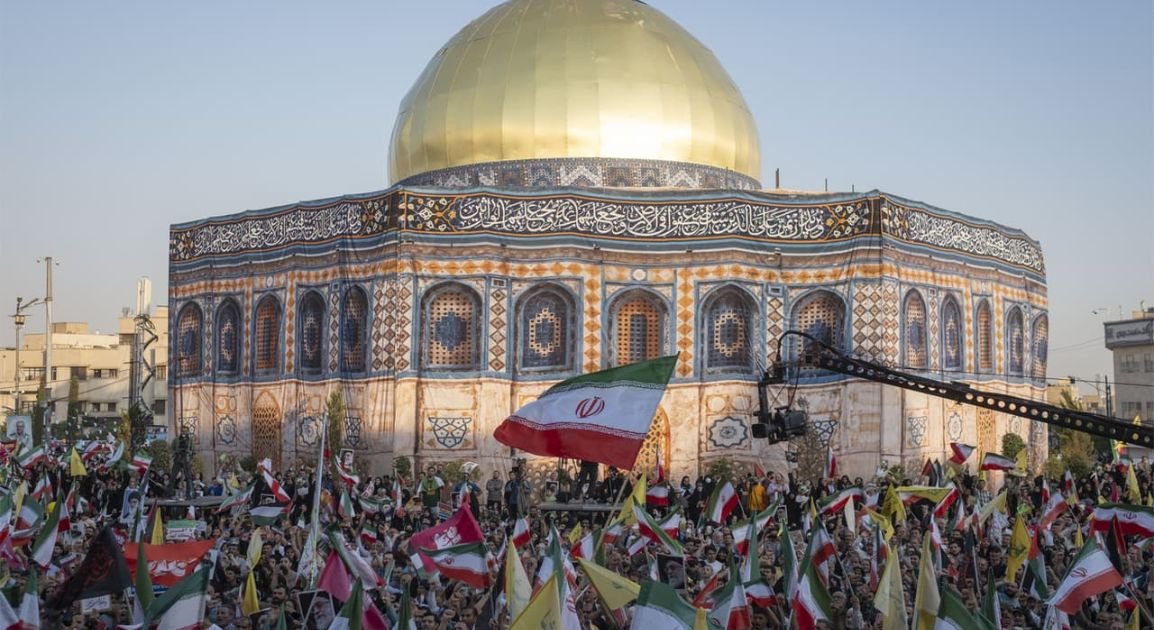
The shadows of the late twentieth century are long, and for those who study the rise and fall of empires, they increasingly resemble the political atmosphere now surrounding Tehran. In the autumn of 1989, the Soviet Union still appeared monolithic. It commanded a nuclear arsenal capable of annihilating continents, presided over a sprawling security state, and claimed an ideological mission that had defined the century. Yet beneath the façade, the structural foundations were crumbling. The disintegration of the Soviet Union is often viewed as a protracted decline and fall. By the late 1980s, this process reached a tipping point, moving “beyond the power of authority to halt, control or even channel.”
Erosion of Legitimacy
Today, observers look at the Islamic Republic and feel an unsettling echo. The ideological content is radically different — Soviet Marxist-Leninist materialism versus Iran Shia theocracy — but the systemic pressures look eerily familiar. Overextension abroad, economic exhaustion, and an aging political elite combine to produce the same sense that a regime is running out of time. As happened in the Soviet case, power is increasingly sustained less by belief and more by inertia.
The most potent weapon of any revolutionary state is not its police, but its legitimacy. The Bolsheviks once promised a workers’ utopia; Ayatollah Khomeini promised a “Government of God.” But legitimacy erodes when promises decay into stagnation. By the late 1980s, Soviet citizens understood that the slogans were empty. The regime had created, in the memorable phrase, “a great divide between the rulers and the ruled,” one more hermetic than in many capitalist systems.
Iran today stands at a similar juncture. The revolutionary energy of 1979 has faded in a country where most citizens were born long after it. A young, globally connected public now confronts an austere ideology that polices intimacy, dress, music, and expression while failing to produce prosperity. The “Woman, Life, Freedom” uprising was not simply about clothing. It was a direct challenge to the regime’s moral claim to rule, the moment when large segments of society signaled that they no longer internalized the state’s definition of right and wrong. When belief evaporates, people no longer obey; they comply, evade, and subvert — precisely the pattern that hollowed out the late Soviet order.
Similarities in Economic Distress
This erosion of belief is tied to something more concrete: economic failure. The Soviet Union and modern Iran both illustrate the logic of the resource curse — oil revenues masking deep dysfunctions. When global oil prices collapsed in the 1980s, the Soviet system could no longer subsidize inefficiency, and the long-tolerated shortages became unbearable. As shortages became unbearable, the empire lost its “economic legitimation” and its hold on power.
Iran faces a similar unravelling. Sanctions have isolated the financial system, corruption has become embedded, and a hybrid “mafia-state” economy dominated by the IRGC extracts rents rather than creating value. Inflation destroys savings, the rial collapses, and the middle class slips downward. Like the late Soviet leadership, the Iranian elite has learned that ideological sermons do not fill refrigerators. When the state cannot provide basic economic dignity, the very masses in whose name the revolution was fought become its sharpest critics.
Geopolitical Ambitions and Internal Discontent
Yet economic decay is intensified by geopolitical ambition. The Soviet Union bled resources in Afghanistan and across its imperial periphery, sustaining an empire that ordinary citizens increasingly viewed as a burden. Even Soviet leaders began to speak of Afghanistan as a “bleeding wound,” a drain without payoff. The result was imperial overstretch: money flowed outward while legitimacy drained at home.
Tehran’s “Axis of Resistance” carries similar risks. Billions are deployed to sustain Hezbollah, the Houthis, and multiple militias — instruments of strategic depth that do little to repair collapsing infrastructure, polluted cities, or empty wallets. The popular chant “Neither Gaza nor Lebanon, my life for Iran” a cry in various movements since 2009 captures this profound shift: geopolitical victories now read domestically as moral and economic failures. What is meant to deter external threats instead accelerates internal discontent.
Geriatric Leadership
Compounding this gap is the age of the regime’s senior leadership. Late Soviet politics became a parade of exhausted figures whose authority rested mainly on habit. A leadership of “Stalinist dinosaurs,” Brezhnev, Andropov, and Chernenko were tolerated only because their “biological and therefore political life-term was so obviously almost up.”
Iran confronts a comparable dilemma. Its supreme authority belongs to an aging figure presiding over institutions designed to prevent change rather than manage it. The absence of a credible, popular successor produces succession anxiety and elite maneuvering. Within the clerical establishment and the IRGC, rival networks prepare for a future that none can clearly control. As in the Soviet case, the old guard clings to a repertoire of repression forged in another era — yet it is confronting a society that is younger, more literate, more networked, and harder to intimidate.
Less Room for Reforms : A Valuable lesson learnt from USSR
Here lies the real danger: reform. The most perilous moment for authoritarian systems is not peak repression, but partial relaxation. In the Soviet Union, glasnost and perestroika were conceived as mechanisms to save the system by modernizing it. Instead, these failures revealed “a moral vacuum modestly but progressively exploited by religion, nationalism and the intelligentsia,” which unleashed forces that reformers “could not halt, control or even channel.”
Iranian elites understand that lesson. Reformists argue that limited concessions — economic openings, social relaxation, diplomatic engagement — could stabilize the system. Hardliners fear the opposite: that any step backward from coercion invites collapse. Political maneuvers, like the easing of hijab restrictions have therefore oscillated between symbolic gestures and renewed repression. The system seeks to let in just enough air to breathe without allowing the fire of dissent to reignite. History suggests this balance is extraordinarily difficult to maintain.
Yet history does not repeat mechanically. Iran is not the USSR. It possesses a deeper civilizational identity, a religious backbone capable of mobilization, and security organs more ideologically fused with the state. Still, the structural environment looks disturbingly familiar. The Soviet empire disintegrated not because of one crisis, but because multiple pressures converged: ideological exhaustion, economic decay, imperial overreach, and geriatric leadership. When they combined, the seemingly permanent structure dissolved with startling speed. The Soviet system had vanished “not only without a bang but with scarcely a whimper.”
Iran today faces its own convergence. Whether it can navigate this narrowing corridor without triggering the “Gorbachev trap” — whether it can reform without unraveling — is one of the defining strategic questions of our time. The ghosts of 1989 do not foretell destiny, but they illuminate possible futures. And they remind us that regimes often appear strongest just before the ground beneath them finally gives way.
