
India’s transition to renewable energy has gained significant momentum since its COP26 commitment to achieve net-zero emissions by 2070. Solar energy has emerged as the cornerstone of this transition, with over 100 GW of installed capacity.
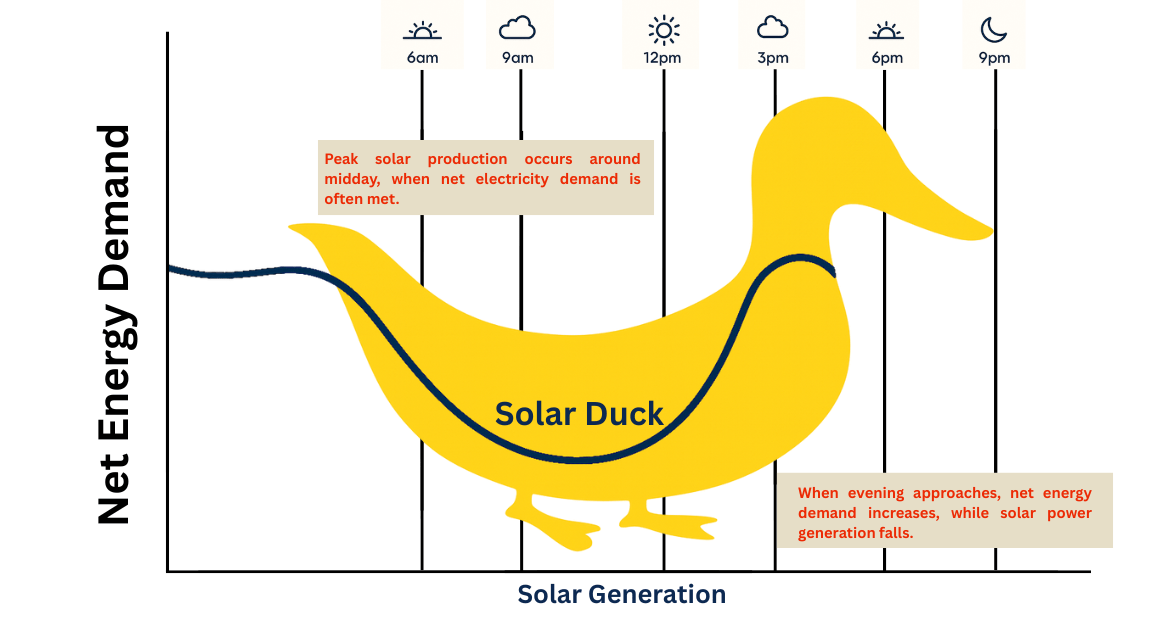
However, its intermittency and variability pose major challenges to grid stability, creating the “duck curve” effect where solar supply fails to match peak demand. This policy brief analyses these challenges and highlights the need to shift the focus from expansion to integration. Drawing lessons from Germany’s flexible energy model, it recommends accelerating investments in Battery and Pumped Hydro Energy Storage Systems, modernizing hydropower, and enabling market-based demand response.
Addressing these challenges will strengthen grid reliability, reduce dependency on coal, support sustainable economic growth, and fulfill India’s commitments under SDG 7 (Affordable and Clean Energy) and SDG 13 (Climate Action).
India’s Solar Surge
India has been actively transitioning to renewable energy to meet its COP26 commitments. At the United Nations Climate Change Conference in Glasgow in October 2021, 120 countries discussed global climate action and updates on Nationally Determined Contributions under the Paris Agreement of 2015. A key moment for India was when Prime Minister Narendra Modi unveiled the five-point Panchamrit climate action plan, which aims for the country to reach net-zero emissions by 2070. This commitment accelerated India’s shift to renewable energy leading to advancements in solar, wind, hydro, green hydrogen, bioenergy, and electric mobility.
Among these, solar energy has emerged as a major focus supported by initiatives undertaken by the Ministry of New and Renewable Energy. Despite rapid growth, ensuring a reliable solar power supply remains a challenge due to its intermittency and variability. Solar generation peaks during the day, often exceeding demand and facing limited storage, while nighttime demand relies on fossil fuels.
This mismatch leads to energy curtailment and strains grid stability. The variability of solar power, influenced by weather and seasonal changes, complicates supply-demand balancing. India’s daily peak electricity demand does not align with solar generation, requiring strategies such as battery and pumped hydro storage, improved forecasting, and demand-side management to ensure a more reliable and resilient grid.
What Slows down India’s Renewable Success Story
India’s renewable energy capacity has reached a major milestone by surpassing 203.18 GW in October 2024, marking a 13.5% increase within a year. This progress aligns with the national goal of achieving 500 GW of non-fossil fuel capacity by 2030. Nonetheless, this swift growth has revealed structural challenges, especially in the solar sector. With solar energy contributing nearly 92 GW, generation remains highly dependent on daylight and weather, resulting in fluctuating supply. The limited capacity of the Battery Energy Storage System (BESS), which is still under 500 MW, combined with insufficient grid flexibility hinders the effective use of surplus daytime generation and results in increased dependence on coal-based power during evening peak hours. This imbalance jeopardizes the stability of the grid and slows India’s transition to renewable energy.
You may also like to read: Why India’s Non-Fossil Revolution Should not be Measured in megawatts Only
What is ‘ Duck Curve ’ ?
The intermittency and variability of solar energy in India has led to a phenomenon called the “duck curve” , where solar power floods the grid during daylight hours when demand is low, then drops sharply in the evening as consumption peaks. This mismatch between supply and demand poses significant balancing challenges.
As evening consumption rises with increased household electrification and the use of appliances such as air conditioners and refrigerators, the grid often reverts to thermal generation when solar output declines. This reliance on conventional power accentuate the limited availability of large-scale storage options. While India has implemented Battery Energy Storage Systems (BESS), pumped hydro storage (PHES), and thermal storage, these solutions are currently insufficient. BESS projects are mostly at pilot or early commercial stages, and PHES addresses only a fraction of the capacity needed to balance daily and seasonal fluctuations.
India’s success in utility-scale solar deployment has propelled it to become the world’s third-largest solar power producer with over 100 GW of installed capacity. This has been achieved by a strong public- private partnership where the private sector has led large-scale implementation through competitive reverse auctions and 100% Foreign Direct Investments, the public sector has acted as the key enabler by providing policy direction, off-take guarantees, and infrastructure support through agencies such as the Solar Energy Corporation of India (SECI) and the Production-Linked Incentive (PLI) scheme.
However, despite this progress in generation capacity, the “duck curve” challenge reveals that the next phase of India’s energy transition hinges not on expansion but on integration. In order to achieve grid stability and a continuous supply of renewable energy, it will now be essential to invest significantly in large-scale energy storage solutions and the development of domestic manufacturing capabilities to reconcile generation with consumption.
Lessons from Germany
Germany has tackled similar solar integration challenges, offering a roadmap India can adapt to its own context. Both countries have surpassed 100 GW of installed solar capacity, but their approaches to managing variability and grid reliability differ significantly. India’s progress has been driven by rapid capacity expansion however, its focus remains largely on generation rather than efficient grid integration. In contrast, Germany has evolved towards a system optimized for flexibility using advanced market mechanisms, decentralized storage, and demand-side management to stabilize its grid.
India’s integration challenges stem from infrastructure bottlenecks, rigid Power Purchase Agreements (PPAs), and the financial weakness of State Distribution Companies (Discoms) which restrict investments in smart grids and flexibility solutions. Germany’s success shows how policy-driven market incentives, such as dynamic pricing and support for distributed storage, can enhance grid stability and minimize curtailment. The key takeaway for India is the need to pivot from expanding capacity to strengthening grid resilience and flexibility.
What India Should Do ?
To strengthen India’s renewable energy integration and address the issue of intermittency and variability of solar energy, India must aim to solve the duck curve phenomenon by accelerating the deployment of BESS, PHESS and hybrid storage solutions. With the BESS costs down 80% since 2015, India should capitalize on the Ministry of Power’s Viability Gap Funding (VGF) scheme for 30 GWh of BESS in addition to 13.2 GWh underway should be leveraged to attract private investment and meet national storage targets, enhancing grid stability and renewable integration.
India can utilize existing hydropower assets that offer rapid ramping capabilities to complement solar energy during peak hours thereby reducing dependency on thermal generation. This potential can be maximized by upgrading older hydro facilities and compensating operators for flexibility services especially in the northern and northeastern regions where the small and run-of-river hydro projects can offer supplementary seasonal generation and reduce the reliance on thermal power and smooth seasonal variability.
The lessons from Germany shows that market-driven demand response and decentralized storage improve grid stability and minimize curtailment. India can adopt similar approaches through regulatory reforms targeting State Distribution Companies (Discoms), incentives for distributed storage, and expand Production-Linked Incentive (PLI) schemes to support domestic manufacturing and private-sector participation.
Finally, building technical capacity is crucial. Training grid operators, engineers, and technicians, combined with knowledge transfer from international best practices, R&D in storage and forecasting, and pilot projects in regulatory sandboxes, will create scalable operational expertise across India’s renewable energy system.
Conclusion
India stands at a critical juncture in its energy transition. The country has demonstrated remarkable capability in deploying solar capacity at scale, now it must show equal ambition in managing that capacity effectively. By accelerating investments in storage, flexible grids, and forward-looking policies, India can ensure reliable power while fulfilling its commitments under SDG 7(Affordable and Clean Energy) and SDG 13 (Climate Action). Ultimately, India’s ability to overcome solar intermittency will define whether its clean energy expansion translates into a truly sustainable and resilient future.
