
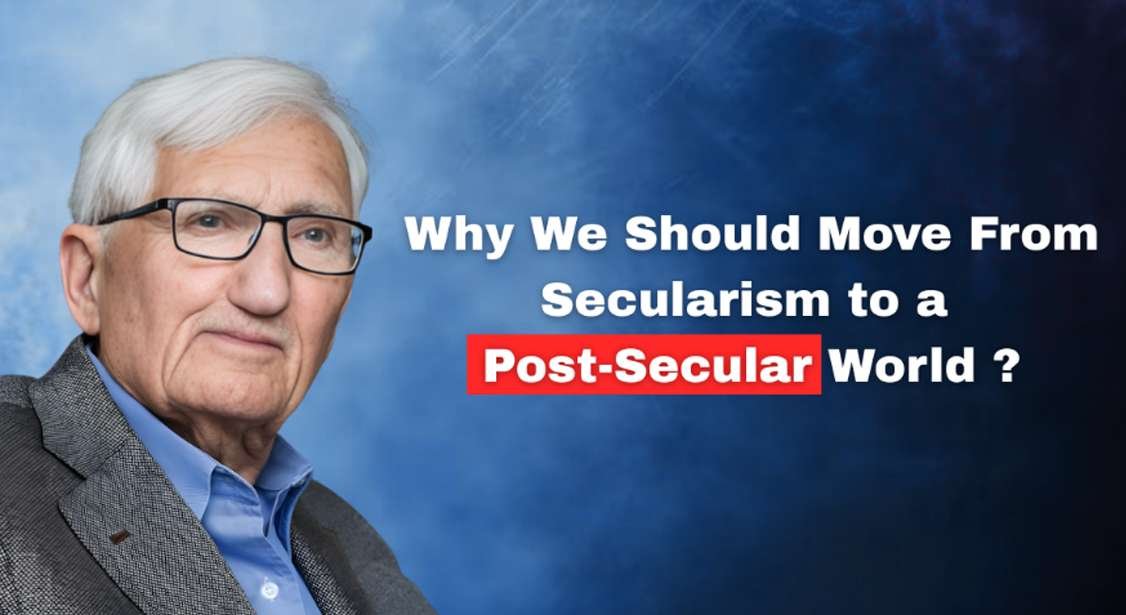
For much of the twentieth century, it was widely believed that the march of modernity—industrial growth, scientific progress, and democratic governance would steadily push religion out of public life. Sociologists called this the secularisation thesis: as societies advanced, religion would retreat into private belief, losing its grip on politics and institutions. For decades, this seemed plausible in parts of Europe and North America.
Yet by the turn of the millennium, it was clear that this story had been oversimplified. Far from fading, religion was resurging in new, complex ways, from the political influence of evangelical groups in America, to Islamic movements across West Asia, to Hindu nationalism in India, and growing Buddhist activism in East Asia. The world, in short, was not secularising in the way scholars expected it to happen.
It was at this moment that German philosopher Jurgen Habermas proposed the post-secular society. This was not a claim that societies were becoming religious again, nor was it a rejection of secular democracy. Rather, it was an acknowledgment that modern societies must learn to negotiate the continued presence of religion in public life, without abandoning the principles of constitutional equality, democratic deliberation, and state neutrality. Habermas was not predicting a return to theocracy. Instead, he described a society where religious and secular citizens engage one another in a shared civic space each with mutual respect and each willing to translate their arguments into terms accessible to all.
Today, this idea feels particularly relevant for India, a country where religion has never been absent from the public sphere, and where debates about secularism, identity, and nationalism have grown intense. India offers a unique laboratory for examining whether Habermas’ post-secular vision is workable or whether political realities overwhelm philosophical ideals.
What Habermas Meant by a “Post-Secular Society”
Habermas’ argument was deceptively simple. He believed that Western societies had to outgrow the assumption that secularisation was inevitable. Religion was not disappearing; it was adapting. Instead of asking religious citizens to privatise their beliefs, democracies needed to create norms where religious and secular arguments could coexist, religious claims entering public debate were “translated” into general, constitutional language, and non-religious citizens did not dismiss religious viewpoints as irrational or pre-modern. At the same time, the state itself must remain strictly neutral, not anti-religious, not pro-religious, but committed to constitutional values.
In this sense, a post-secular society is not anti-modern. It is a society modern enough to accept the persistence of religion without treating it as a threat. Habermas’ shift—from a purely secular public sphere, where religion was treated as irrational and therefore becoming irrelevant, to a more inclusive one is grounded in a basic insight: religious communities continue to generate ethical frameworks, moral motivation, and civic energy. These cannot simply be ignored in democracies.
Neither Secular nor Theocratic
Unlike Europe, India never experienced a linear transition from a religious age to a secular one. Religion has always been part of public life—socially, politically, and institutionally. In fact, India’s founding leaders were aware that a purely Western model of secularisation simply did not fit Indian realities. Indian secularism evolved into a unique model, as Bhargav would call it “principled distance”, where the state neither withdraws from religion nor embraces it; instead, it negotiates actively with religious communities in the interest of justice, reform, and pluralism.
From temple entry movements to personal law reform, from educational institutions run by religious groups to state oversight of religious endowments, India’s secularism has always been engaged and flexible—not strictly separationist. This makes India, in many ways, a pre-existing version of the post-secular society Habermas later described.
Religion in India is not merely a matter of belief. It is embedded in caste structures, community identities, welfare networks, social protest movements, electoral mobilisation, and public rituals and civic life. As a result, India never fully subscribed to the idea of a purely rational, secular public sphere. Instead, it has always operated within a plural, layered public sphere, where religious and secular voices intermingle.
Is India Already a Post Secular World ?
India’s religious ethics and modern democratic values can interact productively. Gandhi’s politics is an iconic example deeply spiritual, yet committed to pluralism, equality, and non-violence. Contemporary civil society movements also draw on religious resources. For example, Sikh langar networks feed thousands daily, the Buddhist revival fuels Dalit emancipation; church groups deliver education and healthcare in underserved regions. These movements are a living post-secular dynamic where religious motivations enrich public life without necessarily threatening democratic norms.
However, there are disagreements over how religious arguments should enter the public sphere. Habermas insists that religious claims be “translated” into secular, universal terms before they shape state policy. In India, this translation happens unevenly. Movements for minority rights often make this transition effectively using religious identity to mobilise, while grounding political arguments in constitutional rights. On the other hand, majoritarian narratives frequently bypass translation altogether, asserting cultural or religious dominance as political entitlement.
India’s public sphere comes from the rise of hyper-politicised religious identities. Here, religious sentiments don’t enrich democratic dialogue, they overwhelm it. When religious identity becomes a tool for political assertion, when dissenters are labelled anti-national, and when the state appears aligned with one religious worldview, the delicate balance that sustains a post-secular society begins to crumble. Habermas’ optimism about mutual respect becomes difficult to sustain in such an atmosphere.
Majoritarianism and Reciprocity
Habermas’ project rests on a moral equilibrium where secular citizens should not dismiss religious viewpoints, and religious citizens should respect the secular foundations of the democratic state. Both sides must meet halfway. But in India today, that equilibrium is under pressure. The rise of majoritarianism has shifted the tone of public debate. Religious symbolism now shapes political rhetoric, state policy, public education debates, and even foreign policy narratives. As one religious identity begins to occupy the centre, others are pushed into defensive positions. This is not simply a matter of cultural pride or civilisational rhetoric. It affects fundamental democratic principles.
A post-secular society requires pluralism, but majoritarian politics tends toward uniformity. It requires translation, but majoritarian claims often present themselves as inherently superior. It requires reciprocity, but majoritarianism fosters hierarchy. Habermas warns that when mutual respect collapses, when the state aligns too closely with any one religious worldview, democratic deliberation becomes distorted. India’s political landscape today reflects that tension sharply.
And Yet, the Post-Secular Possibility Persists
Despite these challenges, India remains one of the world’s most vibrant experiments in religiously diverse democracy. Many developments continue to reflect the essence of a post-secular society. Courts frequently engage religious reasoning while upholding constitutional values, striking a careful balance between reform and respect for belief. Civil society initiatives blend spiritual ethics with social justice, especially in movements led by Dalits, tribal communities, women’s groups, and interfaith networks.
Electoral politics is still shaped by religious pluralism, even if unequal majoritarianism faces continuous pushback from regional parties, minority communities, and constitutional institutions, and secularism exists as a part of everyday life, people of different faiths living, working, celebrating, and mourning together remains a powerful, if underappreciated, social force. Still, India continues to negotiate its religious diversity, sometimes imperfectly, but rarely retreating from its plural characters.
Habermas’ post-secular concept may have emerged from European anxieties about religion’s reappearance in public life, but India offers a different insight: religion never truly disappeared, and democratic negotiation is both necessary and inescapable. Here, Religion can coexist with modernity without undermining democracy, Secularism need not erase religion; it can manage it. A plural public sphere is possible, though always fragile.
Majoritarianism not religion itself is the real threat to democratic equality. A post-secular society requires vigilance, humility, and institutional fairness. Most importantly, India teaches that the goal is not to create a religion-free public sphere, but a fair and inclusive one.
A Post-Secular Future or a Post-Secular Crisis?
Habermas imagined a society mature enough to accept religion as part of public life without compromising democratic principles. India, with all its contradictions, has long embodied this idea—though its path now appears contested. As majoritarian politics asserts itself, the challenge is not simply to preserve secularism, but to preserve the possibility of post-secular coexistence which is grounded in mutual respect and constitutional equality.
The question, then, needs to be asked is not whether India is secular or religious. It is whether India can remain plural where multiple worldviews can inhabit the public sphere without drowning one another out. Habermas’ post-secular imagination offers a useful lens, but India’s lived experience ultimately expands the conversation, showing both the promise and the peril of religiously diverse democracy.
Whether India moves toward a truly post-secular future or toward a post-secular crisis depends on whether its institutions, leaders, and citizens can sustain that delicate balance. The stakes could not be higher, for India may well be the world’s most important test case of how religion and democracy can coexist in the twenty-first century.
