
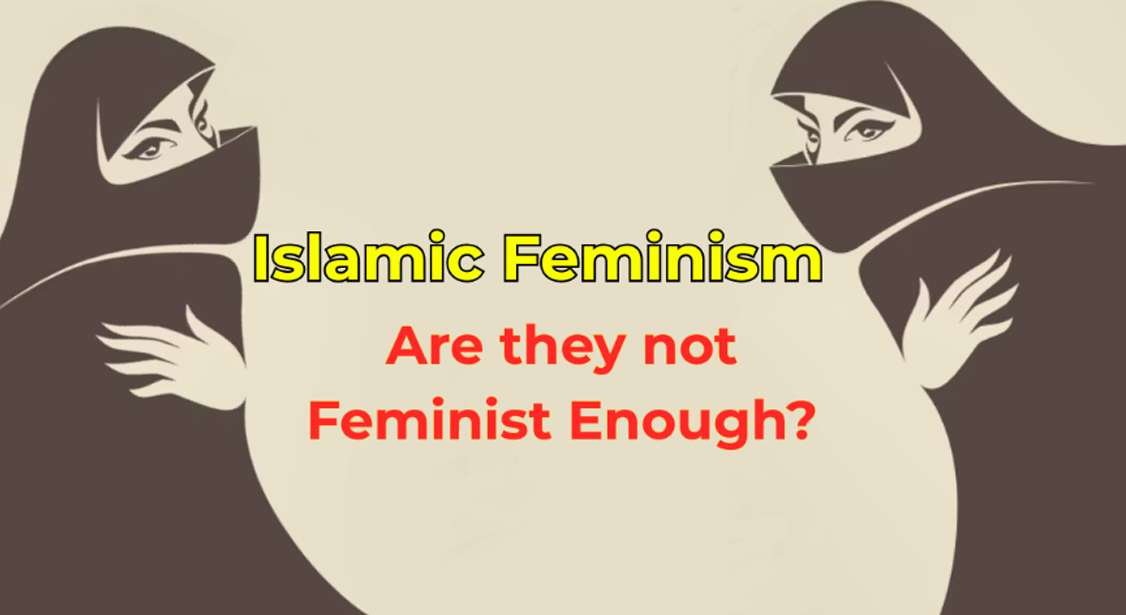
The notion of “Islamic Feminism” invokes the basic confrontation among religion and feminism. While religion is typically deemed as dogmatic and disadvantageous to women largely due to the historical domination of patriarchal interpretation of religious texts. On the other hand, Feminism essentially emerged out of secular movements that invoked the essence of egalitarianism and advocated for emancipation of women. Consequently, when it comes to the term ‘Islamic Feminism’, it is often dismissed as a mere oxymoron.
However, Prof. Margot Badran defined Islamic Feminism as a ‘feminist discourse and practice articulated within an Islamic paradigm.’ Thus, this alien etymology necessitates a nuanced understanding of these contradictory concepts and further it is imperative to underscore how these two contradictory phenomena can essentially complement each other. This article tries to discern the discourse of these contradictory frameworks and how this atypical discourse ‘Islamic Feminism’ pragmatically challenges patriarchy within the purview of Islam.
Contradictory Concepts
The religious regulation has historically directed a privilege of male domination in every sphere of women’s livelihood. Likewise the religious dogma depicts a distorted narrative of gender roles that often defines inequality as divinely mandated. Hence, Feminist essentially challenge this inherent inequality. They confront this patriarchal domination over women and seek emancipation from this subordination. Feminists are keen to relinquish this subservient aspect in both private as well as in the public sphere.
More than a Mere Construct
It is interesting to note that unlike the celebrated feminist scholars like Simon de Beauvoir or Judith Butler, Islamic feminists do not necessarily perceive Religion as a social construct. Rather they posit that Islam as a religion is not inherently against the fundamentals of feminism rather the skewed interpretation has structurally disadvantaged the women. The deliberate distortion of legal and social codes have barred women’s potential participation at an equal footing with men.
A Cautious Compatibility
Thus, essentially the notion of Islamic Feminism, at its heart, seeks to confront the patriarchal interpretation of the fundamental text of Islam (i.e. the Quran and the Hadith). As noted Amina Wadud in her work, Quran and Women, “The text (itself) is silent”. Thus, the Islamic Feminists are keen to employ Islamic methodologies like Ijtihad i.e. re-interpretation of the ambiguous verses in order to establish independent interpretation of the Quran in order to evoke an egalitarian order. They critique the patriarchal interpretation (Fiqh) of Quran as the source of dispute and vouch for an equality emanating from a nonpartisan interpretation of Islamic sources. These feminists perceive religion as a source of empowerment by upholding the egalitarian essence of the Quran.
You may also like to read : Understanding Matrilineal Soceity
Course Of This Discourse
While the feminist consciousness has survived seasons and eras; the surge of Islamic Feminist discourse especially in the world of West Asian is relatively recent. The term ‘Islamic Feminism’ was popularised only in the early 1990s, in the midst of the theocratic era in Iran when women valiantly challenged the corrupt interpretation of Quran were codified into Laws through periodicals like Zanan. This discourse was further advanced by the Women intellectual from the wider West Asian world who concentrated on critically re-interpreting Islamic text in order to unveil the patriarchal distortions.
Another substantial surge surfaced later in the early 2000s in south east Asia where an unusual bottom up campaign came up. Essentially, it sought to evoke the Quranic ethics of Justice and Equality in order to promote the essence of basic human rights within the Islamic scripture. This was pioneered by a cohort of Malaysian Muslim women, formally recognised as Sisters in Islam, (were formally founded in 1988, later registered as NGO in 1993) who were keen to promote awareness about the true principles of Islam. Their most remarkable impact was crystalised in 2009 through Musawah i.e. a global movement advocating for equitable Islamic family law (that is composed of laws concerning Inheritance, Custody and even Polygamy).
In a similar vein, another transnational network of Islamic feminist i.e. Women Living Under Muslim Laws (WLUML) was founded in 1984 who aimed to stand in solidarity with Women whose laws were derived from Islam. They curated a collective space to help muslim women who are discriminated against by the patriarchal interpretation of Islamic law. Moreover, this awakening eventually paved the way for the Moroccan Moudawana in 2004 that substantially elevated the status of women in Morocco.
Curse Of The Orient
It is imperative to underscore that the inception of Islamic Feminism coincides with the Third wave of feminism which centred on overlapping nuances like race and class along with gender (Intersectionality). Their theory posited how women are oppressed in multiple ways. This Third wave of feminism diverted away from the couple of earlier waves which were narrowly centred around the West.
While the feminists of the former wave were much fascinated by the orientalist imagination of the ‘oppressed Muslim woman’ thus their criticism was also shrouded in the narrow oriental understandings. They counter this narrative of ‘barbarity and backwardness’ associated with the Orient. Islamic feminist defy this Orientalist narrative of ‘oppressed’ and draw upon their faith to refute the critique that women in the occident are conditioned to subordination.
Conquest Against Colonialism
Unlike Feminists, they do not simply vouch for emancipation from patriarchal domination, rather they employ faith (Islam) as a means to tame patriarchy and neo-colonialism in tandem. The crux of their confrontation with other feminists (like secular feminists) indicates a fundamentally conscious choice to challenge this neo-colonial attempt of secular feminists. These feminists are not intimidated by their sister strands (like secular feminist) but are rather brave enough to stand their ground against any sugarcoated form of subordination. They do not just disapprove of the subordination of patriarchy but also of colonialism.
Conclusion
To conclude, Islamic Feminism, as Valentine Moghadam notes, is “one feminism among many”. They may be defined as a distinct sister discourse of secular feminism that largely remains under the wider framework of Feminist discourse. These feminist not merely critique the Islamist patriarchy but extensively counter the colonial interpretation of subaltern women.
To put it plainly, Islamic feminist seek equality emanating from re-interpretation of Islamic sources while simultaneously combating colonial sympathy. Unfortunately, they are still crocheting a crucial cleavage and their battle to evoke the egalitarian and ethical essence of Islam through its scriptures is still a gazillion miles away.
