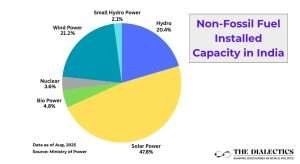
India made headlines around the world when it reached a major milestone: around 50% of its installed electricity capacity now comes from sources other than fossil fuels. Solar farms shine in Rajasthan’s desert, wind turbines line the coast, and government statements are full of stories about clean energy.
This is definitely an amazing accomplishment. It shows both political will and the ability to use technology. But it hides a harsher truth: the gap between energy production and availability is getting bigger. Despite increasing capacity, over two-thirds of Indian families remain in some form of energy poverty. Energy is still unreliable, expensive, or completely unavailable for millions of people.
The milestone hides uneven realities
Most of the growth in clean energy (non-fossil) comes from big projects in states like Gujarat, Rajasthan, and Tamil Nadu. But not everyone will benefit from this change in the same way. People who live in the Sunderban Islands, the Puruliya region of West Bengal, and the rural areas of Jharkhand and Odisha still have to deal with frequent power outages, low voltage, and high connection costs. Installed capacity does not equate to dependable access. A household’s energy experience is evaluated in hours of uninterrupted power, cost, and safety, rather than megawatts generated hundreds of kilometers away.
Policy ambition versus implementation reality
India’s renewable energy plans, ranging from the Deen Dayal Upadhyaya Gram Jyoti Yojana and Saubhagya to the Pradhan Mantri Kisan Urja Suraksha evam Utthaan Mahabhiyan and Pradhan Mantri Surya Ghar Yojana, aim to provide power to every family. However, the implementation has frequently prioritized locations that are easier to electrify.
Community solar models, which can directly benefit energy-poor communities, are underfunded and underutilized. Panchayats and local governments have limited influence on project development. Households are discouraged from engaging due to procedural delays and financial barriers. This is not just an energy issue; it is also a matter of justice. Who benefits first from a clean-energy transition? Who remains on the margins?
Energy justice must become the new frontier
India has shown that it can quickly increase its use of renewable energy. The next step is to make the change fair for everyone. This means that the government needs to change its focus from big solar parks to small community solar systems that directly help people who don’t have enough energy. This means, first of all, giving rural and tribal areas first dibs on community solar programs. Second, letting panchayats and local governments plan and run small-scale energy systems. Third, making financial tools like subsidies and low-interest loans available to families with low incomes. Finally, looking at how reliable, affordable, and high-quality energy access is, as well as how well it connects.
Just transition is an excellent policy
An equitable energy transition is not a charitable endeavor; it is sound policy. It relieves demand on central grids, generates local jobs, and strengthens climate resilience in communities most vulnerable to extreme weather. It also increases political trust in the energy transition.
India’s 50% renewable capacity milestone is worthy of celebration. But it should also be a time for reflection: clean energy should not become another area where the powerful take the rewards first, while the poor wait their turn. If the renewable revolution does not extend to the last mile, it is not a revolution at all.
Energy poverty is not only about supply
India’s energy transition has been heavily grid-centric and developer-driven, with numerous projects linking to the national grid. This methodology fails to address structural problems for marginalized groups, such as inadequate local infrastructure, insufficient finance, difficult terrain, and, in certain cases, a complete lack of last-mile connectivity.
Take the Sagar Islands in West Bengal. Despite years of electrification, residents continue to use diesel generators or hybrid systems during the rainy season. Similarly, in Puruliya, grid supply fluctuations may prevent families from using basic equipment, even if they have “electricity.” Megawatts on paper provide little comfort in these environments. They require decentralized, community-driven solar solutions that are adapted to their specific geographic and economic conditions.
A milestone is just the beginning
India’s achievement of 50% renewable capacity is historical. However, capacity alone cannot provide light, power, or dignity to millions of people who continue to dwell on the fringes. The next jump must be measured not in megawatts but in the number of lives saved. A truly equitable and inclusive energy transition would mean that a lady on Sagar Island does not have to keep life-saving medicines in an icebox during a blackout, and a child in Puruliya can study without fear of the lights going out during exam season. It would imply energy that is dependable, economical, and resilient—no longer a privilege but a right.
India is at a crossroads: it may continue to build capacity for the few or build electricity for everyone. The decision will determine not only the achievement of its climate goals but also the fundamental character of its development model.

Why India’s Non-Fossil Revolution Should Not be Measured in megawatts only
India made headlines around the world when it reached a major milestone: around 50% of its installed electricity capacity now comes from sources other than fossil fuels. Solar farms shine in Rajasthan’s desert, wind turbines line the coast, and government statements are full of stories about clean energy.
This is definitely an amazing accomplishment. It shows both political will and the ability to use technology. But it hides a harsher truth: the gap between energy production and availability is getting bigger. Despite increasing capacity, over two-thirds of Indian families remain in some form of energy poverty. Energy is still unreliable, expensive, or completely unavailable for millions of people.
The milestone hides uneven realities
Most of the growth in clean energy (non-fossil) comes from big projects in states like Gujarat, Rajasthan, and Tamil Nadu. But not everyone will benefit from this change in the same way. People who live in the Sunderban Islands, the Puruliya region of West Bengal, and the rural areas of Jharkhand and Odisha still have to deal with frequent power outages, low voltage, and high connection costs. Installed capacity does not equate to dependable access. A household’s energy experience is evaluated in hours of uninterrupted power, cost, and safety, rather than megawatts generated hundreds of kilometers away.
Policy ambition versus implementation reality
India’s renewable energy plans, ranging from the Deen Dayal Upadhyaya Gram Jyoti Yojana and Saubhagya to the Pradhan Mantri Kisan Urja Suraksha evam Utthaan Mahabhiyan and Pradhan Mantri Surya Ghar Yojana, aim to provide power to every family. However, the implementation has frequently prioritized locations that are easier to electrify.
Community solar models, which can directly benefit energy-poor communities, are underfunded and underutilized. Panchayats and local governments have limited influence on project development. Households are discouraged from engaging due to procedural delays and financial barriers. This is not just an energy issue; it is also a matter of justice. Who benefits first from a clean-energy transition? Who remains on the margins?
Energy justice must become the new frontier
India has shown that it can quickly increase its use of renewable energy. The next step is to make the change fair for everyone. This means that the government needs to change its focus from big solar parks to small community solar systems that directly help people who don’t have enough energy. This means, first of all, giving rural and tribal areas first dibs on community solar programs. Second, letting panchayats and local governments plan and run small-scale energy systems. Third, making financial tools like subsidies and low-interest loans available to families with low incomes. Finally, looking at how reliable, affordable, and high-quality energy access is, as well as how well it connects.
Just transition is an excellent policy
An equitable energy transition is not a charitable endeavor; it is sound policy. It relieves demand on central grids, generates local jobs, and strengthens climate resilience in communities most vulnerable to extreme weather. It also increases political trust in the energy transition.
India’s 50% renewable capacity milestone is worthy of celebration. But it should also be a time for reflection: clean energy should not become another area where the powerful take the rewards first, while the poor wait their turn. If the renewable revolution does not extend to the last mile, it is not a revolution at all.
Energy poverty is not only about supply
India’s energy transition has been heavily grid-centric and developer-driven, with numerous projects linking to the national grid. This methodology fails to address structural problems for marginalized groups, such as inadequate local infrastructure, insufficient finance, difficult terrain, and, in certain cases, a complete lack of last-mile connectivity.
Take the Sagar Islands in West Bengal. Despite years of electrification, residents continue to use diesel generators or hybrid systems during the rainy season. Similarly, in Puruliya, grid supply fluctuations may prevent families from using basic equipment, even if they have “electricity.” Megawatts on paper provide little comfort in these environments. They require decentralized, community-driven solar solutions that are adapted to their specific geographic and economic conditions.
A milestone is just the beginning
India’s achievement of 50% renewable capacity is historical. However, capacity alone cannot provide light, power, or dignity to millions of people who continue to dwell on the fringes. The next jump must be measured not in megawatts but in the number of lives saved. A truly equitable and inclusive energy transition would mean that a lady on Sagar Island does not have to keep life-saving medicines in an icebox during a blackout, and a child in Puruliya can study without fear of the lights going out during exam season. It would imply energy that is dependable, economical, and resilient—no longer a privilege but a right.
India is at a crossroads: it may continue to build capacity for the few or build electricity for everyone. The decision will determine not only the achievement of its climate goals but also the fundamental character of its development model.
Author
Anusreeta Dutta