
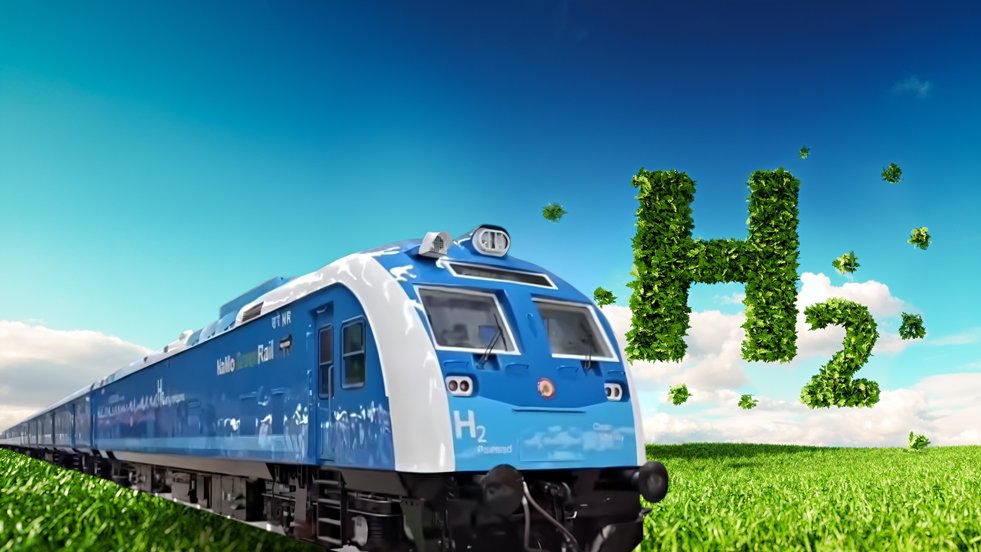
In the first week of September 2025, Indian Railway has reported that India’s First and world’s most powerful hydrogen powered train, developed at the Integral Coach Factory in Chennai, has successfully completed all 3 trial tests and is all set to run between Jind and Sonipat on an 89-km route in Haryana. One might wonder the necessity of hydrogen powered trains in the era of electric trains given that Indian Railways themselves have charted out an ambitious plan of 100 percent electrification by 2030. However, difficult terrains pose huge challenges in laying electric wires. Thus, hydrogen powered trains are seen as a better alternative to retrofit the existing diesel Internal Combustion engines (ICEs) of trains in difficult terrains.
Instead of diesel, the fuel tank of the trains will be supplied by hydrogen and the engine works as a fuel cell with no emissions. The recent hydrogen powered train is part of “Hydrogen for heritage Project” of Indian railways, announced in Union Budget 2023. The plan is to develop 35 hydrogen fuel cell trains and to retrofit existing Diesel-Electric Multiple Unit (DEMU) into green hydrogen fuel cells. Manufacturing of green hydrogen fuel celled trains is also considered as a push for India’s National Green Hydrogen Mission and the country’s efforts to achieve net zero by 2070.
What’s green hydrogen?
The potential of hydrogen as an energy carrier (different from primary source where energy is available for direct use as in coal or petrol – think of it as a battery, you need to charge it before using it) has been well known with its potential to store energy in its hydrogen bonds and to transport the same energy in tanks, pipelines, etc. But the manufacturing of hydrogen has to be from renewable energy sources to make it environmentally friendly.

Generally, hydrogen is produced from coal or natural gas, and based on these sources and processes, it is classified by colour different codes. Hydrogen produced from coal is referred to as black hydrogen, while hydrogen produced from nuclear energy is referred to as pink hydrogen. Hydrogen produced from Natural Gases are coded Grey, Blue and Turquoise based on the method of obtaining the gas. Most of these processes have considerable greenhouse gas emissions and are not environment friendly. Then finally, green hydrogen is considered as the least polluting-hydrogen produced using electrolysis of water, where electricity is supplied from renewable sources of energy like solar, wind, etc.
How does hydrogen work as a fuel?
For generating electricity, hydrogen need not be combusted, rather, it just converts the stored chemical energy from hydrogen into electricity through an electrochemical reaction with oxygen, releasing only water and heat, making it a cleaner source of energy. It is called a “fuel cell” as it stores energy just like a battery, but requires a fuel to be fed. Electricity is produced from hydrogen with just water as the by-product.
Green hydrogen advantages
We have seen how green hydrogen is produced and how cleaner it is as a fuel. Yet it may look inefficient as energy is needed to produce electricity with concerns of energy loss. However, it still fills the gap where direct electrification is unable to do so.
- Energy storage: Renewables like solar and wind are seasonal and surplus (solar/wind) during peaks can be converted into hydrogen and stored and thus the stored hydrogen will help to balance demand in lean periods.
- Decarbonising Hard-to-Electrify / High-Temperature Processes: some sectors like steel (blast furnaces), cement kilns, glass manufacturing, high-grade heat, etc are considered hard to abate in decarbonisation as they require high temperatures which is beyond the heating capability electric resistive heating or induction. Hydrogen combustion or use in SOFCs or high temp burners is a viable alternative in such sectors.
- Transport / Mobility: Amongst all major fuels, calorific value (energy produced while burning a kilogram of fuel) is the highest, making it a preferable fuel of choice for long-range, heavy vehicles (trains, ships, heavy trucks) as they are weight‐sensitive.
- Feedstocks & Chemicals: Hydrogen being used as a feedstock for ammonia, methanol and refining. Thus green hydrogen ensures that carbon footprint is minimised in these sectors.
National Green Hydrogen Mission
As explained, to maximise the potential of green hydrogen and its derivatives and to facilitate a smoother transition into cleaner fuels, Union government has rolled out a National Mission for green hydrogen in January 2023.
The mission aims to produce at least 5 million metric tonnes of Green Hydrogen per year by 2030, with the potential to reach 10 million tonnes as export markets expand. It seeks to replace fossil fuels and fossil fuel-based feedstocks across industries, including ammonia production, petroleum refining, city gas distribution and steelmaking. Green Hydrogen will also be deployed in hard-to-abate sectors like mobility, shipping, and aviation. Additionally, the initiative aims to establish India as a global leader in electrolyser technology and Green Hydrogen manufacturing.
Implementation is planned in a two phase manner: In the first phase (2022–26), the focus is on creating demand in existing hydrogen-using and strengthening electrolyser manufacturing capacity in the country. In the second phase (2026–30), green hydrogen and its derivatives are expected to achieve cost competitiveness with fossil-fuel based alternatives and Commercial-scale Green Hydrogen projects will be explored in steel, mobility, and shipping, alongside pilot projects in sectors like railways and aviation to enable broader industrial decarbonisation.
Comprehensive strategy for National Green Hydrogen Mission

The mission is expected to deliver exceptional outcomes: At least 5 MMT of annual green hydrogen production, addition of around 125 GW of renewable energy capacity, creation of over six lakh jobs, and investment inflows exceeding ₹8 lakh crore. Most importantly, it will help to avert nearly 50 MMT of carbon dioxide emissions annually, marking a decisive step towards cleaner energy

Challenges
High cost- PEM electrolysers use expensive materials for: proton exchange membranes ,
catalyst layers (platinum (Pt) and iridium (Ir), and high-precision stack components driving up initial as well as maintenance costs.
Durability or degradation challenges: In PEM electrolysers, catalysts are generally coated on electrodes to speed up the reaction. However, the metals coated are so rare and expensive that a trade-off is necessitated by loading it less on electrodes to reduce cost as well as to ensure sustainable use of the metal. But this means that layer available for catalysis is thin, and each particle is stressed more under current leading to faster degradation and efficiency challenges.
Infrastructure Gaps: Hydrogen storage, compression, liquefaction, transport pipelines, refuelling stations are still in nascent stage in India.
Concerns related to water stress: usage of water for electrolysis is a cause for concern in water stressed areas.
With most of the researches focussing on PEM membrane, the cost is expected to come down. Researches are planning for alternate catalysts sources as well. With the comprehensive strategy and policy support under National Green Hydrogen Mission, infrastructure gaps can also be reduced.
Conclusion
Green hydrogen cannot be a panacea for generating clean electricity. However, it can be an effective energy carrier for seasonal storage and long-distance mobility making it important in reducing carbon emissions. For India to achieve its net zero targets by 2070, it is imperative that policy support under National Green Hydrogen Mission is continued. The hydrogen powered train is just the new beginning.
