
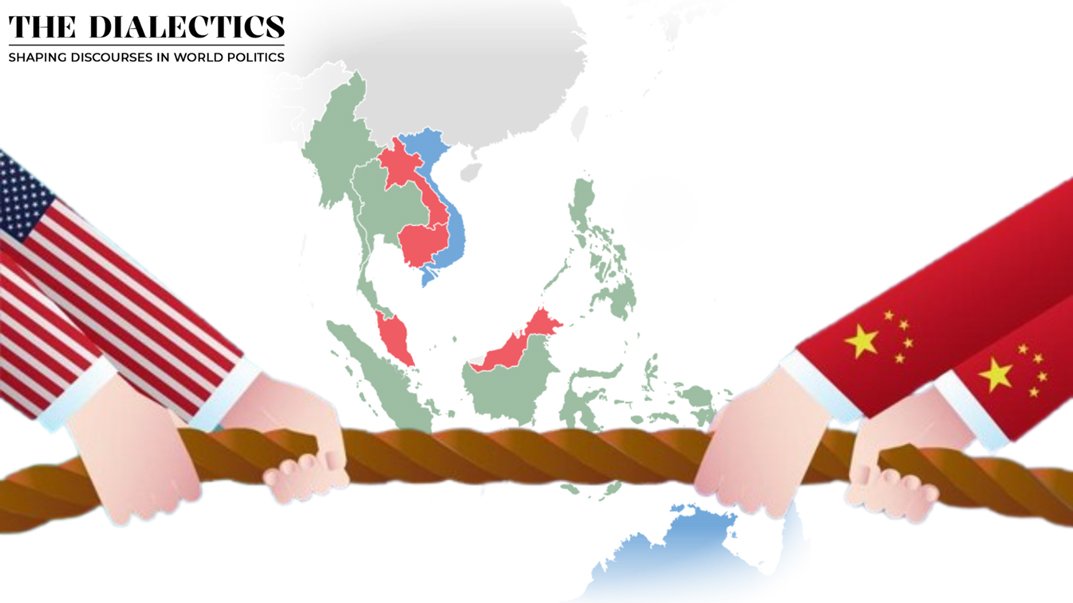
Critical Position of Southeast Asia
Southeast Asia is critically positioned at the juncture of the ongoing great-power competition. This region has already faced the heat of the Cold war bloc politics and so the drawbacks of balancing and bandwagoning. The change in the world order from bipolar to unipolar and currently in a multipolar world order, has unleashed a lot of geopolitical changes.
What is prominently visible in this current world order is that the three great powers i.e., the U.S., China and Russia (predominantly in military aspect) are behaving like revisionist powers. The continuing Ukraine-Russia war, Israel-Hamas and the recent 12 day war between Israel-Iran has posed many questions about the rules-based order. Since the current world order which is characterised by being in flux, states have continued to practice hedging strategy across several areas. In addition, the growing self-centrism of the U.S. and its diminishing strategic interests of the same towards the Southeast Asian region, has become a concern for the region.
With the rise of China and the diminishing of the strategic interests of the U.S. over the Southeast Asian region, has prompted states of this region to reframe its strategic choices. The situation has become murky with the coming of the Trump administration 2.0 and the onslaught of the tariff war which has been a major blow to every middle and small states of the Southeast Asian region to varying degrees. In addition, this era is characterised by interdependency, the states have moved way beyond the traditional aspect of defence to new areas such as securing critical infrastructure, global value chain of semiconductor, rare earth mineral and artificial intelligence. Hence, hedging strategy seeks to serve states self-interest and preserve strategic autonomy by minimizing risks and optimizing returns.
What is a hedging strategy?
The hedging strategy is commonly denoted as a strategy which is used by the states to maintain strategic ambiguity to reduce or avoid the risks and uncertainties of negative consequences produced by balancing or bandwagoning. A hedger makes the attempt that send great powers a signal that a hedger will not take any side. It is important to note that state pursue hedging strategy at the backdrop of great power competition. Unlike the neo-realist and offensive realist who are fixated over the issues around military power and capability. In the current times the competition between great-powers have moved beyond military to include trade, technology, dominance over global supply chain etc. Another aspect is that we are living in an era where the contestation between great-powers have moved beyond contesting over ideologies and now include a broad spectrum of issues.
Given, the complexity, middle and small states often resort to hedging strategy to serve self-interests and balance the opportunity costs which comes with interdependence. Another point is that states hedge in different manner (keeping in account the internal political situation of the state) in varying areas of significance (defence, economic, political and technology). The internal and external variables of a state in a region (e.g. Southeast Asia) would also vary due to the diverse self-interests, foreign policy objectives and internal political situation.
Although there are various interpretations when it comes to defining and specifying the components of the hedging strategy, Kei Koga has stated that a state might consider to tactically hedge in an altering geopolitical situation in which the state will likely expedite the coalition-building process by intensifying negotiation with the ‘like-minded’ states and others. States resort to tactical hedging which they use as a signaling tool so as to reflect their strategic preferences. He gave references to the Quadrilateral Security Dialogue and AUKUS.
Nevertheless, hedging strategy is commonly practiced through internal balancing (blunting), diversification of foreign relations (broadening), internationalizing any dispute (boosting) and deepening ties with potential security threats (binding).
Why have Southeast Asian states continued to hedge?
The Southeast Asian region is deeply embedded in the U.S. economic and strategic interests and a part of China’s fast expanding diplomatic, infrastructure and digital imprints under the Belt and Road Initiative and its related components. Most importantly, the geographical proximity of China and along with its complex historical relations with the Southeast Asian through centuries of economic and political interactions have shaped perceptions and misperceptions.
On the other hand, the U.S. interest is tied to the areas of strategic, securing sea lanes of communication (SLOC), Taiwan issue and to deter the rise of China in the region. Given the competing nature of interests of the U.S. and China over the Southeast Asian region, it has led to shrinking of space for the middle and small states to practice their strategic autonomy. However, these vulnerable states often resort to hedging strategy instead of putting their guards down either by allying against or with any one of the great powers.
In recent times, ever since the engulfing of trade war and tech-competition between the U.S. and China, the states of this region have pursued varying degrees of hedging to mitigate perceived risks, which reflect varying choices of economic-security tradeoffs. It is important to note that the middle and small states which do not explicitly pursue the strategic choices of balancing (allying against the threat) and bandwagoning (allying with the threat) and tend to pursue hedging which helps these states to mitigate risks and maximize returns while preserving its strategic autonomy.
In addition, this strategic choice of hedging pushes these states to diversify their economic relations without falling for economic dependence on any of the great powers. For instance- the heightened pressure exerted by the U.S. on these states to completely exclude Huawei for 5G telecommunication rollout, did not yield in producing a desirable result as perceived by the U.S. Rather states like Vietnam and Singapore have cautiously engaged with the Huawei– the exclusion were limited to sensitive areas like cybersecurity-not over the broad. Since, 5G technology is part of a state’s critical infrastructure, it is imperative for state to give utmost importance to protecting the same so as to deter cyber intrusion and upheld cyber sovereignty.
On the other hand, both Vietnam and Singapore have been a part of China’s Belt and Road Initiative. The Cat Linh-Ha Dong tramline project in Vietnam and the China-Singapore (Chongqing) Demonstration Project on Strategic Connectivity are some of the important collaborations that Vietnam and Singapore have with China.
Moreover, with the coming of the Trump administration 2.0 and the announcement of sweeping tariffs on 2nd April 2025 (also called as “liberation day”) on the Southeast Asian states, have triggered serious concerns among the latter. During the recent 46th Association of Southeast Asian Nations Summit (ASEAN), the leaders have expressed “deep concerns over unilateral tariff measures”. Even the Prime Minister of Singapore Lawrence Wong has expressed disappointment that the U.S. is undoing the global world order which has been created by the latter.
Already the strategic engagement and presence of the U.S. was dwindling in the region and its recent economic measures will cost its reputation in the longer run. However, as the rivalry between the U.S. and China continues to intensify which is also characterised by the withering strategic presence of the U.S. in the region and the inability of China to fill in the power vacuum due to issues such as mistrust, threat of economic coercion and security threat at the micro level; has left the states of this region perplexed.
Nevertheless as a response to the altering strategic environment, states of this region have continued to hedge. For instance despite the imposition of 46% tariff on Vietnam by the U.S., on April 25 Hanoi reached an agreement with Washington to acquire 24 of the Lockheed Martin single-engine fighters.
Similarly Cambodia which is also known as a client-state of China, Japan’s Maritime Self-Defence Force (JMSDF) was the first-ever foreign naval ship which visited the Ream Naval Base on April 21 2025. It is interesting to note that these states did not stop to pursue their strategic autonomy despite the fact that the Chinese Premier Xi Jinping’s rare diplomatic tour to Vietnam, Malaysia and Cambodia from 14 to 18 April 2025. Although this visit could be seen from the perspective of building rhetoric on “Asian Family”, significant agreements were signed by China with these three states which covered broad areas ranging from agricultural products, investment in hard infrastructure, global supply chain and critical infrastructure.
Looking at the short span of time within which such important developments have taken place, it can be deduced that Southeast Asian states are continuing to hedge despite the faltering of the U.S. led ruled-based order. These states will continue to pursue hedging as long as they choose to safeguard their strategic autonomy.
Yet another aspect of hedging is that it does not fail proof like any other strategies such as that of balancing, bandwagoning, soft-balancing etc. Strategies which are pursued by the states are also at times context and issue specific, hence should not be analysed in aggregate terms, In addition, change is a permanent feature of international politics as nothing is status-quoist. So states which are currently pursuing hedging might also switch to another strategy under certain circumstances for the basic purpose of serving self-interests and strategic autonomy.
