
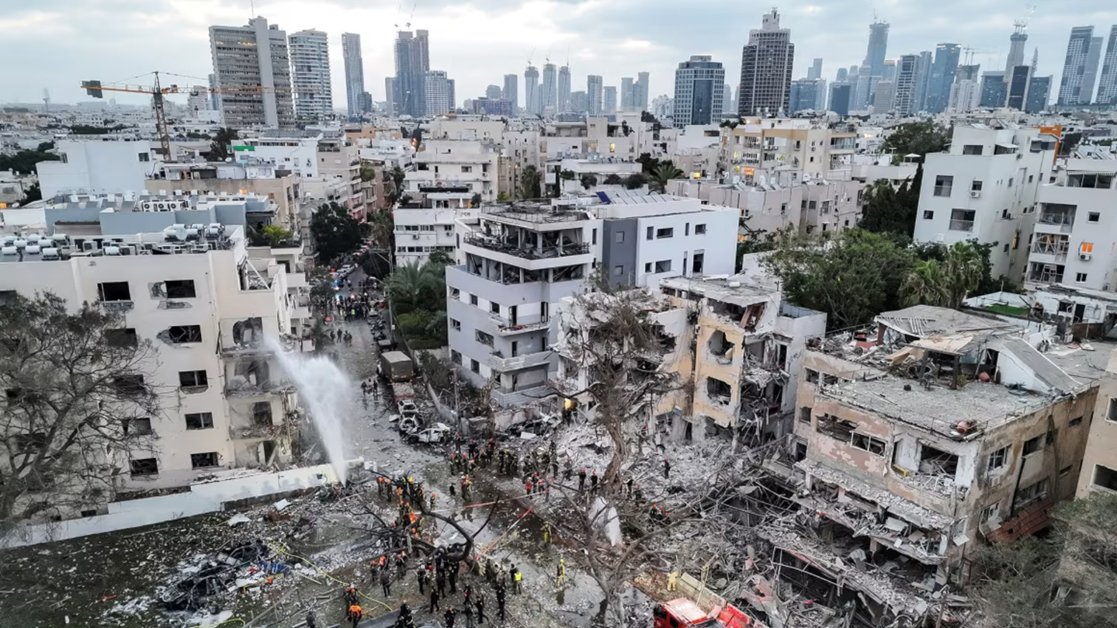
On the dawn of 13 June 2025, West Asia crossed a line it had tiptoed around for decades. Sirens wailed across Tel Aviv and Jerusalem as Israel announced the launch of Operation Rising Lion, a preemptive strike targeting Iran’s nuclear and ballistic infrastructure. What followed was twelve days of extraordinary attacks between two states that had long waged war through proxies, sabotage, and threats—but rarely dared to face each other head-on. This was not merely another war in a region accustomed to crisis; it was a historic rupture whose effects will reverberate for years.
Below, the article unravels how it started, how it escalated, what both sides lost, and why the so-called “ceasefire” might be nothing more than a pause before the next round. Let’s begin with nuclear enrichment.
The Spark: When Deterrence Became Inadequate
The roots of this confrontation lay deeper than any single provocation. Israel’s security establishment, according to The Times, had been monitoring an alarming acceleration in Iran’s nuclear and missile programs. Intelligence suggested Tehran had stockpiled enough enriched uranium to assemble at least nine nuclear warheads, with weaponization only months away.
Simultaneously, Iran’s Revolutionary Guards were expanding their missile arsenal from approximately 3,000 to nearly 20,000 launch-ready platforms, including Khorramshahr and Shahab-series missiles capable of delivering heavy payloads into Europe, Israel, and Gulf capitals. For Israeli leaders, this was no longer an abstract concern but an existential threat. However, it was not easy to take down Iran without eroding the capabilities of Iranian deterrence as proxies.
The war between Israel and Hamas, followed by the Iran-Hezbollah confrontation after 7 October 2023, emboldened Israel to act as the systematic erosion of Iran’s regional proxies. As detailed in Breaking the Shia Crescent, Israel had neutralized much of Hezbollah’s top leadership, degraded Hamas’ supply lines, and isolated IRGC operatives in Syria. The assassination of Hezbollah chief Hassan Nasrallah in early 2025 removed the most credible deterrent against a direct strike on Iran itself.
For Prime Minister Benjamin Netanyahu, the moment had arrived to end what he called “the decade-long illusion that a nuclear Iran could be contained.” Thus, Operation Rising Lion was launched—not as a limited strike, but as a broad attempt to reset the regional power equation in the region.
Shock and Awe: The First Wave of Strikes
In the pre-dawn darkness of 13 June, more than 200 Israeli fighter jets and drones surged across Iraqi airspace into Iran. Over the next eight hours, Israeli forces launched five waves of strikes targeting nuclear sites at Natanz, Isfahan, and Fordow. According to Israeli military briefings, at least 330 precision-guided munitions were deployed in the opening salvo alone.
While conventional airstrikes dominated headlines, an equally decisive factor was the simultaneous use of cyber warfare and covert sabotage. Mossad teams on the ground reportedly disabled segments of Iran’s air defence grid while electronic attacks scrambled early-warning radars. This combination of brute force and technological subversion paralyzed Tehran’s response in the critical first 48 hours.
Iranian officials initially tried to project calm, but images of flames rising from the Isfahan nuclear enrichment centre quickly told another story. Civilian casualties were unavoidable as missile fragments and errant bombs struck neighborhoods near targeted facilities. For many ordinary Iranians, it was the first time they had experienced the horror of large-scale aerial bombardment. The goal was clear from Israel’s Defence Forces- destroy Iranian missile and nuclear capabilities. However, they failed to achieve the second goal due to the deep underground nuclear facilities of Iran. Israel achieved total air dominance but struggled to achieve its goal and changed into a regime change.
Tehran Strikes Back: From Proxy to Direct Warfare
On 14 June, Iran retaliated in a manner that stunned even seasoned observers of the region. For decades, Tehran had relied on proxies—Hezbollah, Hamas, Houthi, or militia raids in Iraq. This time, the Islamic Revolutionary Guard Corps (IRGC) launched a salvo of medium- and long-range ballistic missiles directly at Israeli cities.
Within hours, explosions rattled Bat Yam, Rehovot, Ashdod, and central Tel Aviv. Israel’s vaunted Iron Dome and David’s Sling systems intercepted the majority of incoming missiles, but some penetrated defences, killing at least 25 civilians and injuring more than 200. Hospitals across central Israel scrambled to manage the casualties, while millions of residents took shelter in underground bunkers. According to IDF, Israel’s defence system intercepted 86 percent of the missiles and 99 percent of the drones launched by Iran.
For the Israeli public, the experience was traumatic. No longer was the threat confined to sporadic rocket attacks from Gaza. This was the first time in Israel’s history that an adversary capable of launching thousands of missiles simultaneously had demonstrated the will to do so.
The Escalation Spiral: Days Three to Seven
The next five days became a brutal contest of endurance and messaging. Israel intensified airstrikes, hitting missile production sites near Yazd, drone manufacturing complexes around Tabriz, and IRGC command centres. Iran, in turn, increased the tempo of its missile barrages, at one point launching more than 300 projectiles in a single 24-hour period.
According to The Guardian, this phase of the war carried an unmistakable symbolism: both nations signalling that no military facility or urban centre was off-limits. The human cost soared as Iranian neighborhoods adjacent to missile storage depots were devastated by secondary explosions. Around 30 Iranian Top military commanders, including nuclear scientists, were eliminated, which was a huge human resource toll for Iran and created psychological fear among the Iranian leadership and the common public. People panicked and started leaving Tehran.
International mediators scrambled to contain the conflict. Russia warned that prolonged fighting could ignite a wider war involving Gulf nations and even NATO. The United States, caught between long-standing support for Israel and fears of escalation, publicly called for restraint while quietly accelerating munitions resupply.
By 19 June, satellite imagery confirmed that nearly half of Iran’s known missile launchers had been destroyed or severely damaged. Israel also claimed success in degrading Iran’s drone warfare infrastructure, a pillar of Tehran’s asymmetric strategy. However, the aim has not been achieved yet.
Civilian Suffering and the War’s Psychological Toll
As the fighting dragged into its second week, it became clear that civilians were bearing the heaviest burden. In Iran, more than 900 people were killed, many in areas far from any military installation. Iranian state television broadcast images of families digging through rubble and makeshift morgues in hospitals overwhelmed by casualties.
Israel, though better shielded by missile defence, faced its own trauma. Repeated sirens, closed schools, and images of burning apartment buildings created a profound sense of vulnerability. Commentators described it as the psychological equivalent of the 1991 Gulf War Scud attacks but on a vastly greater scale.
Both governments, while claiming strategic success, were forced to manage the domestic backlash of civilian deaths and economic paralysis. In Tehran, protests erupted despite the government’s efforts to clamp down on dissent. In Tel Aviv, some families openly questioned whether the operation was worth the price. The economic toll of the war is harsh on the already crippled economy of Iran. Israel’s economic growth was also expected to go down due to unparalleled expenditure on the operation.
The Ceasefire: An Uneasy Pause
The initial goal of the operation was to obliterate Iranian nuclear facilities. When that failed, the focus shifted to regime change. However, Trump clearly stopped such actions. In the end, the only viable option left was to bring the U.S. into the war to destroy Iran’s deeply buried nuclear sites, especially Fordow. Only the U.S. had the capability to hit such mountain-based targets using the GBU-57 bunker buster bomb and its B-2 bomber. After careful calculation, Trump entered the war on 22 June and targeted Isfahan, Natanz, and Fordow. At the same time, two dozen cruise missiles were launched at the Isfahan site from a submarine – in total, 75 “precision-guided weapons” were used during the operation.
This limited U.S. involvement helped Trump maintain support from the MAGA group, who wanted Iran’s nuclear sites destroyed but opposed the deployment of U.S. troops. It also helped Netanyahu, as despite military success against Iran, he had not yet achieved his original goal. U.S. involvement helped cover that gap.
After the U.S. attack, Iran responded with a salvo of missiles and targeted Al Udeid Air Base, the primary U.S. military base in Doha, Qatar. However, Iran shared the timing and coordinates of the attack beforehand with the U.S. and Qatar.
On 24 June, after twelve days of sustained conflict and within 48 hours of U.S. targeted bombing, a fragile ceasefire was brokered by Oman and European mediators. Under the terms, both sides agreed to suspend offensive operations and allow humanitarian corridors to operate. This saved the Iranian regime and gave an opportunity to the Islamic Republic to project itself as victorious against the joint forces of Israel and the U.S.
However, neither Iran nor Israel made significant concessions. Tehran refused to halt its nuclear program, while Israel insisted it retained the right to preempt further missile threats. The truce was, in many ways, a tactical necessity rather than a genuine resolution. This was not a war to finish something, it was a war to reset the rules of engagement. Both sides have shown they can cross red lines, and both will prepare for the next crossing.
What Was Gained—and Lost
Strategically, Israel can claim to have degraded Iran’s nuclear and missile timelines by several years. Satellite intelligence suggests Natanz, Isfahan, and key missile production facilities in Kermanshah were extensively damaged. Israel also demonstrated a high level of integrated warfare—combining airpower, cyber sabotage, and real-time intelligence.
For Iran, the fact that it retained enough launch capability to strike Israel’s heartland is now woven into the narrative of “strategic resilience.” Supreme Leader Ayatollah Khamenei called the war “proof that Iran can confront the Zionist regime directly.” This claim, while questionable given the losses, will likely shore up the regime’s legitimacy among hardliners.
But both nations also suffered in ways that will linger. Iran lost much of its infrastructure for producing advanced missiles and drones. Israel, despite its technological edge, faced the reality that no defence shield is impenetrable when confronted by sustained saturation strikes.
The conflict also inflicted deep economic wounds. Iran’s oil exports collapsed under renewed sanctions and insurance bans, while Israel’s tourism and investment flows evaporated almost overnight.
What Comes Next?
The future is fraught with uncertainty. For Iran, the priority will be reconstructing damaged facilities, this time deeper underground and more dispersed to complicate targeting. Some analysts expect Tehran to double down on alliances with Russia and China to circumvent Western restrictions.
Israel, meanwhile, will likely intensify its intelligence operations and continue selective strikes to prevent the reconstitution of Iran’s missile arsenal. Politically, the Netanyahu government has already announced plans to deepen security ties with Gulf monarchies, an alignment that may further isolate Tehran.
One thing is clear: the 12-Day War did not close the file on Israel-Iran tensions. It merely set a new precedent for how direct and destructive future confrontations may be.
The Lessons of Twelve Days
This was a war that shattered illusions about deterrence, about the limits of preemption, and about the resilience of civilian societies in modern high-intensity conflict. As regional leaders and outside powers assess what happened, they will confront a sobering truth: West Asia has entered an era where state-on-state warfare is no longer hypothetical.
For millions who lived under the roar of sirens and the thunder of missile strikes, the 12-Day War will not soon be forgotten. Whether it becomes the first chapter in an even darker saga will depend on what choices are made in the months ahead.
