
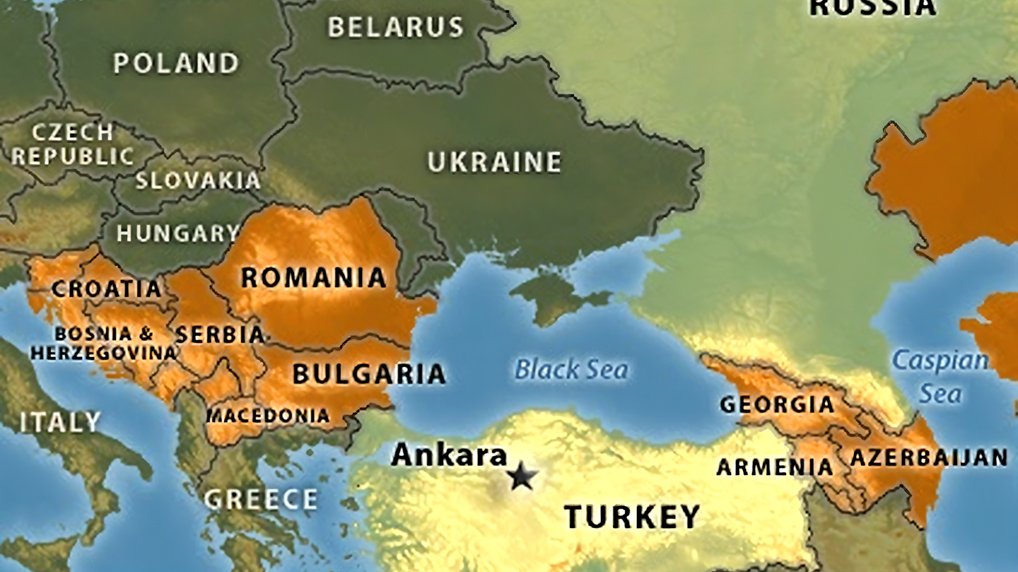
As the geopolitical tectonics of Eurasia shift dramatically in the wake of the Ukraine war, regional rivalries, strategic corridors, and realigned partnerships are carving a new security architecture—one that is deeply reminiscent of the ancient Indian strategist Kautilya’s Mandala Theory. India’s growing partnership with Armenia, its defense outreach to Greece and Cyprus, and its recalibrated posture against the Turkey-Azerbaijan-Pakistan (TAP) axis reflect a resurgent realpolitik.
Indian PM Modi’s trip to Cyprus, a visit that had its strategic vision. It is after over 2 decades that an Indian PM visits the Mediterranean country, the last being PM Atal Bihari Vajpayee in 2002.
India, long cautious in its West Asian engagements, is now moving with deliberate speed to entrench itself in the South Caucasus and Eastern Mediterranean. At the heart of this shift lies an urgent strategic rationale: to counterbalance the growing synergy between Turkey, Pakistan, and Azerbaijan, whose trilateral alignment has begun to threaten New Delhi’s interests both in Kashmir and across Eurasia.
Kautilya’s Mandala: Eternal Geopolitical Truth
According to Kautilya’s Arthashastra, every kingdom is surrounded by circles of enemies and allies. The “Mandala Theory” posits that the immediate neighbor is a natural adversary, and the neighbor’s neighbor is a natural ally. In modern strategic language, this translates into “my enemy’s enemy is my friend.” This ancient yet astutely pragmatic doctrine is now unfolding in India’s Westward strategy.
With Pakistan being India’s perennial adversary and Turkey-Azerbaijan firmly aligning with Islamabad—supporting it on Kashmir and even deploying Turkish drones in Operation Sindoor—India is now embracing Armenia, Greece, and Cyprus as strategic balancers.
Operation Sindoor: A Catalyst
In February 2025, India’s Operation Sindoor—a series of precision strikes on cross-border militant camps—triggered not only international attention but a coordinated response from the TAP alliance. Turkey and Azerbaijan swiftly issued statements backing Pakistan, further solidifying their trilateral unity. Turkish drones such as the Asisguard Songar, reportedly deployed by Pakistan, drew India’s ire and ignited popular backlash, with consumer boycotts of Turkish and Azerbaijani goods and bans on Turkish firms like Celebi Aviation.
It is within this evolving triangle of hostility that India finds natural convergence with Armenia, a nation threatened by Azerbaijani aggression and abandoned by its traditional guarantor, Russia. India’s support for Armenia, then, is not just altruistic diplomacy; it is textbook mandala strategy—a pragmatic alignment rooted in shared adversaries and converging geopolitical interests.
Armenia: From Russia’s Shadow to India’s Embrace
The Armenia-India defense partnership has expanded rapidly since 2020. With Russia distracted in Ukraine and unwilling to risk further deterioration in ties with Turkey or Azerbaijan, Yerevan found itself exposed during and after the Second Nagorno-Karabakh War. India stepped into the vacuum, supplying Akash-1S surface-to-air missiles, Pinaka multiple launch rocket systems, and howitzers, signaling not just military assistance but a long-term strategic partnership.
India’s growing role in Armenia also allows it to project influence into the South Caucasus—a region pivotal to Eurasian connectivity. Armenia is a critical node in the International North-South Transport Corridor (INSTC) and a gateway to Europe through Iranian and Georgian routes. Through Armenia, India also aligns itself against the Zangezur Corridor, a Turkish-Azerbaijani initiative that threatens to cut off Armenia’s southern border with Iran and potentially isolate both countries economically and politically.
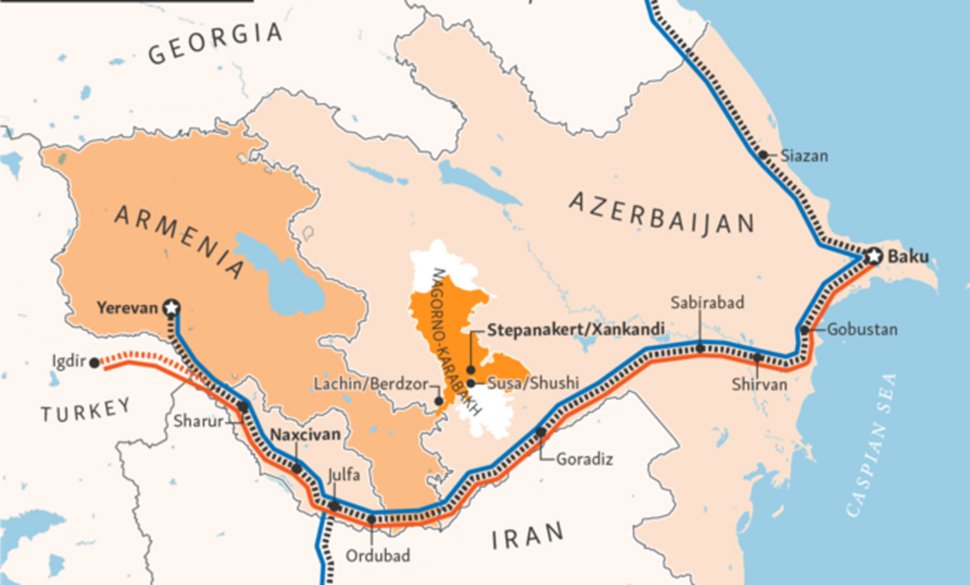
Image: Zangezur Corridor
Corridor Wars: IMEC vs. Zangezur vs. INSTC
At the heart of this geopolitical chessboard are competing strategic corridors:
- The Zangezur Corridor, backed by Turkey and Azerbaijan, would connect mainland Azerbaijan to its exclave Nakhchivan through Armenia’s Syunik province, providing Turkey a direct land route to the Caspian Sea and Central Asia.
- The International North-South Transport Corridor (INSTC), supported by India, Iran, and Armenia, offers an alternative route to Europe that bypasses Turkey and Pakistan entirely.
- The newly announced India-Middle East-Europe Corridor (IMEC), involving India, the UAE, Saudi Arabia, and Europe, has drawn criticism from Turkey, which sees it as an affront to its ambitions as a Eurasian transport hub.
Turkey’s open opposition to IMEC and its support for the Zangezur Corridor position it squarely against India’s logistical and economic interests. Iran, too, is deeply opposed to Zangezur, as it would marginalize Tehran in regional transit and potentially revive pan-Turkic irredentism, threatening Iran’s own Azerbaijani population.
In this intricate puzzle, India’s support for Armenia—and by extension, Iran—is part of a broader game of corridor balancing. It is no longer just about defense hardware; it is about regional architecture.
Greece and Cyprus: The Mediterranean Mandala
Extending its outreach, India has begun cultivating ties with Greece and Cyprus, who also find themselves on the opposing side of Turkish regional ambition. Greece’s rivalry with Turkey in the Aegean and Cyprus’ longstanding conflict with Ankara create natural synergies with Indian geopolitical concerns. PM Modi’s trip to Cyprus was part of that synergies in order to consolidate Indian position in the Mediterranean.
Recent dialogues between India and these Mediterranean nations have focused on maritime security, energy cooperation, and defense interoperability. Joint naval exercises, potential arms deals, and coordinated stances in multilateral forums are likely to follow. From the Caucasus to the Aegean, India is crafting a westward arc of strategic relationships to counter Turkey and Azerbaijan using its presence through Armenia, Greece and Cyprus.
TAP Axis: An Emerging Adversarial Bloc
The Turkey-Azerbaijan-Pakistan axis presents a coherent challenge to India’s regional aims:
- Turkey, under President Erdoğan, aspires to revive neo-Ottoman and pan-Turkic influence across West Asia and Central Asia.
- Pakistan, emboldened by Turkish drones and diplomatic cover, remains committed to asymmetric strategies in Kashmir.
- Azerbaijan, riding high after its Karabakh victory, is expanding military capacity with Turkish and Israeli support and sees India’s presence in Armenia as a hostile move.
What binds them is more than ideology—it’s a shared opposition to India’s growing westward ambitions and mutual support in key geopolitical theatres. India, in turn, must respond with sustained partnerships, economic integration, and strategic signalling.
The American and Russian Calculus
Both Russia and the U.S. are watching this realignment with caution. Russia’s fading grip on the Caucasus, due to the Ukraine war and its strategic overextension, has opened space for new actors like India. Meanwhile, Washington, though publicly neutral, may tacitly welcome India’s westward reach as a counterbalance to Turkey—a NATO ally that has increasingly acted at odds with U.S. interests.
India’s Strategic Awakening
India’s embrace of Armenia, outreach to Greece and Cyprus, and expanding influence in Eurasian corridors reflect a new strategic doctrine—one rooted in balance of power, geography, and classical statecraft. New Delhi is no longer just reacting to crises in its neighborhood; it is shaping the environment in which those crises unfold. In an era of fluid alliances, India’s ability to forge enduring partnerships across Eurasia could define its rise as a regional—and eventually global—power.
The TAP axis is formidable, but not insurmountable. With strategic depth, intelligent diplomacy, and doctrinal clarity, India can ensure that the Mandala turns in its favor.
