
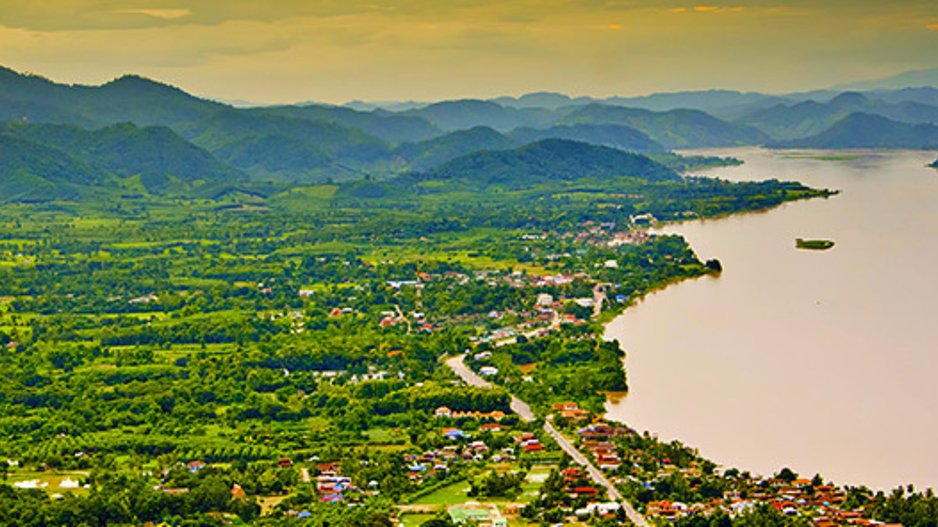
The Mekong River is a trans-boundary river which spans for 4,350 km, is co-shared by China, Myanmar, Thailand, Cambodia, Laos PDR and Vietnam. Given the presence of rich biodiversity, resources, food supply chain and tourism- it acts as a lifeline for all the upper and lower riparian states. The river originates in the Jifu Mountain high in the Tibetan Highlands in Southern Quinhai province of China where it is called the Lancang river which covers 40% of the length of the Mekong river. The Lower Mekong Region which covers a total area of 630,000 sq. km is also known as the ‘Asia’s Rice Bowl’ is responsible for providing food and water security.
Given the presence of abundant resources and rising demands of energy among all the riparian countries, has resulted in construction of upstream dams. Moreover, riverbed manipulation and development of the wider Mekong sub-region, partly within the framework of China’s Belt and Road Initiative, have complicated the existing issues and brought up new challenges to these riparian states.
Issues and Complexities behind Construction of Hydropower plants
The construction of mega hydropower projects on the upper-riparian areas of the Lancang- has raised concerns about resource sharing, depletion of fisheries, ecological impacts and climate change for the Mekong River Basin. In addition, the Xiaowan (2010) and the Nuozhadu (2012) are large storage dams which gives China massive control over the release of water to the Mekong river basin. Yet another facet is that every lower riparian country and their developmental activities on the same affects the overall flow of the river too.
According to the 2023 State of the Basin Report published by the Mekong River Commission it is stated that there are a number of issues faced by the Mekong region such as severe dry season has impacted the fishing and has increased salinity of water, less sedimentation, loss of wetlands, changes in the timing and extent of drought and rising sea levels. One of the major reasons behind this is the reservoir development in the Mekong basin. In addition the excessive damming of the Mekong river and its manifestation came out prominent in the State of the Basin Report.
In addition, according to a report published by the Stimson Centre in 2024, there are a total of 745 hydropower projects which are built by China and the rest of the Mekong countries. In addition, China has embarked on extensive dam-building activities in the Mekong area, operating 12 mainstream dams and 95 tributary dams which poses a major threat to the lower riparian countries. On the other hand, there are other complex issues such as population growth, urbanization and modernization that complicates comprehensive governance of the region.
China and the other Mekong States
There are existing differences among China and the rest of the riparian countries in regard to how they perceive the Mekong region. China views the Lancang river to be essential for national security, including energy and economic security. Whereas, the Mekong riparian countries perceive it from the aspect of their respective sovereign rights over the river as it flows through their territory.
At the same it is also interesting to note that already the region of Southeast Asia has garnered much attention due to the ongoing maritime and territorial dispute in the South China Sea which involved multiple regional claimants; and international stake holders due to the presence of energy resources and strategic straits.
On the other hand, the Mekong issue mostly features an asymmetric relation between China (upper riparian country) and the five other riparian countries. There is comparatively less attention which is paid to the issues of the Mekong river. It is often observed that hydro-hegemon turns out be an upper riparian country and they often gain compliance of the lower riparian country without coercion. This is quite evident in the case of the Mekong river basin.
Another aspect is every riparian country is driven to pursue their self-interests. For instance, Laos aspires to become the “Battery of Southeast Asia” by utilizing their hydropower potential. Currently, Laos is operating 77 hydropower plants, including two mainstream Mekong projects. Some of the significant hydropower projects are- Xayaburi Dam (1285 MW), Nam Theun 2 (1070 MW) and Nam Ngum (615 MW). Such level of accelerated construction of hydropower projects is definitely going to result in more intense disagreements among other riparian countries.
Vietnam has officially objected the construction of Xayaburi dam in 2010 and has urged Laos to avoid pursuing prosperity at the expense of downstream nations. Similarly, Vietnam has also raised concerns on the construction of Cambodia’s Funan Techno Canal project which has the potential to divert a significant portion of the Mekong’s flow away from the Mekong delta, particularly during the dry season. Also, much of Cambodia’s hydroelectric power expansion has been financed by Chinese corporations such as the state-owned Sinhydro– the world’s largest hydropower developer.
Moreover, another complicated element in doubt is whether riparian countries constructing hydropower projects are providing transparent canal designs, operation and water usage which can have severe impact on the assessment of expected environmental outcomes in the future.
Existing Transboundary Water Cooperation
In 1957, the Committee for Coordination of Investigation on the Lower Mekong River Basin was set up under the auspices of the United Nations, with the membership of Thailand, Cambodia, Laos PDR and Vietnam. The objective of this UN committee was to provide financial and technical assistance for development projects like irrigation and hydropower projects. However, in 1977 Cambodia withdrew from the Committee due to the growing tensions with Vietnam which ultimately culminated in the Cambodian war in 1978-88. So during this time period, the committee functioned with only three members.
It was finally in 1995 that Thailand, Cambodia, Laos PDR and Vietnam signed the Agreement on Cooperation for Sustainable Development of the Mekong River Basin in Chiang Mai, Thailand. It paved the way for the establishment of the Mekong River Commission (MRC) which acts as a consultative platform for its member states to discuss vital issues related to water and resources management and issues related to sustainability. It has also streamlined the responsibilities of the states of the Lower Mekong countries (LMC) when it comes to sustainable development, utilization and conservation of the Mekong basin. Moreover, in 1996 China and Myanmar were granted observer status in MRC.
Apart from this, the Lancang-Mekong Cooperation which was formed by China in 2016, is closely tied to the BRI. The LMC has acted as a platform for China to shift from “unilateral development with limited multilateral cooperation” to “water diplomacy”. Moreover, it has also facilitated joint water development projects, China’s financial aid, direct investment, technical assistance and agricultural cooperation.
Involvement of External Powers
There are two other regional institutional initiatives which involve external power. In 2019, the Japan-U.S.-Mekong Power Partnership (JUMPP) was set up. Simultaneously in 2020 another institutional initiative called the US-Mekong Partnership is formed by the US and the Southeast Asian riparian states and builds on the Lower Mekong Initiative (LMI). The entry of Japan and the U.S. in the management of the Mekong river basin indicates an emergence of new geopolitics over water and has also become an area to exert soft power especially among the riparian countries.
It can be inferred from above that there are attempts made by China and external powers like the US and Japan to push for a credible cooperative network among the riparian countries of Mekong. These commissions and initiatives also serve as a platform to discuss sustainable use of water resources and other challenges in the Mekong basin.
Although, the involvement of China in the LMC is also looked from the perspective of exerting soft power but at the same time China has high stakes in the Lancang basin due to its growing energy demands. Its funded projects in Laos and Cambodia not only creates the probability of acting as an obstacle to achieve consensus over any pressing issue but also adds a layer of strategic complexity.
In addition, the continuing strategic rivalry between the U.S. and China has also brought the issue of Mekong into the area of power politics. For these middle and small states, it will be dire to compete between great powers as the region of Southeast Asia had already experienced a more or less similar situation during the Cold War. As of now, the main objective of these riparian countries should be how to address the pressing issue related to Mekong either bilaterally or through the existing transboundary water commission.
