
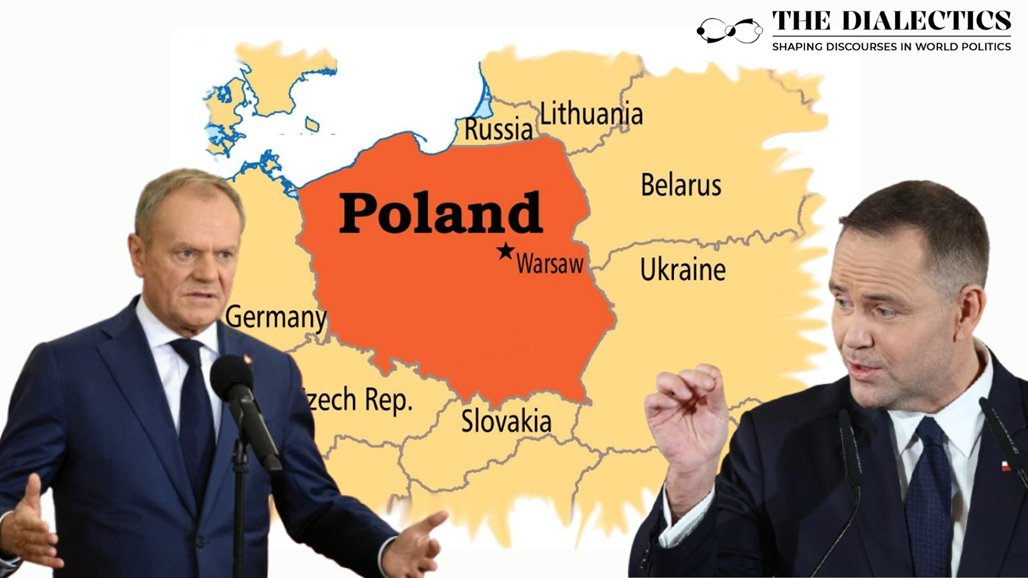
Over the past ten years, Poland has become one of Europe’s most important and closely watched countries. Its rise is not only because of where it is on the map—bordering Ukraine and lying between Eastern and Western Europe— but also because of how its politics and institutions have developed in a challenging time. As war continues in Ukraine and as the European Union and NATO adapt to new realities, Poland stands at the center of decisions that could shape the continent’s future.
How does Poland’s Political System function?
Poland’s political system is based on what’s known as a semi-presidential democracy. This means it has both a President and a Prime minister who share executive power. The President is elected by the people and plays a big role in foreign policy, national defense, and appointing key officials like judges. The prime minister, on the other hand, leads the government and is responsible for managing the country’s daily affairs and policy implementation. This setup can work smoothly when both leaders belong to the same political camp. But when they come from opposing parties, it can lead to a power struggle—something called “cohabitation.” And that is exactly what Poland is experiencing right now.
Current Cohabitation in Poland
In June 2025, the country elected a new president: Karol Nawrocki, a conservative figure associated with the Law and Justice party (known by its Polish acronym, PiS). He narrowly defeated Rafał Trzaskowski, a centrist with a strong pro-European outlook. Nawrocki’s win was razor-thin—he received just under 51% of the vote—showing how divided Poland is. At the same time, Donald Tusk, a long-time political player known for his pro-EU stance, continues to serve as prime minister after leading his center-right Civic Coalition to victory in the 2023 parliamentary elections.
This means that Poland’s top two leaders hold very different political views. Tusk wants to bring Poland closer to the EU, reform the justice system, and expand civil rights. Nawrocki, by contrast, is more conservative and skeptical of some EU initiatives. This division creates tension not just between two politicians, but between two very different visions for the country’s future.
The division at the top reflects a deeper split within Polish society. Urban areas, especially among younger voters, tend to support centrist or liberal policies. Rural regions, older generations, and people who feel left out of Poland’s rapid development since joining the EU in 2004 often lean conservative. These differences are more than just political—they’re cultural, economic, and generational.
Poland and NATO
Even though the political climate is tense, there are still important areas where both sides agree. One of these is national security. Regardless of their political differences, Polish leaders understand the threat posed by Russia and agree on the need to support Ukraine. Poland has played a crucial role in helping Ukraine, both by sending weapons and by welcoming millions of refugees. It is also one of the few NATO countries that spends significantly more than the alliance’s recommended 2% of GDP on defense—reaching nearly 4%.
This investment has made Poland one of NATO’s most committed and capable members. The country has purchased advanced weapons systems, modernized its military, and expanded its defense industry. It is even discussing whether to host U.S. nuclear weapons. These moves send a strong message: Poland is serious about its security, and it is willing to lead on the eastern flank of NATO.
What is Poland’s Geopolitical Importance?
Poland’s location makes this role especially important. It shares more than 500 kilometers of border with Ukraine and acts as a gateway for the movement of military aid, humanitarian supplies, and NATO troops. Cities like Rzeszów and Lublin have become key logistical hubs. Without Poland’s cooperation, Western support for Ukraine would face serious delays. In this way, Poland is not just defending itself—it is helping defend Europe as a whole.
But Poland’s role doesn’t stop at security. It is also deeply involved in the political future of the European Union. Under Prime Minister Tusk, the government has worked to improve relations with Brussels, especially by trying to fix problems in the judicial system that had caused earlier clashes with EU officials. Tusk has also pushed for more EU integration and stronger rule-of-law standards.
How conservative is Nawrocki?
However, with President Nawrocki in office, some of these reforms may be blocked. Nawrocki has made it clear he does not support some of Tusk’s proposals, particularly around civil unions and abortion rights. He also wants to take a tougher stance on historical disputes with Ukraine and is skeptical about Ukraine joining the EU. These positions could make it harder for Poland to access certain EU funds or maintain close cooperation with Brussels.
Even so, Nawrocki is unlikely to completely turn away from the EU. He sees value in maintaining good relations, but on terms that align more with his conservative worldview. He has also signaled interest in aligning Poland with other right-leaning governments, such as those in Hungary or possibly with the U.S. administration. This could shift Poland’s position within the EU, making it a bridge between more liberal western countries and conservative central or eastern ones.
What comes next for Poland depends on how its leaders handle this new political setup. The risk is that the president and prime minister will block each other at every turn, leading to legislative gridlock. If Nawrocki uses his veto power too aggressively, Tusk’s government may not be able to pass key reforms. At the same time, if Tusk pushes forward without trying to find compromise, he may further deepen the political divide.
Poland and Europe
One possible path forward is to focus on areas where both sides can agree. National defense, immigration policy, and economic modernization are all fields where cooperation is possible. In fact, continuing to invest in security and military capabilities is something that both sides see as essential. Given the war in Ukraine and the risk of further instability in the region, Poland cannot afford to let domestic politics weaken its external position.
Poland’s broader importance goes beyond its borders. In the eyes of its allies in London, Washington, and Brussels, Poland is a test case for how a democracy can stay strong under pressure. It shows how institutions can keep functioning even when leaders disagree—and how crucial it is to avoid letting political fights turn into long-term paralysis. If Poland can navigate this period with maturity and strategic thinking, it has a chance to emerge not only as a key security partner, but also as a model of democratic resilience.
Poland’s Geoeconomic Leverage
Geographically, Poland is right at the center of Europe’s new security map. Politically, it is becoming one of the most influential countries in shaping the EU’s future. Economically, it is modernizing quickly and investing in infrastructure that will have long-term benefits for the region. And diplomatically, it is learning how to balance national interests with shared European goals.
Way forward for Poland
In short, Poland is not a marginal player—it is a core actor in Europe’s future. The choices made in Warsaw will echo across the continent. If its leaders rise to the occasion, Poland could become a true anchor for stability, security, and democratic values in a time of uncertainty.
But if political fights dominate and compromise becomes impossible, Poland could risk stalling at a moment when momentum is most needed. That would not only hurt Poland—it would weaken Europe’s eastern defense line and divide an already fragile European Union.
What is at stake is not just Poland’s direction, but the direction of Europe’s response to the world’s growing challenges. That’s why the decisions made today in Warsaw may shape not only the future of one country, but the future of the entire continent.
