
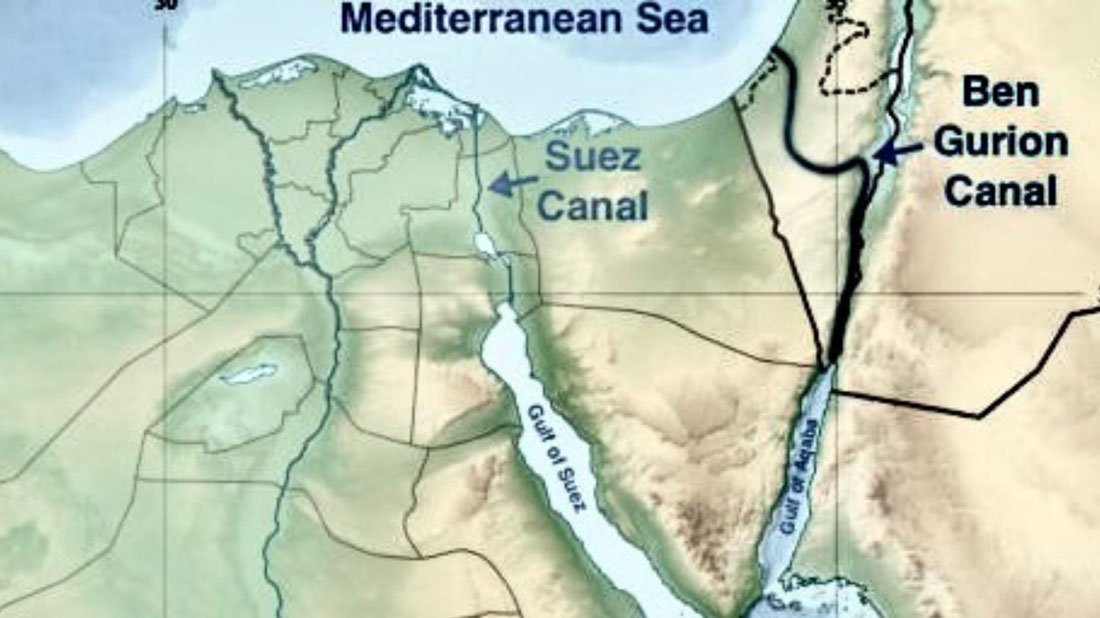
“Ein Mikreh ba Olam” i.e. there are no coincidences in the world, is an ancient Hebrew maxim that aptly reverbates with the current geopolitical aspirations of the West (United States) and its West Asian ally Israel to hegemonize the global maritime trade route. It is imperative to underscore the wider interests behind the recent displacement proposal of Palestinian natives from Gaza strip to strategically seize a potential pathway for a long-proposed Ben Gurion canal, which would further bolster the intended IMEC project. The West along with Israel is striving to curate a maritime alternative route which caters their Geo-political interests. This article traces how age-old aspirations maneuvers the current geo maritime landscape of West Asia.
The intimidating remarks of President Donald Trump over the Gaza strip to curate it into the “Riviera of Middle East”, albeit far from being a viable reality, considerably reflects the age-old aspirations to maneuver in and around the optimal location of Gaza strip. In similar vein, during Trump’s last presidency in 2020, Jared Kushner, the then White House senior adviser, pitched the Peace to Prosperity plan which was an initiative aimed at annexing Gaza under the pretext of resolving the Israeli-Palestinian conflict through economic incentives and conditional negotiations. This plan was denoted by Trump as the “Deal of the Century”.
The Gaza strip is merely about 141 square miles which had been colonized by the British during the Mandate period, then was administered by Egypt up till 1967 war and later on by Israel until the Hamas succeeded the leadership in 2006. The strip which had remained a lucrative trade hub in the past has emerged as a strategic buffer zone between Israel and Egypt in the modern era. Back in 2005, Benjamin Netanyahu was apprehensive of Ariel Sharon’s Gaza Disengagement Plan to unilaterally withdraw from Gaza and had also resigned from his post as Finance Minister dissenting the plan. He argued that the withdrawal would lead to increased security threats from the Gaza strip.
The Gaza Strip has long remained crucial for Israel not solely in terms of security but for being a potential pathway towards achieving regional supremacy. Thus, Israel has remained a vocal critic of militarism in the Gaza Strip. Danny Danon, a member of the Israeli Knesset has underscored the need to ‘complete demilitarization’ and ‘establishment of buffer zone’ in the Gaza strip to securitize Israel’s sovereignty. Moreover, apprehension has surfaced regarding foreknowledge of the Hamas attack on Israel on October 7, 2023, and Israel’s possible gain in maintaining an understated stance, is in cognizance with grander pursuit of Israel.
The Ben Gurion Canal – A plan to bypass Suez
Moreover, the western nations have long sought to navigate an alternative route to the Egyptian controlled Suez Canal particularly since the Suez crisis in 1956. This episode stigmatized the presence of Britain and France along with the vested interest of Israel and their collective operation (Code named Three Musketeers)that undermined Egypt’s sovereignty. Thus the proposal of the Ben Gurion Canal first surfaced in 1963 by Lawrence Livermore National Laboratory, an American research facility that specialises in Nuclear science, Energy and Defense.
It is imperative to realise that the Riviera plan for Gaza is directly proportional to the Ben Gurion canal project. The western powers have long sought to navigate an alternative route, as it remains lucrative to hegemonize the Maritime trade routes. Thus, both USA and Israel are vying for that strip of land to satiate their real estate aspirations without any remorse or apathy for the lives of Palestinian natives. This proposed canal aims to rectify the shortcomings of the current Suez canal thus being more efficient to cater the colossal cargo loads. It is proposed to be 10 meters deeper than Suez and about 200 meters wide.
The proposed route of the Ben Gurion canal had been chalked out to be originating from the Israeli port city of Eilat flowing through the Arabah valley into the Dead Sea and further navigating northward toward the Gaza strip thus finally connecting to the Mediterranean. This canal would be potentially beneficial to the Israelis in countering the strategic Suez canal as well as in terms of revenue. The toll tax that Egypt collects from freight transit makes up to almost Ten billion dollars per annum. Osama Rabie, the present Suez Canal Authority Chairman noted that albeit the recent transit revenues has been marred by the ongoing fissures in the Bab el Mandeb strait, Egypt in 2024 still managed to bag a profit of 422% , compared to last fiscal year.
Subsequently, beyond the Gaza strip, Israel’s potential benefit lies in scrambling the underlying offshore Mediterranean assets. It is estimated that the Gaza Marine gas field possesses around 1 trillion cubic feet (Tcf) of natural gas that was discovered by the British Gas (BG) back in 2000. Indeed it is comparatively modest in comparison to other fields in the Levant basin but it is estimated to generate around 2 billion cubic meters (bcm) of gas annually, that can in return yield about $4.5 billion in revenue. Moreover, this aligns with Israel’s broader goal to substitute coal with natural gas for electricity generation by 2030. Thus, besides the Leviathan and Tamar gas fields, the Gaza Marine field would be a favourable asset in their quest towards energy independence.
Furthermore, the proposed transcontinental economic corridor i.e. the India-Middle East-Europe Economic Corridor (IMEC) project which was unveiled at the sideline of the G20 Summit in New Delhi in September 2023 would further alter the trade flow and restructure the influence in favor of the West in general and Israel in particular. Trump has labelled it as ‘ greatest trade routes in all of history.’ Along with India and the US, the European Union, Germany, France, United Arab Emirates, Italy and Saudi Arabia are the chief signatories of this project.
IMEC, at large, strives for these economies to integrate which is not feasible without a certain form of diplomatic cooperation among them. And it is essential to note that Israel is also a significant facilitator of this proposed project. Hence, the normalization of Saudi Arabia’s ties with Israel is a prerequisite for this project to sail steadily. A meagre back channel diplomacy has been brewing among them since the successful mediation of Abraham Accords by the United States in 2020 where UAE, Bahrain, Morocco, and Sudan normalized their ties with Israel. Saudi Arabia is yet to strike a peace deal with Israel which is majorly jeopardised by the Palestinian Question at stake. All these normalization treaties have remained a mere veneer to realise their long term aspirations towards realising the grandeur infrastructure projects.
These strategic maneuvers are likely to have repercussions in the wider global as well as regional dynamics. If either the Ben Gurion Canal or IMEC project comes to fruition, it would tarnish the aspiration of China’s Belt and Road Initiative (BRI). Further, it would significantly jeopardise Egypt’s strategic and economic hegemony over the critical bottleneck by reducing the reliance of global commerce on the Suez Canal solely. These projects threaten Egypts crucial revenue source and saturates the geopolitical significance of the Suez canal. Consequently this could hamper the relation Egypt has maintained with Israel since 1979 and would destabilize the peace in the levant basin which would not be favourable for Israel in the long run.
These proposed projects have the potential to challenge the regional adversaries of Israel and the West. Iran, who remains the primary adversary to Israel in the region, has been perceived as a destabilizing element primarily due to its nuclear endeavors and its support for the militant proxies like Hezbollah, Hamas and the Houthis. Similarly, Yemen’s hostility remains crucial as they have targeted Israeli-linked vessels which exhibit their advocacy for the palestinian cause. Their authority over the Red Sea coastline gives them the leverage to threaten international shipping. Thus, navigating an alternative route remains lucrative to hegemonize the maritime choke points and would likely saturate the significance of traditional Straits like Hormuz and Bab el-Mandeb. This could ensure an undisputed flow of trade and energy even amid regional as well as international instability.
Israel’s desire for robust security measures can be deciphered from its existence within the precarious surroundings. This insecurity can be traced to its inception in 1947 when the UN Partition Plan was contested by Arabs and Israel retaliated by capturing lands beyond the UN’s designated plan in 1948. Even during the 1967 Six-Day War when Israel seized the West Bank and East Jerusalem from Jordan, Gaza Strip and the Sinai Peninsula from Egypt and Golan Heights from Syria, further modified the landscape of Levant. Post Oct 7 (2023) cross border attack, (by Hamas), the episode has stood as a pretext to advance further into the Gaza strip.
Recently the Turkish foreign minister Hakan Fidan has aptly called out Israel for being a stubborn pursuant of “expansionist agenda” in the region, citing its recent maneuvers in Syria, Lebanon and even in the West Bank. In the contemporary scenario, Israel’s persistent occupation in Syria and Lebanon is not merely driven by security concerns but also by strategic consideration to leverage tactical locations as well as critical water resources in the region. Its desire for Greater Israel (Eretz Yisrael) has remained consistent through its territorial acquisition to establish strategic buffer zones for security concerns that is also bolstered by historical precedence. Thus, Israel’s aspiration of land expropriation can be delineated to be emanating from its insecurity of being a relatively small nation surrounded by hostile neighbours. Hence, it is ideal to conclude that President Donald Trump’s proposal of revamping the Gaza Strip into the “Riviera of Middle East” is in cognizance with the Ben Gurion canal project along with the IMEC project. The consistent demand to demilitarize and displace the populace of Gaza coincides with the Geo Economic aspirations of Israel under the pretence of mere securitization. So far the Palestinian cause remains to be the major blockade at the heart of crystallization of these projects. These proposed projects are aligned with the broader strategic calculus of the West and Israel to counter the existing geo-maritime order.
REFERENCES:
- https://jinsa.org/israel-ensure-security-postwar-gaza-dec24/
- https://www.csis.org/analysis/how-could-israeli-intelligence-miss-hamas-invasion-plans
- https://www.egypttoday.com/Article/3/133560/Suez-Canal-revenues-maintain-downward-trend-falling-to-7-2B
- https://www.mesp.me/2024/02/13/between-tales-and-facts-the-long-saga-of-gaza-marine/
- https://www.moneycontrol.com/news/india/greatest-trade-route-in-history-trump-modi-reaffirm-ambitious-imec-plan-in-bid-to-counter-china-12940584.html
- https://erl.scholasticahq.com/article/123649-india-middle-east-europe-economic-corridor-a-strategic-energy-alternative
- https://moderndiplomacy.eu/2025/02/03/how-gazas-displacement-plan-could-shake-chinas-bri-and-suez-via-israels-ben-gurion-port/
- https://www.middleeasteye.net/news/turkey-says-israel-occupation-syria-expansionist
- https://www.newindianexpress.com/world/2024/Dec/18/israels-borders-have-shifted-throughout-its-history-action-in-syria-may-reshape-them-again
- https://www.fairobserver.com/politics/the-greater-israel-plan-has-a-colossal-reach/
