
Imagine a man whose ancestors, his father and grandfather, have lived in a country for centuries, yet he remains oblivious to the rich past buried beneath the soil of his homeland. He is unaware of his historical legacy or the political heritage that shaped his land. When invaders from foreign lands arrive and tell him that he is uncivilized and inferior, he has no choice but to believe them. That is, until one day a groundbreaking discovery reveals to him the rich cultural and historical legacy of his people, a revelation so profound it shakes the foundations of history and ignites a spark in those yearning for freedom. A cry for self-identity awakens in him; the call of his forefathers’ rings in his ears, urging him to fight for independence from foreign rule. The identity, once hidden and unknown to him, goes far beyond the one imposed upon him by those who were once strangers to his land.
A British man unearths the mysteries of ancient Bharat
One might wonder if it sounds like the plot twist of a movie. Yet, this very event unfolded in the country of India, and it happened to the Indian people themselves. The Indians were given the connotation of a tribal uncivilized people by the Britishers. The Indians unaware of the ancient civilization were told by the British that they were inferior to them, and it was for the good heart of the British that they were civilizing the Indians, which they termed as “the white man’s burden” to justify their colonial rule on India. The British believed that Indians had no significant historical background and no real identity, but it was for a British man who proved this wrong. Who was he? Where did he come from? What was the groundbreaking discovery that led and sparked nationalism in the hearts of oppressed Indians who had a newfound identity and a legacy to be proud of?
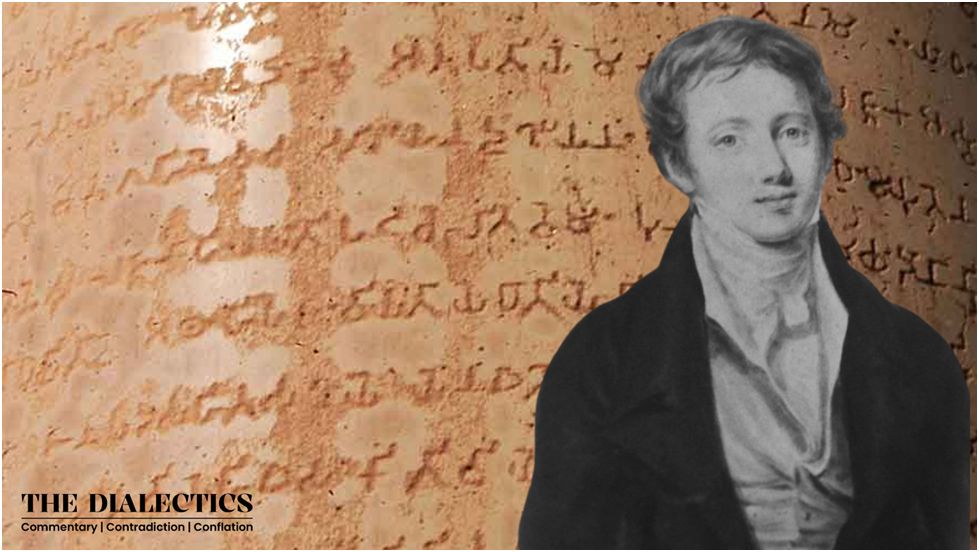
James Prinsep wanted to be an architect but an eye infection nearly blinded him and he lost the opportunity to pursue that career and came to India perhaps to pursue what had already been destined. James Prinsep was an epigraphist even before it was a formal discipline. We can perhaps revere him as an English personnel with outstanding brilliance. He had deep interest in fields in which he had no formal training and contributed massively in a variety of fields including civil engineering, meteorology, mining, metallurgy, town planning, architecture, geometry, mathematics, astronomy, natural sciences, anthropology, and archaeology disciplines like epigraphy, numismatics, and history.
Not so ordinary Assay master lands in India
James Prinsep left a legacy behind him. In his short span of 41 years, he laid the foundation for the study of Ancient Indian History. James Prinsep came to India on 15th September 1819 at the age of 20 to work as an Assay master at the Banaras Mint after joining the service of the East India Company. He joined as a Deputy Assay Master at the Calcutta Mint and remained as the chief of the Calcutta Mint till 1833 but he had to return to England due to a life-threatening illness. While working in the mint as an assay master what he did was remarkable, the deciphering of the two Indian Ancient scripts which had long been forgotten. He opened the keys to the vast empire of Ashoka.
There are different sources through which one can connect the dots and find out about the history of a civilization. It can be done through sources left behind such as material remains, pottery, inscriptions, artifacts, monuments, manuscripts, art, etc. But it is for the inscription of that era that holds the keys to the complete understanding of socio-political, economic life of the people belonging to a particular civilization or an empire. For example, we don’t know much about the Indus Valley civilization. Through the material remains we can identify the town planning, and the areas where people had inhabited and lived, through the remains we can understand the agricultural aspect, and the drainage system, through the coins found we can understand that trade was practiced. Even after the discovery of the Indus Valley civilization, the decline of the civilization remains a huge mystery and still baffles historians. We have no clue who these people were, what religion they followed, or what kind of political system was there as the script of the Indus valley remains undeciphered. Imagine the history that we could have been able to restore if we had deciphered the clues that the Indus people had left behind through their writing and the entire civilization would have been deeply understood. Hence the script and the inscriptions are clues to the great lives of the people who lived before us, it is a way to preserve the legacy of that period.
The stick Figure Script comes into picture
The same happened with what was called the “Stick Figure Script” which hid the secrets of the Ancient Indian Mauryan Empire which is now known as “the Brahmi script”. What did the unique letters compiled together that made the oldest script of South Asia contain? Well, an Entire history of the great King Ashoka and the mighty Mauryan empire that he built, he went by the name Piyadassi– pleasant to behold in these inscriptions. Now one might wonder what an assay master of a mint has to do with an Indian script and its deciphering. Let us explore what led Prinsep down this remarkable path. to the discovery of the Ashokan empire. In 1830, Prinsep’s position in Calcutta marked a turning point in his academic career. His scientific inclination led him to collaborate with the Asiatic Society of Bengal, where he played a crucial role in the establishment of “Gleanings in Science”. During this period, the society served as the primary repository for historical and scientific materials contributed by Europeans in government or private roles, further establishing Prinsep’s reputation in academic and scientific circles.
Prinsep’s incredible journey with the JASB platform led to the exploration of a wealth of historical and numismatic material. His groundbreaking efforts involved nearly completing the deciphering of the Brahmi and Kharosthi scripts, shaping the study of early Indian history. Additionally, his numismatic forays yielded captivating genealogies of ruling families. While some modern historians may perceive his work as outdated, there’s no denying that Prinsep laid the very foundation for the advancement of knowledge in these fields. Achieving all this within merely seven years, from 1832 to 1838, underscores his unparalleled dedication, culminating sadly in his untimely passing in April 1840 due to mental overwork and exhaustion.
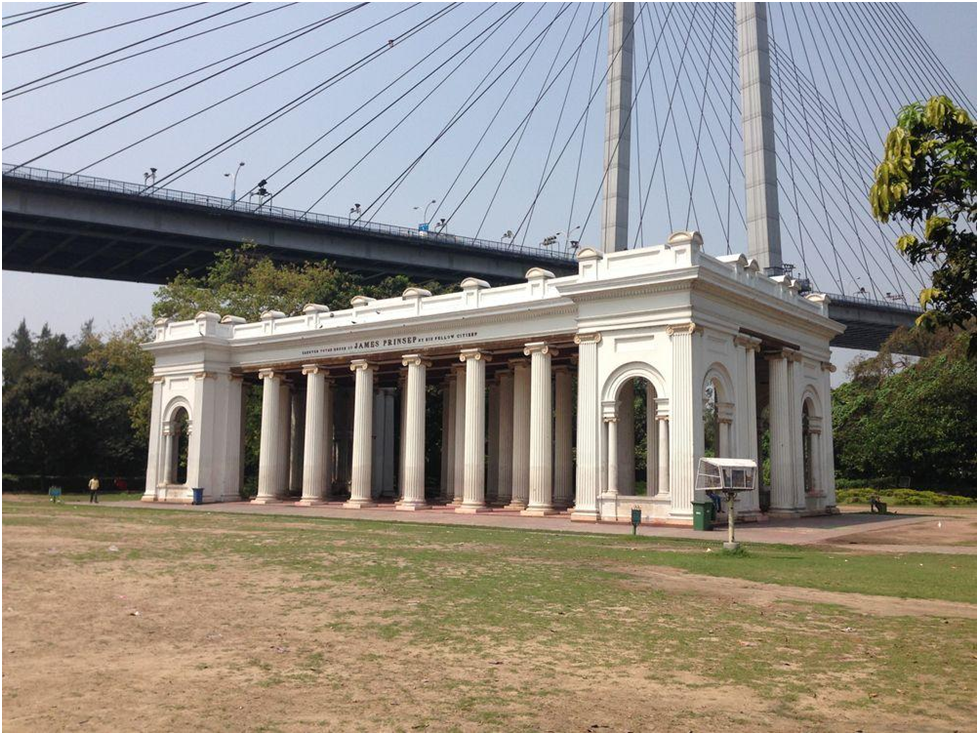
Prinsep Ghat, a Palladian porch was erected in his memory by the citizens of Calcutta.
Keys to the Empire of the Mighty King Piyadassi
An intriguing new episode in Indian history unfolded when a 2000-year-old script was decoded revealing the existence of a revered ruler of the Indian subcontinent, Emperor Ashoka. This story explores the life of an ancient monarch who carved his declarations on rock surfaces and stone columns across India, bringing attention to James Prinsep, a determined Englishman whose efforts uncovered the meaning behind these ancient writings. This fascinating tale highlighted the Brahmi script, the oldest readable Indian script of South Asia and the precursor of most modern Indian scripts. It had been lost for nearly 1000 years.
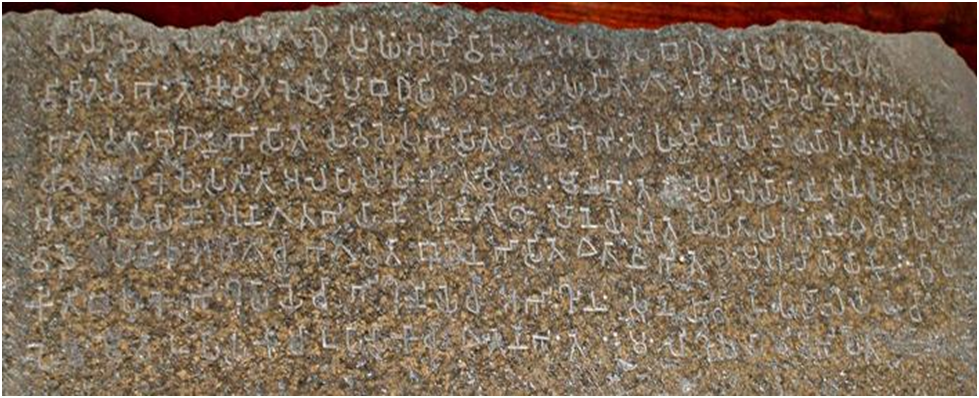
During the 1800s, the East India Company’s rule in India kindled the curiosity of Westerners about the country’s history. However, the ancient inscriptions found across India remained undeciphered, leaving the early Indian history shrouded in mystery. Fascinated by ancient scripts, James Prinsep embarked on a mission to decode these inscriptions. His meticulous examination led to a breakthrough when he noticed a recurring word, “Danam” (donation), which provided a key insight into the inscription’s meaning. This discovery eventually led to the deciphering of the ancient Brahmi script, shedding light on India’s ancient past and laying the groundwork for the modern scripts still in use today.
The writing mentioned a king as “Devanampiya Piyadassi,” which meant “beloved of Gods.” Initially, Prinsep believed this referred to a king from Sri Lanka due to the name. However, it raised the question of why a Sri Lankan king would inscribe messages in the Northern Parts of India. This led to the discovery that the Sri Lankan people knew of a great Indian king named Ashoka, who was given the title of “Devanampiya Piyadassi.” Ashoka, known for spreading dhamma (Buddhist teachings), introduced Buddhism to Sri Lanka 2000 years ago. Thanks to Prinsep’s deciphering of the script, other experts translated all of Ashoka’s inscriptions, unveiling a crucial part of India’s ancient history and giving India a newfound sense of identity.
The deciphering of the Kharosthi script
James Prinsep didn’t celebrate his win of deciphering the ancient language of Brahmi for too long as “the Kharosthi script” which was more complex and challenging was tackled next. By cross-referencing Greek and Persian inscriptions, Prinsep was able to unlock the script’s secrets by 1838. His success in deciphering Kharosthi opened up a treasure trove of historical information about ancient trade networks and cultural exchanges.
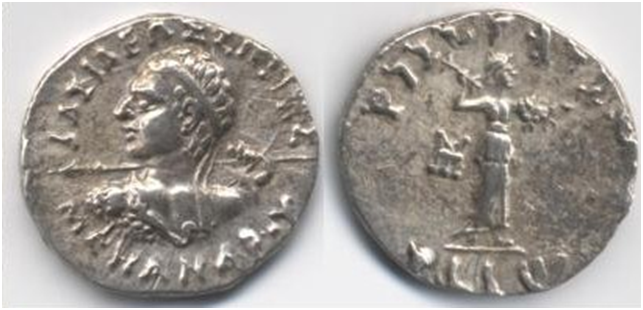
Unlike the Brahmi script which was spread throughout the Indian subcontinent, the Kharosthi script was mostly popular in the Northwestern region of the Indian Subcontinent. We see that the Kharosthi script was used to write the Gandhari language, a form of the Prakrit Language. James Prinsep played a pivotal role in deciphering the Kharosthi language, which was prevalent in Northwestern India, Pakistan, East Afghanistan, and parts of Central Asia during the 4th century BCE and 3rd century CE, a time when Indo-Greek rulers held sway over these regions. Subsequently, the language fell into obscurity. Prinsep’s interest in this script was aroused by the presence of Ashokan inscriptions in Kharosthi. As a numismatist, Prinsep observed bilingual coins inscribed with both Greek and Kharosthi texts, leading him to surmise that the messages in both languages generally conveyed the same information. Leveraging his proficiency in Greek, Prinsep successfully decoded the Kharosthi script.
Ignition of nationalism
James Prinsep an English man gave India its Identity and that shook away from us our inferiority complex. He introduced us to our rich political history. He changed the connotation that the Britishers had about Indians, we were believed to be tribals, uncivilized people, with no significant past. The narrative about India was that it was a land of snake charmers, gold, and rich resources. Edward Said perfectly described this in his Orientalism book. Wherein the Orient is looked down upon as inferior. It is not that nothing was Known about India’s past before the deciphering of the two scripts. The knowledge about the Vedas was there but it was confined within the reach of the high-class Brahmin society and preserved through oral accounts. Earlier apart from the Brahmins other castes people were restrained from learning Sanskrit. Prinsep’s work helped the Indians to gain confidence and understand that they as a civilization were neither inferior nor uncivilized to the British power. There was a boost in our Morality, the same moral was used by the freedom fighters to inculcate the spirit of nationalism by making the Indians aware of their rich legacy. A deciphering of a script led to the spark of nationalism and changed the course of Indian Modern history.
