
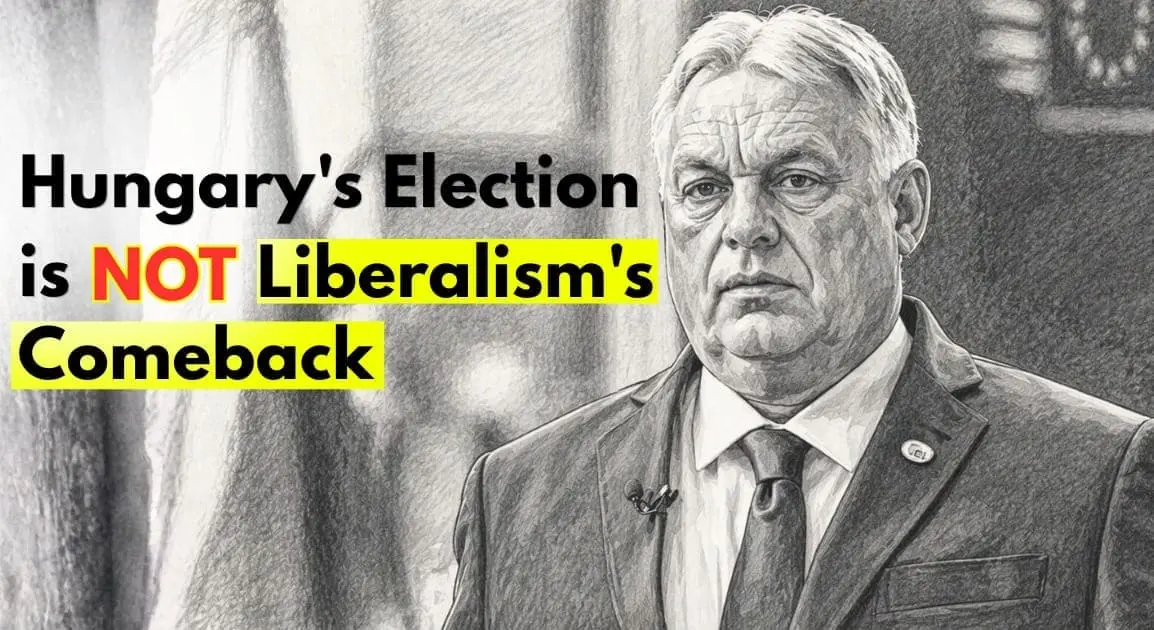
For over a decade and a half, Viktor Orbán stood as one of the most consequential and controversial leaders of Europe, a figure who reshaped Hungary into what he openly described as an “illiberal democracy.” His dominance seemed unassailable. Yet the 2026 parliamentary election has delivered a decisive rupture. Hungary’s voters, in record numbers, have brought an end to Orbán’s 16-year rule, handing a sweeping mandate to Péter Magyar and his Tisza party.
The scale of the defeat was striking. Magyar’s party secured a two-thirds parliamentary majority, enough not merely to govern, but to dismantle the legal and institutional architecture Orbán painstakingly constructed. This was no narrow electoral upset; it was a systemic rejection. Turnout reached nearly 80 percent, the highest since Hungary’s democratic transition in 1990, underscoring the sense of resolve and urgency among voters.
Orbán’s fall reflects the limits of a political model that fused nationalism, cultural conservatism, and centralized control. While admired by segments of the global right, his domestic coalition ultimately fractured under the weight of economic stagnation, corruption allegations, and institutional fatigue. The election was widely seen not simply as a contest of parties, but as a referendum on Hungary’s political direction: between entrenched illiberalism and a renewed engagement with democratic norms.
The Anatomy of an Illiberal Regime
To understand the magnitude of this electoral shift, one must examine the system Orbán built. Since returning to power in 2010, his party, Fidesz, systematically restructured Hungary’s institutions. Electoral laws were rewritten, judicial appointments centralized, and much of the media landscape brought under pro-government control.
This transformation did not eliminate democratic processes; elections continued, opposition parties operated, and protests took place. Yet the playing field was profoundly uneven. Hungary was described as a hybrid regime; neither fully authoritarian nor meaningfully liberal. Orbán’s government framed this model as a defense of national sovereignty against external pressures, particularly from the European Union.
The paradox of Orbán’s Hungary lay precisely in this coexistence of control and contestation. Even as civil society space narrowed, dissent persisted. Demonstrations in Budapest, sometimes in front of Parliament, challenged policies ranging from judicial reforms to restrictions on LGBTQ+ rights.
The existence of a “gay cruise bar” in the country reflects this tension rather than a contradiction. Hungary under Orbán did not eliminate LGBTQ+ existence or spaces outright; rather, it sought to marginalize them politically and culturally. Anti-LGBTQ legislation, including attempts to restrict Pride events, coexisted with a degree of urban social pluralism, particularly in Budapest. This duality allowed the government to claim democratic legitimacy while advancing policies widely criticized as discriminatory.
In effect, Orbán’s system was not a dictatorship in the classical sense. It was more subtle and, arguably, more resilient: a managed democracy where formal freedoms existed, but their substance was eroded.
Why Hungarians Turned Against Orbán
The decisive rejection of Orbán cannot be reduced to a single cause. It emerged from the convergence of economic frustration, governance failures, and a growing perception of systemic corruption. Hungary’s economic performance had deteriorated in recent years. Growth slowed sharply, inflation surged, and public services—from healthcare to infrastructure—showed signs of strain. For many voters, the promise of stability that once underpinned Orbán’s appeal had given way to stagnation.
Equally significant were corruption scandals that increasingly implicated figures close to the government. Reports of elite excess, symbolized by revelations about lavish estates linked to Orbán’s inner circle, resonated deeply in a society grappling with declining living standards.
Yet perhaps the most decisive factor was political fatigue. After 16 years, Orbán’s governance came to be associated not just with authority, but with inertia. His messaging, centered on migration, cultural identity, and external threats, began to lose its potency in the face of everyday economic concerns.
Magyar’s campaign capitalized on this shift. A former insider of the Fidesz system, he positioned himself not as a radical outsider, but as a reformist corrective. His emphasis on anti-corruption, administrative competence, and restoring public services allowed him to build a broad coalition that transcended traditional ideological divides.
Notably, Magyar did not fully repudiate conservative positions on issues like migration. Instead, he reframed the political debate away from cultural polarization toward governance and accountability. This strategic recalibration proved effective in a country where right-leaning sentiments remain significant.
Europe, the United States, and the Limits of Populist Solidarity
Orbán’s Hungary was not merely a domestic project; it was a node in a wider international network of right-wing populism. He cultivated close ties with leaders and movements that shared his skepticism of liberal democracy and supranational institutions.
In this context, the involvement of U.S. political figures, particularly support from elements aligned with US President Donald Trump and particularly the Vice President JD Vance himself, was notable. Orbán was often celebrated abroad as a model of conservative governance, and his election became a symbolic battleground in the broader contest between liberal and nationalist visions of politics. Yet this external endorsement failed to translate into domestic advantage. If anything, it may have reinforced perceptions that Orbán’s priorities were increasingly detached from Hungary’s immediate concerns.
The European Union, meanwhile, loomed large over the election. Relations between Budapest and Brussels had deteriorated significantly under Orbán, with billions of euros in EU funds frozen over concerns about rule of law and democratic backsliding.
Magyar’s victory has been interpreted across Europe as an opportunity for reset. His government is expected to pursue a more cooperative relationship with the EU, potentially unlocking substantial financial resources critical for economic recovery.
The election thus carries implications far beyond Hungary. It signals that even entrenched populist regimes are not immune to electoral reversal—and that international alliances cannot compensate for domestic discontent.
A Broader Political Signal: Are Voters Moving On?
Hungary’s election invites a larger question: are voters globally beginning to tire of hard-right, anti-pluralistic politics? The answer is complex, but the Hungarian case offers suggestive evidence.
Orbán’s model, characterized by anti-immigrant rhetoric, skepticism toward liberal institutions, and a strong emphasis on cultural homogeneity, once appeared ascendant. It influenced political movements across Europe and beyond. Yet its durability depended on delivering tangible improvements in citizens’ lives.
When that promise faltered, the ideological appeal proved insufficient. Hungarian voters did not suddenly embrace liberalism in the abstract; rather, they prioritized governance, transparency, and economic stability over identity-driven politics.
This distinction really matters. The backlash against Orbán is less a wholesale rejection of conservative values than a repudiation of their instrumentalization in service of entrenched power. Magyar himself reflects this nuance: a conservative reformer rather than a liberal revolutionary.
At the same time, the election underscores the resilience of democratic mechanisms—even within constrained systems. Despite media imbalances, institutional capture, and concerns about electoral fairness, Hungarian voters were able to effect meaningful change through the ballot box.
The Road Ahead: Reform, Resistance, and Uncertainty
The fall of Orbán marks a turning point, but not a resolution. Magyar inherits a state deeply shaped by his predecessor’s legacy—politically, institutionally, and culturally.
Reversing this legacy will not be straightforward. Many key institutions remain staffed by Orbán loyalists, and constitutional changes may face both legal and political obstacles. The risk of institutional resistance is real, as is the possibility of political polarization intensifying during the transition.
Economically, the new government faces immediate pressures. Restoring growth, addressing public service deficits, and managing fiscal constraints will test its capacity to translate electoral momentum into tangible outcomes.
Yet there are also grounds for cautious optimism. The prospect of renewed engagement with the EU and the release of frozen funds offers a pathway to economic stabilization. More broadly, the election has reinvigorated Hungary’s democratic imagination, demonstrating that even long-dominant leaders can be challenged and defeated.
Ultimately, Hungary’s 2026 election is not merely a national story. It is a reflection of a broader democratic recalibration: one in which voters, confronted with the lived realities of governance, reassess the appeal of populist narratives.
Orbán’s Hungary showed how democratic institutions can be reshaped from within. Magyar’s victory now poses the inverse challenge: whether they can be restored with equal determination.
