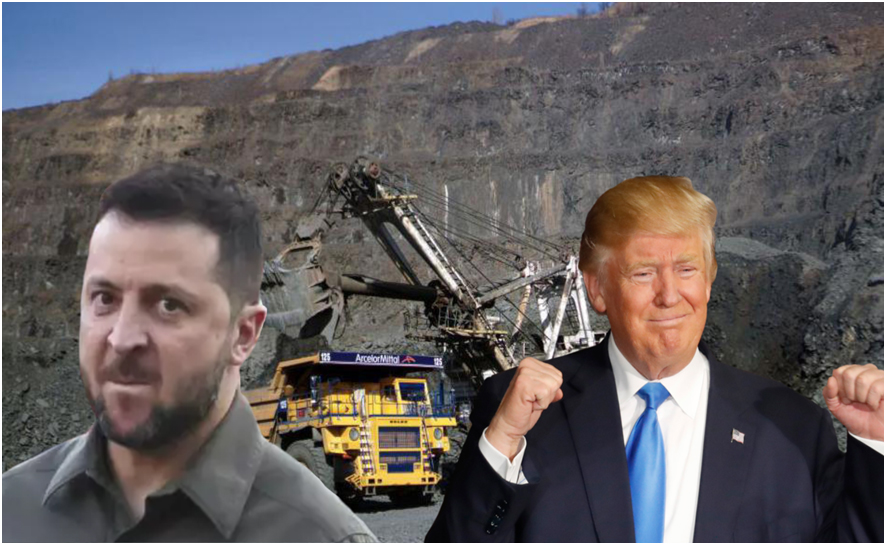
After weeks of tense negotiations characterized by public disagreements and diplomatic pressure, the United States and Ukraine signed the “United States-Ukraine Reconstruction Investment Fund” agreement on April 30, 2025. This deal emerged after a period of strained relations between President Trump and President Zelensky, with both sides engaging in confrontational rhetoric before reaching a compromise that clearly reflected the power imbalance between the two nations.
A Relationship Under Strain
The path to this agreement was marked by an unfortunate diplomatic friction. Early drafts reportedly demanded that Ukraine repay approximately $500 billion to the United States for previously provided military aid through mineral rights transfers, a proposal Zelensky characterized as asking him to “sell my country.” This led to a notably contentious Oval Office meeting in February where, according to reports, heated exchanges occurred and Trump labeled Zelensky “a dictator” after the Ukrainian president rejected initial terms.
The relationship deteriorated further just after the Oval Office meeting when the Trump administration halted aid to Ukraine – a critical lifeline for the war-torn country, creating substantial leverage over Kyiv as negotiations continued. This suspension of military assistance during an active conflict effectively forced Ukraine back to the negotiating table, highlighting the asymmetric power dynamics underlying the talks.
From Rejection to Acquiescence
Zelensky initially took a strong public stance against the early proposals, rejecting them outright and seeking to rally international support. President Zelensky rallied for Europe’s support. However, the Ukrainian position softened considerably as the conflict with Russia continued, American aid remained suspended, and no sign of help originating from Europe. Faced with the reality of dwindling supplies and an uncertain European alternative, Ukrainian officials pivoted to portraying even modest improvements to the agreement terms as significant victories.
Ukrainian Economy Minister Yulia Svyrydenko’s statement that “All resources on our territory and in our territorial waters belong to Ukraine” reflects this attempt to frame the agreement as preserving sovereignty, despite the document containing multiple provisions that effectively limit Ukraine’s autonomous decision-making in resource development.
The Final Agreement: A Balance Sheet
What Ukraine Secured
- Formal Resource Sovereignty: The agreement acknowledges Ukraine’s legal sovereignty over its natural resources, though this is constrained by numerous preferential rights granted to the US.
- No Direct Reimbursement: Ukraine avoided having to explicitly “pay back” past military aid, with the agreement instead structuring future assistance as investment contributions.
- Recognition of EU Aspirations: The document acknowledges Ukraine’s candidate status for EU membership and provides for renegotiation if accession occurs. However, no such assurance is provided for the NATO membership.
- Anti-Russia Language: The agreement identifies Russia as the aggressor, contradicting some of Trump’s earlier statements.
What Ukraine Conceded
- Preferential Resource Access: Ukraine granted the US preferential rights to invest in and purchase natural resources without securing the security guarantees it initially demanded. It can also be seen as an indirect sovereignty loss of Ukraine on its critical minerals.
- Legal Supremacy: The agreement explicitly states that in case of conflict between Ukrainian law and the agreement, “this Agreement shall prevail to the extent of the inconsistency,” effectively creating a carve-out from Ukrainian legal sovereignty.
- Tax Exemptions: All partnership income and transactions are exempt from Ukrainian taxes, potentially reducing the national benefit from resource development.
- Mandatory Investment Opportunities: Ukraine committed to requiring all natural resource licensees to provide partnership investment opportunities, limiting the country’s ability to independently develop these sectors.
Financial Structure and Power Imbalance
The partnership’s financial structure reflects the unequal bargaining positions:
- Ukraine’s Contribution: Ukraine contributes “an irrevocable right to receive the Ukraine Agreed Revenue” from designated resource projects, effectively pledging future national income.
- US Contribution: The US primarily contributes through future military assistance, stating that “If, after the Effective Date, the Government of the United States of America delivers new military assistance to the Government of Ukraine in any form… the capital contribution of the U.S. Partner will be deemed to be increased by the assessed value of such military assistance.”
This structure effectively transforms what would otherwise be military aid into an investment stake, potentially allowing the US to recoup value from assistance that might previously have been provided without such expectations of return.
The Security Guarantee Impasse
Perhaps the most meaningful Ukrainian concession was dropping demands for explicit American security guarantees. During the February Oval Office confrontation, this was reportedly a major point of contention, with Trump refusing to provide guarantees and insisting that Ukraine sign the resource agreement first. As the Ukrainian negotiating position weakened with the aid suspension, Kyiv ultimately accepted a deal without these protections.
Ukrainian officials have since attempted to reframe this concession, suggesting that American investment will naturally create security interests. However, no binding security commitments exist in the document, representing a clear retreat from Ukraine’s initial position.
Investment Rights and Market Access
The agreement grants substantial economic privileges to the US:
- Investment Opportunity Rights: Any entity receiving Ukrainian licenses for natural resource development must make investment information available to the partnership and cannot offer better terms to third parties.
- Market-Based Offtake Rights: The US secures preferential rights to purchase resources, with restrictions on offering better terms to other parties.
- Counterparty Restrictions: Ukraine agrees to limit who its licensees can sell resources to, likely targeting Russian entities.
These provisions collectively grant the US privileged access to Ukraine’s resource wealth while limiting Ukraine’s freedom to develop independent commercial relationships.
Practical Implementation Challenges
The agreement faces significant practical challenges that raise questions about its actual implementation:
- War Zone Development: Many valuable Ukrainian mineral deposits are in territories affected by conflict, making immediate development implausible. Eventually, it may end on the side of Russia, if Russia takes over the territories.
- Technical Feasibility: As experts like Gavin Mudd of the Critical Minerals Intelligence Centre have noted, developing rare earth minerals would “take years to ramp up capacity” including studies, mining infrastructure, and refinery construction.
- Capital Requirements: The agreement focuses on new development projects requiring substantial investment before generating returns, creating uncertainty about the timeline for economic benefits.
These realities suggest the agreement may deliver fewer immediate benefits than publicly portrayed, particularly to Ukraine, while the US gains strategic positioning in a resource-rich region.
Geopolitical Context and Implications
The agreement emerges against a complex geopolitical backdrop:
- Stalled Peace Process: Despite Ukraine accepting a US-proposed 30-day ceasefire, Russia has rejected it, with deadly attacks continuing even as the resource deal was signed.
- EU Relations: While the agreement acknowledges Ukraine’s EU aspirations, questions remain about whether some provisions might complicate the accession process through constraints on resource development policies.
- American Domestic Politics: For the Trump administration, the deal allows for continued support to Ukraine while framing it as an investment rather than aid, addressing domestic political concerns about foreign assistance.
Legal Framework and Sovereignty Questions
Several provisions raise questions about the agreement’s impact on Ukrainian sovereignty:
- Legal Precedence: The explicit statement that the agreement prevails over contradictory Ukrainian law represents a significant limitation on national legislative authority.
- Implementation Requirements: Ukraine commits to “adopting, maintaining, and enforcing legislation as may be required to execute and implement this Agreement,” binding future governments to the current administration’s decisions.
- Dispute Resolution: All disputes are to be resolved through “mutual consultation” rather than independent arbitration, potentially advantaging the stronger party.
Divergent Narratives
Both sides have presented differing narratives about the agreement:
US Treasury Secretary Scott Bessent characterized it as a “historic economic partnership” that “signals clearly to Russia that the Trump Administration is committed to a peace process centered on a free, sovereign, and prosperous Ukraine.”
Ukrainian officials, having retreated from earlier opposition, now emphasize that the final terms are significantly better than earlier proposals, with Economy Minister Svyrydenko highlighting that “It is the Ukrainian state that determines where and what to extract.”
These competing narratives reflect the complex domestic political considerations in both countries and attempts to present the agreement in the most favorable light to respective constituencies.
Economic Realities and Future Prospects
The agreement’s economic value remains uncertain:
- Resource Potential: While Ukraine possesses significant mineral wealth, including titanium, lithium, graphite, and rare earth elements, developing these resources requires substantial investment and time.
- Revenue Timeline: Analysts from Capital Economics note that actual resource development will take years, meaning any significant economic benefits for either party lie in the medium to long term.
- Reconstruction Funding Gap: The agreement provides a framework for potential investment but does not directly address Ukraine’s immediate reconstruction needs, estimated at hundreds of billions of dollars.
Conclusion
The United States-Ukraine Reconstruction Investment Fund agreement represents the outcome of an uneven negotiation process where Ukraine, facing suspended military aid during an active conflict, ultimately accepted terms that grant the United States significant economic privileges in exchange for continued support. While the final agreement does contain improvements from Ukraine’s perspective compared to early drafts, it nonetheless reflects the considerable leverage the US wielded throughout negotiations.
The agreement establishes a framework for resource development that maintains Ukraine’s formal sovereignty while imposing substantial constraints on its economic decision-making. Whether this represents a fair partnership or a deal born of necessity will likely remain a point of debate, but what’s clear is that the agreement emerged not from equal negotiating positions but from the geopolitical and military realities and coercive diplomacy confronting a nation at war seeking support from a much more powerful ally with its own strategic and economic interests at stake. Overall, Ukraine is losing its territorial sovereignty to Russia in the war and mineral sovereignty to the US due to the war.