

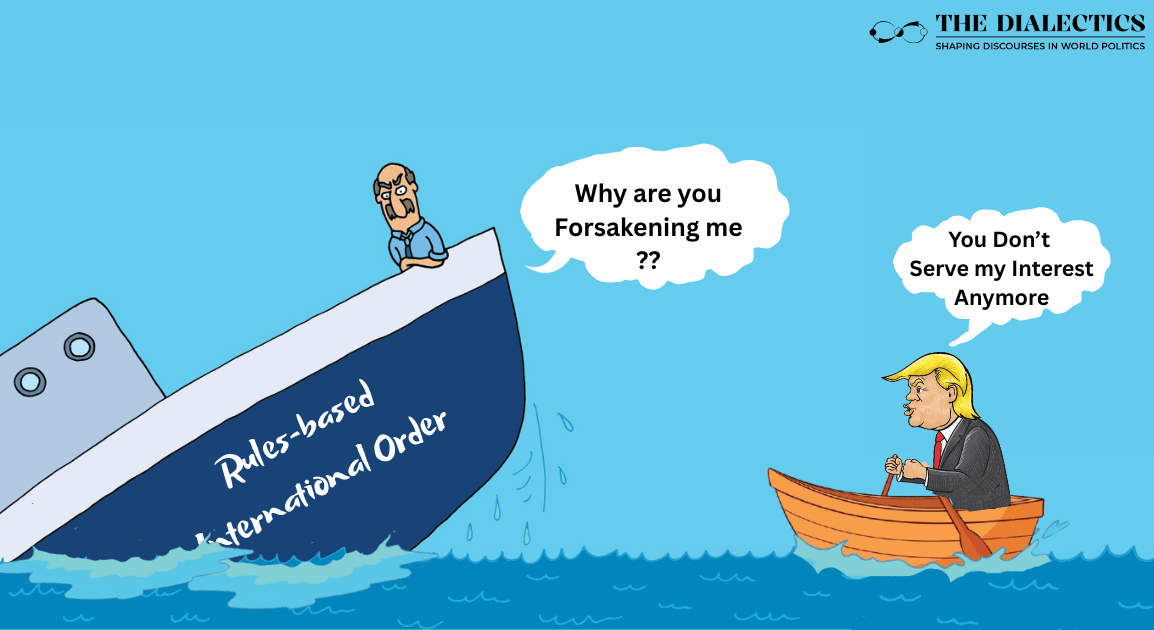
The reported US military action against Venezuela—culminating in the capture of President Nicolás Maduro and his transfer to New York for trial—marks a defining rupture in contemporary international politics. It is not merely an act of regime coercion; it is a direct assault on the foundational principles of the post-1945 international order. A sovereign state was attacked, its elected head of government detained, and domestic US law was imposed extraterritorially through force. This single act collapses the moral and legal pretence on which the so-called “rules-based international order” has long rested.
The gravity of this moment lies not only in what the United States has done, but in what it represents: the leading architect and enforcer of international law has chosen to openly violate it. When the guardian becomes the breaker, the system ceases to function as a system. What remains is power, stripped of normative restraint.
The Death of the Rules-Based Order
For decades, the United States and its Western allies have projected themselves as custodians of international law, the UN Charter, and liberal norms such as sovereignty, non-intervention, and territorial integrity. These principles were selectively applied, but at least rhetorically upheld. The Venezuela episode ends even that selective commitment.
Article 2(4) of the UN Charter prohibits the use of force against the political independence or territorial integrity of any state. The forcible capture of a sitting president violates not only this provision but also basic diplomatic and legal conventions. There is no credible international mandate, no UN Security Council authorisation, and no universally accepted legal framework that justifies such an action.
When the US undermines these norms, it does more than weaken international law—it delegitimises it. Other states are no longer morally or politically compelled to respect rules that even their creators discard when inconvenient.
For Further Reading : Can the US legally Strike Iran ?
From Order to Anarchy
This incident reinforces a structural shift already underway: the transition from a rule-governed international order to a condition approaching anarchy, as described in classical realist theory. In such a system, power—not law—becomes the ultimate arbiter.
International politics is increasingly characterised by powerful states openly breaking rules they once championed. The message is unambiguous: laws and norms are instruments, not constraints. They are observed when they serve national interest and abandoned when they do not.
This is not an accidental breakdown. It is a conscious recalibration by declining powers, particularly the US, which finds existing norms inadequate to preserve its primacy in an increasingly multipolar world.
Great Power Behaviour
Traditional theories define great powers by measurable attributes—population, military strength, economic capacity, technological advancement, and soft power. These remain relevant, but they are no longer sufficient.
Two additional criteria now define great power status in practice:
- First, the capability and willingness to undermine international law, rules, and norms to secure one’s interpretation of national interest.
- Second, the ability to dominate one’s immediate region and prevent external interference.
By these standards, great power behaviour across the globe follows a clear and consistent pattern.
The United States and Its Backyard
The US has long enforced the Monroe Doctrine in practice, if not in name. Latin America is treated as Washington’s exclusive sphere of influence. From coups during the Cold War to sanctions, regime-change operations, and now direct military intervention, the message remains unchanged: no external power will be allowed to shape outcomes in the Western Hemisphere. Venezuela, with its vast oil reserves and defiance of US influence, has long been a target. The capture of Maduro represents the most explicit assertion yet that sovereignty in America’s “backyard” exists only at Washington’s discretion.
Further Reading: The World Must Realise, Latin America is not a Backyard of the US
Russia, Ukraine, and the Logic of Force
Russia’s invasion of Ukraine in 2022 similarly violated international law and Ukraine’s territorial integrity. Moscow justified its actions through security concerns, NATO expansion, and historical claims. These arguments do not legalise the invasion, but they reveal the same logic: great powers reserve the right to use force in regions they consider vital to their security.
Russia acted not because international law failed, but because it calculated that power mattered more than legality.
China and the South China Sea
China’s conduct in the South China Sea follows the same pattern. Despite adverse rulings under international maritime law, Beijing has militarised disputed features, rejected arbitration, and imposed its claims through facts on the ground.
Here again, law bends before power. Regional dominance takes precedence over global norms.
Israel and West Asia
Israel’s repeated military actions in Gaza, Syria, Lebanon, and strikes linked to Iran further illustrate this reality. These operations often bypass international legal scrutiny, protected by geopolitical alignments and veto politics. Strategic necessity is invoked to justify actions that routinely violate established norms.
The result is not accountability, but normalisation of exception.
Sam, Daam, Dand, Bhed: An Indian Lens
Indian political philosophy offers a strikingly honest framework to understand this behaviour. Kautilya’s concept of Sam (conciliation), Daam (inducement), Dand (coercion), and Bhed (division) recognises that states pursue interests through multiple means, including force and deception.
Great powers do not rely on one method alone. They negotiate when possible, bribe when useful, coerce when necessary, and divide when advantageous. The difference between rhetoric and reality lies in who admits this truth. The West preaches morality while practising Kautilya without acknowledging him.
The Hypocrisy Cost
The long-term cost of such hypocrisy is systemic erosion. Smaller states lose faith in international institutions. Middlepowers hedge. Alliances become transactional. Arms races intensify. Nuclear deterrence regains centrality.
Most dangerously, the moral high ground disappears. When the US condemns violations elsewhere, its words ring hollow. When international law is invoked, it is seen as a political weapon rather than a neutral framework.
What This Means for the World—and India
For countries like India, this moment demands strategic clarity, not moral outrage alone. The lesson is stark: sovereignty is ultimately protected by capability, not principle. Law matters, but only when backed by power. India must strengthen its comprehensive national power, dominate its neighbourhood with strategic responsibility, and engage international law pragmatically rather than idealistically. Principles should guide policy, but illusions must not replace preparedness.
Power Has Spoken
The capture of Venezuela’s president is not an aberration; it is a revelation. The international order was never purely rules-based—it was power-based with rules layered on top. Today, even that layer is peeling away.
The world is entering an era where great powers no longer pretend. They act, and justify later—or not at all. In such a world, understanding power as it is, not as it is preached, becomes the first requirement of serious statecraft.
The rules are breaking because their makers no longer believe they need them.
For Further Reading: Difference Between International Order and World Order


