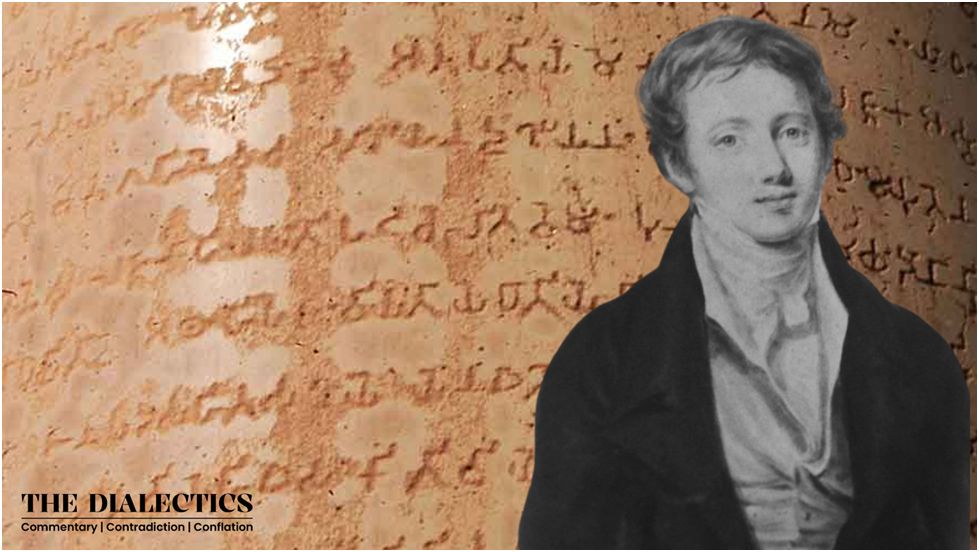
Imagine a man whose ancestors, his father and grandfather, have lived in a country for centuries, yet he remains oblivious to the rich past buried beneath the soil of his homeland. He is unaware of his historical legacy or the political heritage that shaped his land. When invaders from foreign lands arrive and tell him that he is uncivilized and inferior, he has no choice but to believe them. That is, until one day a groundbreaking discovery reveals to him the rich cultural and historical legacy of his people, a revelation so profound it shakes the foundations of history and ignites a spark in those yearning for freedom. A cry for self-identity awakens in him; the call of his forefathers’ rings in his ears, urging him to fight for independence from foreign rule. The identity, once hidden and unknown to him, goes far beyond the one imposed upon him by those who were once strangers to his land. A British man unearths the mysteries of ancient Bharat One might wonder if it sounds like the plot twist of a movie. Yet, this very event unfolded in the country of India, and it happened to the Indian people themselves. The Indians were given the connotation of a tribal uncivilized people by the Britishers. The Indians unaware of the ancient civilization were told by the British that they were inferior to them, and it was for the good heart of the British that they were civilizing the Indians, which they termed as “the white man’s burden” to justify their colonial rule on India. The British believed that Indians had no significant historical background and no real identity, but it was for a British man who proved this wrong. Who was he? Where did he come from? What was the groundbreaking discovery that led and sparked nationalism in the hearts of oppressed Indians who had a newfound identity and a legacy to be proud of? James Prinsep wanted to be an architect but an eye infection nearly blinded him and he lost the opportunity to pursue that career and came to India perhaps to pursue what had already been destined. James Prinsep was an epigraphist even before it was a formal discipline. We can perhaps revere him as an English personnel with outstanding brilliance. He had deep interest in fields in which he had no formal training and contributed massively in a variety of fields including civil engineering, meteorology, mining, metallurgy, town planning, architecture, geometry, mathematics, astronomy, natural sciences, anthropology, and archaeology disciplines like epigraphy, numismatics, and history. Not so ordinary Assay master lands in India James Prinsep left a legacy behind him. In his short span of 41 years, he laid the foundation for the study of Ancient Indian History. James Prinsep came to India on 15th September 1819 at the age of 20 to work as an Assay master at the Banaras Mint after joining the service of the East India Company. He joined as a Deputy Assay Master at the Calcutta Mint and remained as the chief of the Calcutta Mint till 1833 but he had to return to England due to a life-threatening illness. While working in the mint as an assay master what he did was remarkable, the deciphering of the two Indian Ancient scripts which had long been forgotten. He opened the keys to the vast empire of Ashoka. There are different sources through which one can connect the dots and find out about the history of a civilization. It can be done through sources left behind such as material remains, pottery, inscriptions, artifacts, monuments, manuscripts, art, etc. But it is for the inscription of that era that holds the keys to the complete understanding of socio-political, economic life of the people belonging to a particular civilization or an empire. For example, we don’t know much about the Indus Valley civilization. Through the material remains we can identify the town planning, and the areas where people had inhabited and lived, through the remains we can understand the agricultural aspect, and the drainage system, through the coins found we can understand that trade was practiced. Even after the discovery of the Indus Valley civilization, the decline of the civilization remains a huge mystery and still baffles historians. We have no clue who these people were, what religion they followed, or what kind of political system was there as the script of the Indus valley remains undeciphered. Imagine the history that we could have been able to restore if we had deciphered the clues that the Indus people had left behind through their writing and the entire civilization would have been deeply understood. Hence the script and the inscriptions are clues to the great lives of the people who lived before us, it is a way to preserve the legacy of that period. The stick Figure Script comes into picture The same happened with what was called the “Stick Figure Script” which hid the secrets of the Ancient Indian Mauryan Empire which is now known as “the Brahmi script”. What did the unique letters compiled together that made the oldest script of South Asia contain? Well, an Entire history of the great King Ashoka and the mighty Mauryan empire that he built, he went by the name Piyadassi– pleasant to behold in these inscriptions. Now one might wonder what an assay master of a mint has to do with an Indian script and its deciphering. Let us explore what led Prinsep down this remarkable path. to the discovery of the Ashokan empire. In 1830, Prinsep’s position in Calcutta marked a turning point in his academic career. His scientific inclination led him to collaborate with the Asiatic Society of Bengal, where he played a crucial role in the establishment of “Gleanings in Science”. During this period, the society served as the primary repository for historical and scientific materials contributed by Europeans in government or private roles, further establishing Prinsep’s reputation in academic and scientific circles. Prinsep’s incredible journey with...
The Man Who Cracked the Code: James Prinsep and the Ancient Scripts