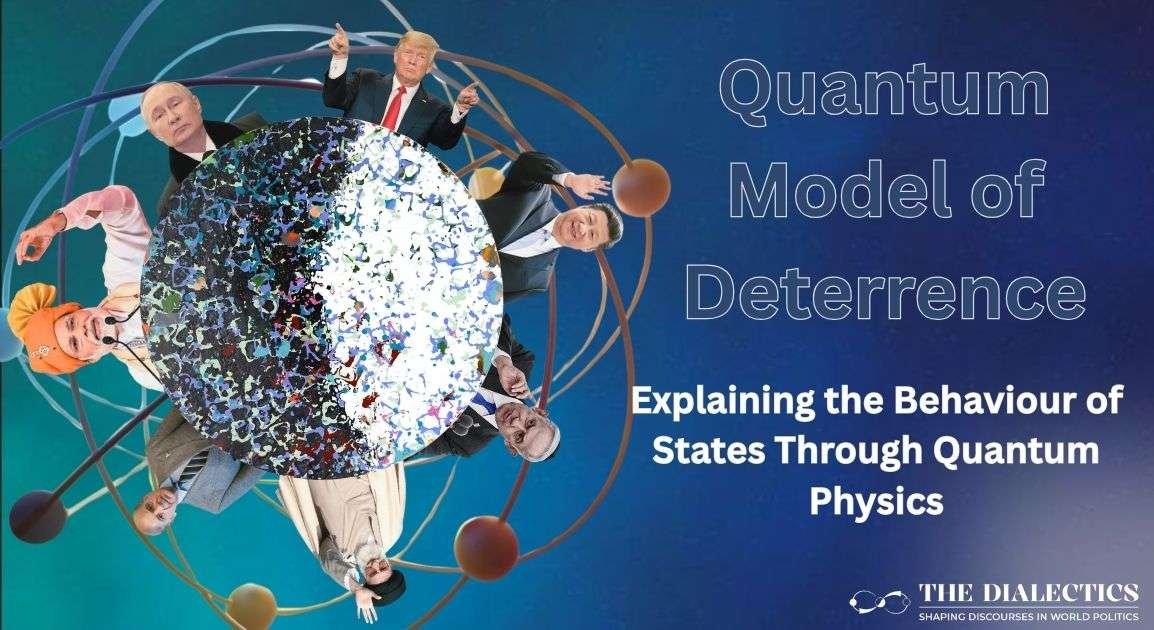
As a Student or Practitioner of International Relations, one must have read and applied various concepts that explain the behaviour of states. Cobweb, billiards ball model, game theories, system theories and what not. All these have tried to understand and explain the behaviours of the states. This article too tries to understand the behaviour of states but through a different lens. And this lens is applied by none or may be very few, could also be in a nascent stage. That is analysing and understanding the behaviour of states, particularly deterrence, through the tenets of Quantum physics.
The logic of deterrence was built on classical physics—linear, predictable, and reasonable. If you have the power to retaliate, no one will strike first. Stability is supposed to come from strength.
But the world has changed a lot since then. Power is distributed among diverse actors; technologies exhibit increased interdependence and unpredictability; and geopolitical signals are interpreted through fragmented narratives rather than the precise clarity of a bipolar fight. This loss of linearity is causing what is called the quantum paradox of deterrence. In this state, force meant to protect also destabilizes, certainty and uncertainty coexist, and deterrence itself acts as both a shield and a provocation, depending on how it is seen.
This paradox reflects the behavior of quantum particles, which can function as both waves and particles at the same time. Perception and signaling affect geopolitical reality in the same way that observation alters quantum systems. Strategic power no longer ensures predictable results. Instead, it produces overlapping, entangled, and occasionally contradicting results.
The First Quantum State: Stability and Instability coexist

In classical deterrence, states are classified as secure or insecure. In a quantum deterrence reality, they exist at the same time. A nuclear arsenal may provide security to a state’s leadership, but its mere existence causes instability in another’s strategic calculus. However, for another state, generally an adversary or rival, the same armament puts uncertainty into its strategic calculus. Even if no new weapon is fired, it loses its sense of security. This dual sense of stability and insecurity is not a theoretical anomaly; it is an experienced strategic reality.
A nice example is seen in South Asia. India’s modernization of strategic capabilities has been portrayed as a defensive move to maintain deterrence stability. However, in Islamabad, the same efforts are viewed as escalatory, prompting responses and greater investment in tactical nuclear weapons. Everyone thinks they are protecting themselves, but they are only making each other more uneasy. This dynamic is not limited to South Asia. Similar cycles can be witnessed between the United States and China over strategic technology, as well as between Russia and NATO over Eastern European missile deployments.
This is the geopolitical counterpart of quantum superposition: two states with competing security perceptions at the same time, both legitimate and consequential. One city thinks that a missile system will keep it safe, while another thinks it will attack. Strategic comfort and strategic worry are very similar, like quantum states that are in the same physical place yet create different realities.
Also, this superposition doesn’t just exist; it feeds on itself. The more power accumulated on one side, the more vulnerable the other feels—and the cycle continues. Instead of reducing insecurity, deterrence forces agents into an unstable equilibrium, similar to particles caught in an indeterminate state. States increase their arsenals to promote stability, but each new step adds another layer of vulnerability to the system.
The Second Quantum State: Entanglement of Threat and Trust

In quantum physics, entanglement happens when two particles are so closely coupled that the state of one affects the state of the other, no matter how far away they are. Deterrence operates in surprisingly similar ways. When two competing nations enter a deterrence dynamic, be it nuclear or otherwise, their security choices become irrevocably interconnected. When one side upgrades its weapons systems or tests a new capability, the other replies almost immediately, triggering an undetectable but powerful chain reaction. This can happen in classic nuclear postures, as well as in cyber deterrence, autonomous weapon development, and the race for quantum technologies. Even without explicit coordination or intent, the structure of deterrence incentivizes synchronized action.
The Cold War arms race between the United States and the Soviet Union is perhaps the best-known example of this entanglement. When Washington deployed multiple independently targetable reentry vehicles (MIRVs), Moscow launched its own upgrade program. Years later, when Moscow pursued strategic missile defense, Washington responded with new offensive weapons. The cycle was unrelenting and structurally embedded—the two powers were more than just enemies; they were strategic reflections of one another.
Similar trends may be seen in the current conflict between the United States and China. Beijing sees Washington’s Indo-Pacific strategic posture as encirclement, although being presented as deterrence. China’s rapid naval expansion and missile upgrading are justified internally as defensive but regarded abroad as threatening. Both actors are now caught in a deterrent loop that neither fully controls, despite their participation in generating it.
Entanglement indicates that threat and trust are connected. The identical move intended to provide assurance can result in defensive escalation elsewhere. Even when no one intends a clash, the system acts as if escalation is unavoidable. This is the hidden physics of deterrence: once states are entangled, perception, not capability, determines strategy.
The Third Quantum State: Observation Alters the System
One of the most exciting aspects of quantum physics is that observation changes the behavior of a system. In geopolitics, signaling power has a similar impact: it alters the fundamental essence of security.
A missile launch intended to “reassure” domestic audiences is misinterpreted as an aggressive escalation by a competitor. A military exercise presented as ordinary defense preparedness is viewed as power projection. A deterrence posture designed to prevent war can resemble an aggressive buildup. The observer interprets information to construct a new strategic reality, rather than simply receiving it.
This is why deterrence needs both clear and unclear messages. If you communicate too much about your unique strategic goals, skills, or limitations, it can be easier for others to get around or change your mind about what you want to do. But being too vague could be dangerous and make it hard to know what would happen, which could lead to mistakes or inaccurate guesses.
This is a really good parallel to Schrödinger’s cat. Deterrence is like the cat: it can be steady or unstable, alive or dead, until something happens that makes it one clear truth. A strong deterrent attitude can quickly become a destabilizing provocation if there is a crisis, a signal that is not understood, or a change in politics. This collapse of uncertainty is how deterrent crises frequently play out: not because someone fires the first shot, but because perception snaps into clarity.
Rethinking Deterrence in the Quantum World

The current strategic environment is significantly more fluid than the rigid bipolar world that characterized the Cold War. Power is distributed among various actors, both state and non-state, and developing technologies are establishing new realms of deterrence that are more entangled, unpredictable, and nonlinear than previous nuclear strategies.
Deterrence logic emerged in a period when policymakers presumed rational actors, consistent desires, and reasonably visible power dynamics. However, in today’s quantum strategic environment, perceptions, narratives, and interpretations are as important as capabilities. A single military drill can be interpreted as defensive, deterrent, or offensive, depending on who is viewing and through what lens.
Power is no longer just something you get; it’s something you make by being involved. This requires a novel approach to diplomacy. In the quantum age, we need to stop thinking of deterrence as a zero-sum game and create feedback systems that prevent perception spirals from happening. Arsenals can no longer provide strategic stability. It is predicated on interpretive stability—common understandings of aim, signaling clarity, and a strong crisis management architecture capable of absorbing shocks without collapsing into confrontation.
Track 1.5 and Track II conversations, which are unofficial and informal diplomatic exchanges, can be crucial in this context. Strategic signaling systems that ensure openness while not overexposing vulnerabilities are also possible. Crisis hotlines, coordinated statements, and arms control regimes can all serve to keep deterrence in place rather than collapsing—keeping governments in managed uncertainty rather than active hostility.
Power as Security and Power as Fragility
The quantum lens does not reject deterrence; instead, it reveals its dual nature. Ultimately, deterrence is a dynamic system rather than a rigid structure. It, like quantum systems, thrives on managing ambiguity rather than certainty. The job of modern diplomacy is not to erase this uncertainty—that is impossible—but to stabilize its effects, to keep the contradiction intact without allowing it to devolve into conflict.
The 21st century will be defined not by who has the most weapons, but by who best understands the paradox of power. The most heavily armed will not be stable, but rather those who can navigate the quantum landscape of deterrence with strategic agility, diplomatic skill, and perceptual clarity.
Deterrence has always involved more than just weapons. In the quantum age, it is about balancing perception and power, anxiety and reassurance, and fragility and stability—all in the same breath.