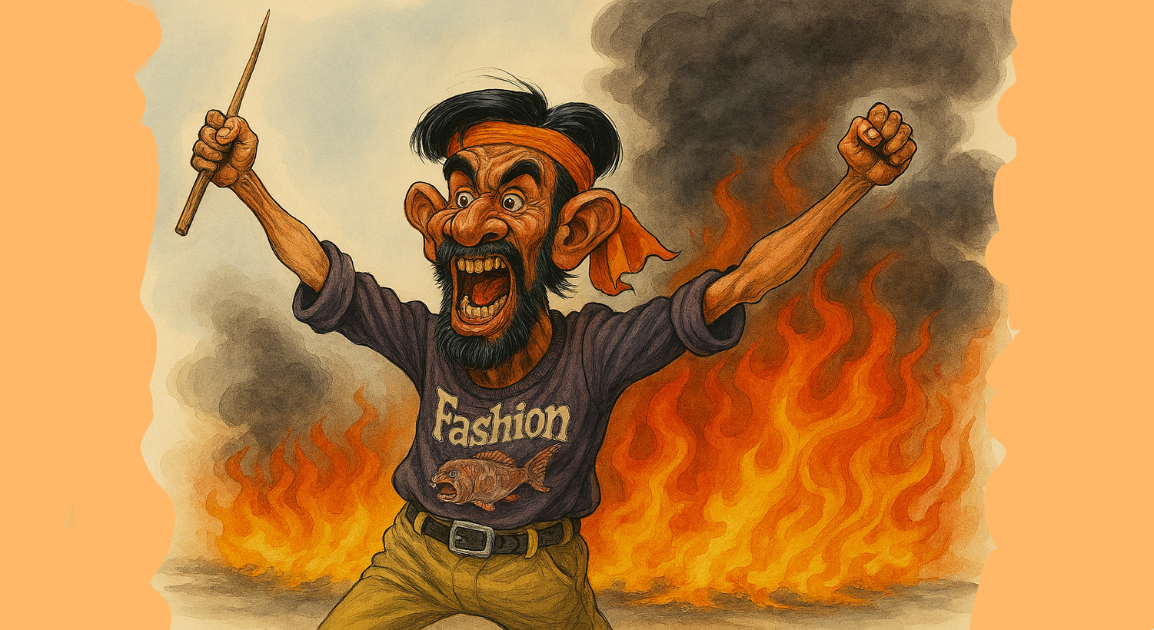
In contemporary India, the survival of the political right is no longer anchored in governance, delivery, or even ideological coherence; it is anchored in the continuous production of an enemy. This enemy is neither accidental nor emerging organically from social tensions. It is strategically assembled, carefully narrated, emotionally calibrated, and endlessly circulated. The logic is stark: without an enemy, the right wing stands naked before its own failures. Fear has become its most stable currency, hostility its most reliable campaign tool, and suspicion its most durable ideology.
Polarisation
To understand this, one must abandon the comforting illusion that polarisation is merely a byproduct of democracy. In India’s current political architecture, polarisation is a governing technique. It structures conversations, scripts media, trains bureaucracies, shapes police instincts, and disciplines public imagination. The nation is narrated not as a collective project of shared citizenship but as a besieged fortress surrounded by infiltrators. Inside this fortress, loyalty is never presumed, dissent is always treason, and minorities are perpetually provisional.
The brilliance of this political strategy lies in its capacity to transform weakness into strength. A government that struggles to deliver economic justice no longer competes on the terrain of material welfare. It shifts the terrain to symbolic survival. Instead of answering for unemployment, it manufactures cultural threats. Instead of addressing agrarian collapse, it stokes civilisational anxiety. Instead of fixing institutional decay, it discovers new internal enemies. The electorate is not asked, “What do you want?” but “Who must we protect you from?”
Muslims as Historical Injury
The process of enemy construction begins in the domain of memory. History is no longer read as a complex archive of coexistence, conflict, synthesis, and contradiction. It is compressed into a single wound. This move owes an intellectual debt to civilisational pessimism, including arguments associated with V. S. Naipaul, particularly his articulation of India as a “wounded civilisation” in India: A Wounded Civilization. In contemporary political discourse, this literary metaphor becomes political common sense. The wound is no longer a subject of healing; it becomes a permanent resource. The Muslim is positioned not as a historical participant but as the historical injury itself – a living reminder of defeat, humiliation, and stolen glory.
Majoritarian Politics needs an Internal Enemy
Here the argument must be made sharply: the right wing does not hate Muslims simply because of prejudice. It needs Muslims as a political technology. They function as an internal “other” – visible enough to be targeted, marginal enough to be contained, and symbolically potent enough to mobilise. Without this community being permanently available as a suspect population, the emotional economy of majoritarian politics collapses.
The enemy is never presented as completely external. External enemies can unify a nation in ways that stabilise democracy. Internal enemies fracture it in ways that fertilise authoritarianism. The Muslim, the dissenter, the leftist, the student protester, the civil rights lawyer -these figures are crafted as parasites within the body of the nation, not competitors in the marketplace of ideas. This internalisation of threat justifies extraordinary surveillance, extraordinary policing, and extraordinary violence, all while maintaining a theatrical commitment to constitutionalism.
The media does not simply report this enemy; it performs it. Prime-time debates have become dramaturgical rituals where conclusions precede evidence and verdicts precede trials. The visual grammar is that of a courtroom, the emotional grammar that of a battleground. The Muslim voice is rarely invited to explain; it is summoned to be interrogated. The activist is rarely heard; they are displayed as a warning. Over time, the audience internalises the logic: some citizens speak, others are spoken about. Some deserve empathy, others deserve suspicion.
At this point, the argument must deepen. This strategy is not only cynical; it is structurally rational. In a country marked by massive inequality, governing through policy would require redistributing privilege. Manufacturing enemies is cheaper. It allows elites to retain economic dominance while offering the masses symbolic power. The voter may not have secure employment or quality education, but they can participate in humiliation. They may not control policy, but they can share memes. They may not access justice, but they can chant slogans. Hatred becomes a democratised experience.
Hatred as a Democratised Experience
The survival logic of the right also demands constant escalation. Yesterday’s enemy loses potency. Fear, like any drug, requires higher doses. This is why the boundaries of suspicion keep expanding. Once Muslims were the primary target, now students are added. Once activists were peripheral, now they are central. Even institutions that were once respected – courts, universities, media – are pulled into the orbit of treachery the moment they resist. The enemy must be everywhere, because exhaustion is fatal to authoritarian populism.
This process also depends on turning the majority into a psychologically aggrieved community. This is perhaps the most perverse element: a socially dominant group is trained to feel like a perpetual victim. Historical defeats are exaggerated, symbolic humiliations are repeated daily, and imagined demographic threats are amplified. Through this inversion, aggression becomes defence. Lynching becomes sentiment. Hate speech becomes frustration. Discrimination becomes cultural self-preservation.
By now, the political economy of fear is firmly established. It does not operate through secret conspiracies; it operates through public rituals. Rallies become rehearsals. Social media becomes a training camp. Religious gatherings become political classrooms. A vocabulary of suspicion slowly replaces the language of rights. Words like “love jihad”, “urban Naxal”, and “anti-national” enter everyday speech not as metaphors but as assumptions.
Law is not immune to this transformation. Rather than standing above politics, legal frameworks increasingly absorb political paranoia. Preventive detention becomes routine. Evidence becomes optional. Due process becomes an inconvenience. The burden of proof silently shifts from the state to the accused – a tendency visible in the deployment of laws such as the Unlawful Activities (Prevention) Act – UAPA. This is not the collapse of legality; it is its repurposing.
Never ending Emotional Mobilisation
The most dangerous element of this architecture is not open violence, but quiet everyday normalcy. People get used to it. Fear becomes familiar. Suspicion becomes common sense. Outrage becomes entertainment. In such an environment, democracy does not die by coup. It dies by comfort with cruelty.
This politics is not about love for the nation. It is about the terror of complexity. A society too afraid to face its inequalities finds scapegoats. A state too weak to deliver justice finds enemies. A political project too hollow to inspire hope finds fuel in paranoia.
Why Economic and Policy Failures Doesn’t Influence Voting Behaviour ?
The right wing survives not by governing better, but by ensuring that citizens remain emotionally mobilised against someone, somewhere, always. In this model of politics, the enemy is not a temporary tool; it is a permanent institution. It must be continuously renovated, modernised, and emotionally refreshed. The right wing does not merely win elections through this process – it manufactures a psychological environment in which elections become secondary to existential belonging. Voting shifts from being a democratic act to a ritual of civilisational defence. The citizen is not choosing policies but aligning with a camp in an imagined war.
This is why the survival strategy is so resilient. Economic downturns, institutional failures, international embarrassment, and policy disasters do not weaken it in the way they would weaken a conventional political project. These failures are not denied; they are simply drowned. The informational landscape is flooded with symbolic threats so frequently that the human mind loses its capacity to hold more than one kind of urgency at a time. People are trained to see cultural survival as more urgent than material survival. Poverty can be tolerated; humiliation, as narrated by the political imagination, cannot.
When Dissent Equals Conspiracy
The right wing understands something deeply uncomfortable about modern politics: human beings are often mobilised more effectively through fear than through hope. Hope demands patience, organisation, and compromise. Fear demands only instinct. It bypasses complexity. It does not require evidence; it thrives on suggestion. In this sense, the political project is not anchored in arguments but in atmospheres. It does not want citizens who think; it wants citizens who feel threatened.
The technique is brutally efficient. Through repeated exposure, society internalises a narrative of permanent emergency. Every protest becomes a conspiracy. Every critical question becomes a foreign-funded attack. Every minority demand becomes a demographic plot. The language of governance becomes militarised. Ministers speak as if they are generals; policies are announced as if they are rescue operations. The ordinary citizen is turned into an informal foot soldier in a war that mostly exists in imagination but produces very real bodies, very real prisons, and very real graves.
There is an additional layer of cynicism that must be acknowledged. The right wing’s enemy-manufacturing is also a technology of elite protection. By directing popular anger horizontally towards minorities and dissenters, it prevents it from being directed vertically towards concentrated wealth and structural injustice. The poor are taught to blame the poorer. The anxious are trained to hate the marginal. The weak are encouraged to police those who are weakest. In this architecture, the actual designers of inequality remain untouched, unexamined, unthreatened.
Fear – A disciplined Political Art
The cultural industry plays a central role. Films, television serials, social media influencers, and digital propaganda do not simply reflect reality; they curate emotion. Through repetition, they construct an intuitive moral universe where some bodies look suspicious and some faces look patriotic. Over time, prejudice stops looking like prejudice. It starts looking like instinct. The manufactured enemy becomes a reflex.
This reflex reshapes everyday life. Housing discrimination is justified as “cultural preference.” Police excess is defended as “countless pressures.” Mob violence is reframed as “public anger.” Bureaucratic exclusion becomes “administrative delay.” The language never admits hatred; it launders it. Violence becomes respectable once it passes through the vocabulary of nationhood.
This is how the right survives not only at the ballot box but in the bloodstream of society. One must insist, forcefully, that this is not an organic process. It is not the natural evolution of culture. It is a disciplined political art. It has architects, technicians, financiers, and institutional allies. It circulates through WhatsApp forwards, party training camps, media strategy rooms, and digital troll armies. The political language of the street is not spontaneous; it is rehearsed.
How Majoritarianism Sustains
Argumentatively, the claim is simple and severe: contemporary Indian right-wing politics has no stable future without a permanent internal enemy. Its social base is too heterogeneous, its economic risks too high, its promises too thin to survive on performance. It survives by converting democracy itself into a soft civil war — never declared, never formally named, but always emotionally active.
The tragedy is that this strategy slowly poisons the very concept of the nation. When a nation needs enemies more than citizens, something foundational has already collapsed. When loyalty is measured by hatred rather than by solidarity, patriotism becomes indistinguishable from paranoia. When dissent is treated as infection, constitutionalism turns into theatre.
Yet, the most frightening aspect of this process is not the hatred of the powerful, but the participation of the ordinary. Ordinary people begin to anticipate the logic before it is delivered. They police language in advance. They self-censor compassion. They mock victims. They internalise the suspicion. At this point, the enemy no longer needs to be manufactured each day; society does the work itself. Authoritarianism is most stable not when it is feared, but when it is normal.
But Eventually Majoritarianism devours itself
The right wing’s survival strategy, therefore, is not merely electoral. It is ontological. It reshapes what people think politics is. Politics becomes war. Citizenship becomes alignment. Identity becomes destiny. Complexity becomes betrayal. Silence becomes wisdom.
This creates a tragic circularity. The more society accepts the logic of permanent enemies, the less capable it becomes of imagining genuine community. The fewer tools it has to resolve conflict without violence. The more brittle its national self becomes. A nation that cannot tolerate difference without panic is not strong; it is terrified.
The final, unavoidable argument is that such a political ecosystem devours itself. Politics organised around enemies cannot stop creating them. Once minorities are exhausted, new targets will emerge. Friends become suspects. Loyalists become insufficient. The circle of belonging shrinks. It must shrink, because survival depends on permanent threat.
In the end, what is being manufactured is not just an enemy. It is a frightened nation. And a frightened nation, however loudly it shouts, is never secure.