

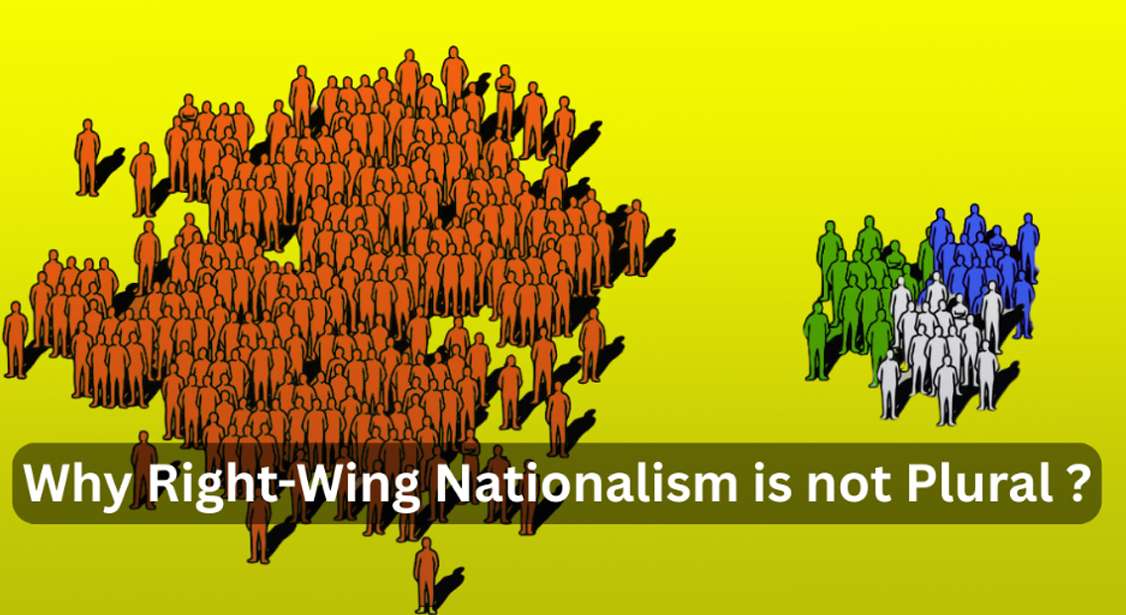
One must first ask: Is calling right-wing nationalism unable to accept diversity and inclusion just a theoretical idea or an ethical argument made by its critics? The truth seems deeper : it’s not just criticism, but a clear description of how it actually works.
Let us begin by precisely defining the core requirements of pluralism.
1. Coexist and Free Expression
At its deepest philosophical and operational level, it necessitates a political landscape structured to allow significantly varied constituent groups (defined by ethnic heritage, religious affiliation, or cultural distinctiveness) not only to coexist but to freely express their distinct identities.
2. Full Participation without Forced Assimilation
Furthermore, this commitment requires that all such groups be afforded the capacity to participate fully in the life of the nation without experiencing coercion to either assimilate or minimize the differences that define them. This ideal is fundamentally supported by inclusivity, which serves as the active principle ensuring that every individual citizen perceives their valuation as axiomatic, and their membership in the societal compact as entirely unconditional.
Considering the structural demands of right-wing nationalism, however, one must posit that its very architecture requires the systematic attenuation or functional destruction of these two essential principles to achieve efficacy. Consequently, its inherent lack of pluralism must be understood not as an accidental defect, but rather as an intrinsic feature of its political design.
The Operational Mechanism of Right Wing Nationalism: Three Steps of Exclusion
1. Homogenisation
The initial mechanical step of right-wing nationalism is to define the nation through what may be called a homogenizing filter (collective identity). Unlike civic nationalism, which defines the nation through shared adherence to constitutional values, this mechanism defines the nation by a singular, often rigid, idea of culture, ancestry, history, or religion. It seeks to establish what the “authentic” or “real” nation is, selecting certain historical, linguistic, or religious traits and elevating them to provisions for full belonging.
This is evident in countries as diverse as Hungary, India, and the United States. In Hungary, Prime Minister Viktor Orbán’s insistence on building an “illiberal democracy” rests on framing Hungary as a Christian bulwark against Muslim migrants and liberal cosmopolitanism. In India, the politics of Hindutva have redefined national belonging around a Hindu cultural identity, often marginalizing Muslims and other minorities as “outsiders” to the civilizational core. And in the United States, Donald Trump’s “Make America Great Again” movement invoked a nostalgic vision of national identity —implicitly white, Christian, and traditional— that rendered many groups, from immigrants to progressives, as threats to the “real” America.
When the national narrative is anchored exclusively to the history or culture of a dominant group, the histories, languages, and contributions of others are reduced to the margins—or cast as deviations. This process is inherently non-pluralistic because it refuses to accept multiple, equally valid “essences” of the nation; it insists on one standardized core that all others must orbit, or from which they must be excluded.
How Homogenisation is sustained?
To sustain the Homogenizing Filter, right-wing nationalism fundamentally requires historical revisionism. The past is not treated as a complex, multifaceted record of events but as a resource for present-day political legitimation. Historical narratives are selectively edited to erase the contributions, suffering, or even the mere presence of the Out-Group, thereby validating the In-Group’s claim to exclusive “authenticity.”
In Poland, efforts to minimize the historical role of Polish citizens in the Holocaust, while maximizing the narrative of victimhood under external powers, serves to cement a pure, Catholic national identity. Similarly, in many nations, curricula are rewritten to transform figures or events that represent pluralism or dissent into emblems of the singular national core. This act of historical cleansing is a direct assault on pluralism because it denies the nation’s true complexity.
By rewriting history to reflect a singular, sanitized past, it simultaneously delegitimizes the present-day claims of minority groups. If the nation was always this way, then those who challenge that definition, whether through their culture, history, or political demands can be more easily branded as modern, foreign, or illegitimate impositions. The past is thus weaponized to justify present-day exclusion.
2. Creation of Exclusionary Boundary
The second step follows almost automatically: the creation of an Exclusionary Boundary. A “pure” or “authentic” nation cannot exist without an “inauthentic” contrast. This boundary draws a stark line between those seen as the rightful members, the In-Group and those deemed alien, the Out-Group.
This dynamic has played out repeatedly across the world. In France, Marine Le Pen’s National Rally portrays Muslims, migrants, and the EU as forces eroding the “true” French identity. In Brazil, Jair Bolsonaro’s rhetoric cast Indigenous communities, LGBTQ+ citizens, and environmentalists as obstacles to the “real” Brazil, one defined by Christian, patriarchal, and militarized values. In Israel, the increasingly ethnonationalist framing of the state as explicitly “Jewish” has deepened the divide between Jewish and Arab citizens, even within formal citizenship. In all these cases, belonging is treated not as a matter of shared civic membership, but of cultural conformity.
This distinction is vital to the operation of right-wing nationalism: it transforms mere diversity into a threat. The national identity becomes a zero-sum game in which the purity and strength of the In-Group depend on the containment or exclusion of the Out-Group. The political scientist Cas Mudde notes that this coupling of nationalism with nativism is based on the belief that only those seen as “native” should dominate the state, is essential to its survival. The ideology, in other words, thrives on separation rather than integration.
3. Reinforcing Exclusionary Boundaries
The third, and most politically dynamic, step is the Crisis Generation and Scapegoating mechanism. Once the Exclusionary Boundary is drawn, it must be continually reinforced to keep the In-Group mobilized and loyal. The simplest way to achieve this is to link every national anxiety to the existence of the Out-Group.
This pattern repeats with striking consistency across countries. In Britain, the Brexit campaign tied job losses and economic anxiety to immigration and EU membership, recasting a complex structural issue as a story of betrayal by “outsiders.” In India, recurring waves of communal rhetoric around issues such as “love jihad” or cow protection, serve to maintain a sense of cultural siege, reinforcing Hindu majoritarian unity against an imagined internal threat. In the United States, conspiratorial notions of “globalists” or “migrant invasions” perform the same function, transforming social and economic grievances into fear of an encroaching Other.
This scapegoating mechanism turns complex problems—inequality, unemployment, corruption—into simple narratives of threat and blame. It distracts the In-Group from demanding real solutions and continually justifies the need for a rigid boundary between “us” and “them.” The nation is perpetually depicted as being under siege, which makes unity synonymous with conformity and dissent synonymous with betrayal.
The Policy and Psychological Destruction of Pluralism
The policy expression of this non-plural mechanism often appears as what scholars call welfare chauvinism—the idea that social benefits should be restricted to those deemed “authentic” nationals. This logic has driven welfare reforms in parts of Scandinavia and Western Europe, where far-right parties such as Denmark’s People’s Party and the Alternative for Germany argue that immigrants or refugees should receive fewer social protections, even when legally resident. This is not a neutral fiscal stance; it is a deliberate reinforcement of the exclusionary boundary, using the state’s welfare system to define hierarchies of belonging.
The targeting of independent institutions that uphold pluralism is equally critical. In Poland, the Law and Justice Party’s campaign against judicial independence and media pluralism was justified in the name of protecting national sovereignty from “foreign” liberal influence. In Turkey, President Erdoğan’s purges of academia and the press by branding critics as “enemies of the state” demonstrate how the dismantling of plural institutions is necessary for consolidating a homogenized national core. These bodies, by design, are pluralistic; they protect diversity, safeguard minority rights, and question simplistic narratives. That makes them natural enemies of the nationalist machine.
The Internal Toll on the In-Group
Crucially, the destruction of pluralism is not just an external act of exclusion, but an internal process of psychological constriction on the In-Group itself. For the nationalist project to succeed, the In-Group must accept its own loss of complexity. Individual identities such as political, regional, socio-economic, must be subsumed into the single, defining nationalist identity. This demands a high degree of political and intellectual conformity. Disagreement within the In-Group is not treated as healthy pluralism, but as a form of treason that aids the external enemy (the Out-Group).
By demanding such loyalty, right-wing nationalism erodes the democratic space even for its own adherents. It replaces robust political debate with a performative unity, where the value of an In-Group member is measured not by their critical thinking or contribution to a diverse society, but by the intensity of their hatred or fear of the Out-Group. The final product is a society where the nation, stripped of its diverse elements, becomes an empty vessel for the dominant political party’s ideology, leaving all citizens, ultimately, less free.
Long before these contemporary manifestations, thinkers like Rabindranath Tagore foresaw this danger. He argued that narrow, aggressive nationalism can never be a “final spiritual shelter,” because it prioritizes artificial unity over the universal values of humanity and mutual respect. The nationalist project’s success depends on constant differentiation between insiders and outsiders, loyalists and dissenters, patriots and “traitors.”
The contemporary world, from Budapest to New Delhi, from Washington to Warsaw, shows that right-wing nationalism is not a movement of inclusion or unity, but a machine for separation. Its power rests on division. It unites by excluding, and it thrives not on shared humanity but on shared hostility.
In the end, right-wing nationalism cannot embrace pluralism because its operational integrity—its very ability to mobilize, maintain cohesion, and justify authority—depends on defining itself against an internal and external “Other.” It does not fail to be inclusive by accident; it succeeds precisely because it is not. It is, at its core, a system of exclusion, an identity engine that trades complexity for simplicity, belonging for loyalty, and pluralism for purity.


