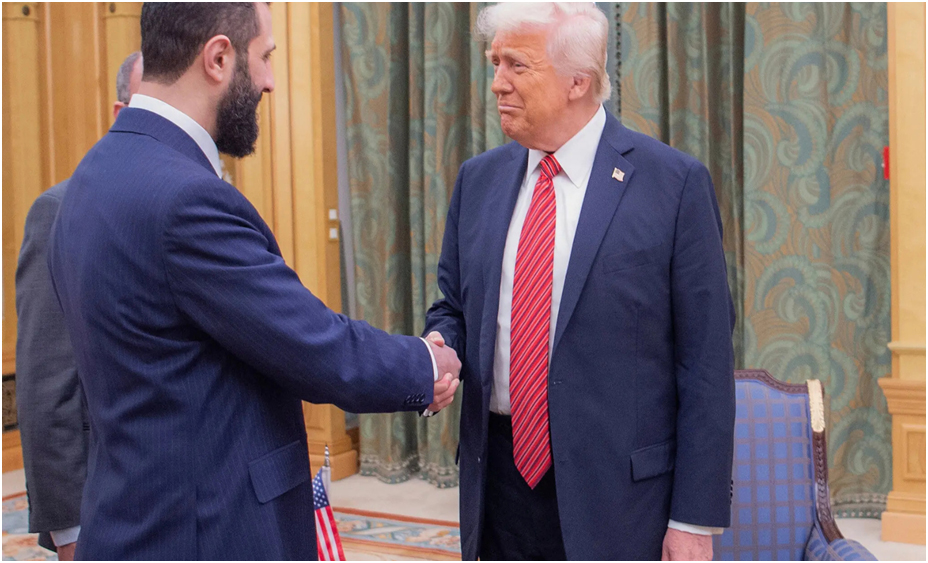
In a move that has shocked analysts and regional observers, U.S. President Donald Trump, during a four-day diplomatic tour of West Asia, held a landmark meeting with Syria’s newly installed president, Al-Shara. Speaking at a Gulf Cooperation Council (GCC) summit in Riyadh, Trump announced the U.S. would lift “all sanctions” against Syria. This meeting—brokered by regional powerhouses Saudi Arabia and Turkey—signals a sudden shift in the regional security complex of West Asia, underscoring a powerful recalibration in alliance patterns and strategic priorities. It marks the first U.S. presidential engagement with a Syrian leader in over 25 years, and more than symbolic, it reconfigures the lines of amity and enmity that underpin the region’s security interdependencies.
The Regional Security Complex in Flux: Shifting Alliances and Threat Perceptions
According to Regional Security Complex Theory (RSCT), regional clusters of states are so interlinked in their security concerns that their national security cannot be fully understood in isolation. West Asia is a near-perfect example where power contests among Saudi Arabia, Iran, Israel, Turkey, and now Syria form a highly interdependent complex. Within this system, Al-Shara’s unexpected ascent and subsequent recognition by the U.S. introduce a new actor that is rapidly altering the regional balance of threat.
Al-Shara’s emergence as Syria’s leader represents a dramatic rupture from the prior regime. Once a jihadist commander within Al-Qaeda, he led the insurgency that ultimately overthrew Bashar al-Assad. His past triggered alarm in Western capitals, where he was until recently labeled a terrorist with a multimillion-dollar bounty on his head. Yet his swift transformation—from fugitive to internationally recognized head of state—reveals not ideological endorsement but strategic necessity, shaped by regional threat perceptions and the intersubjective redefinition of enemies and allies.
Central to this realignment is the enduring aftershock of the Israel-Hamas war, which erupted on October 7, 2023. That conflict acted as a catalyst, intensifying existing tensions and exposing vulnerabilities within the regional security complex. It forced key actors to reassess their threat hierarchies, prompting new patterns of alignment. Trump’s re-entry onto the global stage further amplifies these shifts, especially with his focus on extending the Abraham Accords. His strategic aim: to reshape the security architecture by increasing connectivity among pro-U.S. states (Between Arab states and Israel) and isolating mutual adversaries like Iran.
The fall of the Alawite-dominated Assad regime and its replacement by a Sunni-led administration provides Saudi Arabia with a rare opening. Historically, Syria was a vital member of the Iran-led axis, providing geographic and strategic depth across the so-called “Shia Crescent”—a corridor of influence extending through Iraq, Lebanon, and Yemen. Iran’s relationship with Syria offered a western flank against Israel and a conduit for supporting Hezbollah. But in RSCT terms, Al-Shara’s rule fragments this historically cohesive subcomplex between Iran and Syria. A Sunni-led Damascus may shift toward Riyadh, potentially dismantling one of the pillars of Iran’s regional influence.
This fragmentation is precisely what RSCT predicts in the evolution of security complexes: new actors and structural changes (like regime collapse) can reorganize threat perceptions and alliance patterns. Saudi Arabia, driven by competition with Iran and aspirations of regional primacy, is now courting Damascus. By backing Syria’s reintegration, Riyadh aims to pivot the Syrian node of the complex away from Tehran and into a Sunni alignment more amenable to Saudi and U.S. interests.
U.S. Penetration and Economic Diplomacy: Rebuilding Syria, Restructuring Power
For the United States, the security implications are profound. Washington sees the realignment as a means to strategically dislocate Syria from the Iran-Russia axis. Under RSCT, external powers like the U.S. play a crucial role in shaping regional complexes through penetration—projecting power and shaping local balances. Trump’s decision to lift sanctions and engage diplomatically is a form of such penetration, designed to restructure the complex from the inside.
Economically, Syria is an opportunity as much as it is a security issue. After over a decade of war, the country is devastated. U.S. economic diplomacy—facilitated through sanctions relief and access to reconstruction funds—offers a pathway for influence. American companies and Gulf investors would gain first-mover advantage in Syria’s reconstruction, which in turn could enhance U.S. leverage over the country’s political trajectory. In RSCT terms, economic interdependence becomes a tool of desecuritization, lowering the perception of threat through institutional and economic reintegration.
Perhaps most dramatically, Trump’s engagement aims to pull Syria into the Abraham Accords. A former enemy of Israel, Syria’s potential normalization of ties would represent a tectonic shift in the structure of the West Asian security complex. This would erode one of the last major fault lines of hostility toward Israel and further consolidate a bloc of pro-Western, status quo states. The redefinition of friend-foe relationships—central to RSCT—would be complete if Damascus and Jerusalem were to exchange embassies.
From Pariah to Partner: Realpolitik and Normalization
The consequences for Iran are severe. The Islamic Republic faces simultaneous pressure on multiple fronts: Hamas in Gaza has been decimated, Hezbollah is increasingly constrained, and the Houthis are facing intensified international pushback. Losing Syria would shatter the backbone of the Axis of Resistance. From an RSCT perspective, Iran risks becoming a marginalized actor in the regional complex—its traditional sphere of influence unraveling under coordinated U.S., Israeli, and Arab moves.
This growing isolation might push Iran back to the negotiating table. The U.S. could use the situation as a lever in renewed nuclear negotiations, possibly demanding stricter limits than the original Joint Comprehensive Plan of Action (JCPOA) entailed. These might include capped uranium enrichment to 3.67%, dismantling missile programs, and ending support for proxies. In return, Iran could seek sanctions relief—a classic case of securitization giving way to negotiated desecuritization.
Domestically, the end of sanctions and Syria’s reintegration into the global economy could bring tangible relief. With access to international finance, trade, and aid, Syrians might begin to rebuild their lives. The currency could stabilize, goods could become affordable, and public services might slowly recover. Yet, as RSCT reminds us, security is not only about state survival—it is also about societal stability. Long-term peace depends on inclusive reconstruction and reconciliation.
Still, normalizing ties with a former jihadist leader remains contentious. Critics worry it undermines international counterterrorism standards. But from a realpolitik lens, states often shift allegiances and redefine threats based on strategic calculus rather than moral consistency. Al-Shara’s transformation from outlaw to partner is less an anomaly than a reflection of how quickly security narratives can evolve in a complex, interdependent system.
In conclusion, Trump’s unorthodox but strategic meeting with Al-Shara signifies more than a diplomatic gambit—it reflects a deep reordering of West Asia’s regional security complex. By redrawing the boundaries of alliance and enmity, this engagement could rewire the entire architecture of regional security. The move encapsulates the logic of RSCT: regional dynamics matter most, and within those dynamics, states act not on moral absolutes but shifting patterns of threat, opportunity, and survival.