The Impeachment of former South Korean President Yoon Suk yeol
The political saga which started in South Korea on 3rd December 2024 upon the imposition of martial law by the President Yoon Suk yeol, finally culminated with the impeachment of the President Yoon. The South Korea’s Constitutional Court has unanimously upheld the impeachment of President Yoon on 4th April 2025. Despite some of the judges of the Constitutional Court being President, Yoon is the first President of South Korea to be impeached while still in office.
Why did Yoon declare Martial law?
The Court ruled that Yoon’s declaration of martial law along with suspension of political activities and authorized military inventions in press and politics, violated constitutional principles. The threats from North Korea was used as the ground on which martial law was declared. However, the main reason was to break the deadlock between the majority opposition and Yoon’s People’s Power Party who formed a minority government. The more controversial action was when President Yoon mobilized troops to dismantle the functioning of the National Assembly as a reaction to the protests by the opposition party members after the declaration of martial law. This was a clear violation of the constitutional division of power among three branches of the government.
Former President Yoon is still facing criminal trials on insurrection charges related to the martial law proclamation, which carry a maximum sentence of death or life imprisonment. If convicted, he will never be allowed to hold any public office and all other amenities such as pensions, official residence and security will be denied.
Although the martial law was withdrawn within six hours from declaration, the entire episode shook the state which is comparatively a young democracy and had thrown off from the shackles of military rule in 1987. It was also a harrowing reminder that the state can soon verge into the state of marital law which would jeopardise not only democratic form of government but also political freedom.
The impeachment motion which was passed by the National Assembly on 14th December 2025, which was received by the Constitutional Court. It adopted two preliminary sessions and 11 hearings and questioned 16 witnesses.
Presidential Election 2025
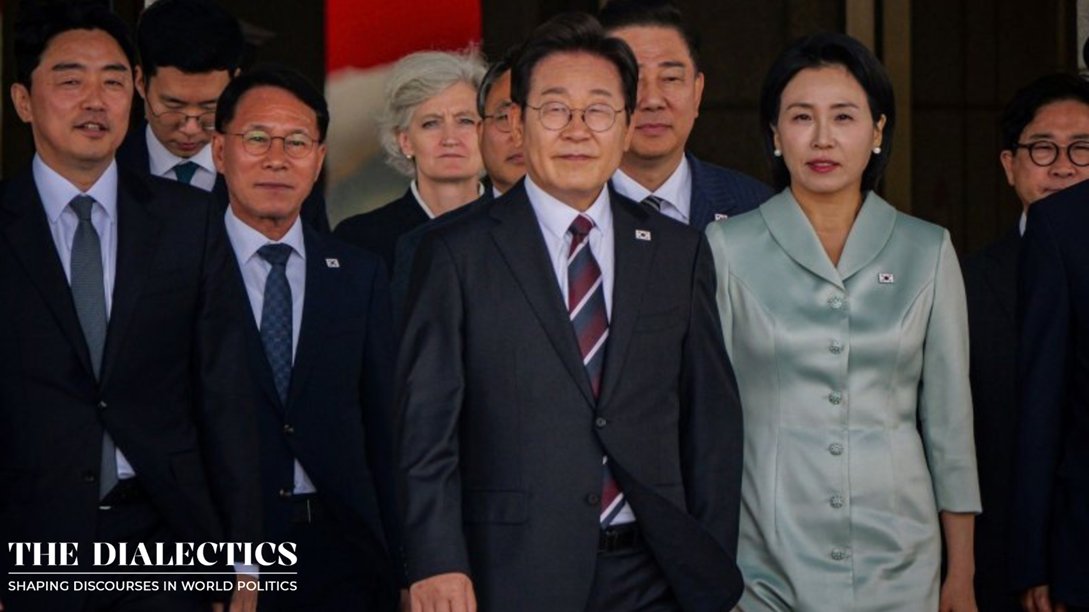
This Presidential election can be called astonishing as it has tested the democratic spirit of South Korea; after having undergone a brief yet disturbing phase post the imposition of martial law and the political saga which followed thereafter. In addition, this election was not only meant for choosing a new President but also for their verdict on everything that unfolded over the past six months. There was already a tough competition between Mr. Lee and Mr. Kim, both from opposing parties. Mr. Lee-Jae-myung has been elected as the 21st President of South Korea.
Mr. Lee-Jae-myung’s journey to politics has been marked by personal hardship which later shaped agenda for reform during his career as a lawyer. The cases which he fought became the foundation of his political identity: anti-elitist, reformist, and unapologetically populist. He was elected as Mayor of Seongnam in 2010. In 2018, Mr. Lee became Governor of Gyeonggi province, South Korea’s most populous and economically critical region. During his tenure, he expanded housing welfare schemes and pushed for a pilot universal basic income programme.
The voter turnout exceeded 77% which has shown that South Korea has delivered a decisive verdict. Mr. Lee secured just under 50% of the vote, comfortably defeating conservative rival Kim Moon-soo. The state saw the highest turnout in nearly three decades.
What is expected from Lee Jae Myung’s Government?
What will make Lee’s governance easy in the upcoming days is that the National Assembly is controlled by the Democratic Party which gives Lee significant support and capital to pursue policies such as industrial diversification and economic growth initiatives. The biggest task for President Lee will be to secure political stability after a gap of half a year.
In the aspects of foreign policy, President Lee will generally align with the Democratic Party’s traditional approach for promoting dialogue with North Korea and maintain a more balanced relation with China. During his tenure, three aspects of South Korea’s foreign policy will be closely watched such as: Seoul’s engagement with Pyongyang. In 2021, Mr. Lee referred to the United States Forces Korea as “Occupying force”. While he serves his term, it will be interesting to watch how the relation between South Korea and the U.S. is going to shape.
Lee’s Transactional Realism
President Lee’s instincts lean more towards transactional realism: less about aligning with democratic values or defending multilateral norms, and more about flexibility to serve South Korea’s immediate domestic interests. It is anticipated that under President Lee’s reign, there will be a marked shift in South Korea’s alliances as it is believed that Lee is going to navigate through the ongoing great-power competition by pursuing South Korea’s self-interest rather than succumbing to the dictates of any great power.
In this current global scenario which is shaped by rapidly realigning global order, intensifying regional tensions and more faltering norms and institutions- Lee has promised to pursue a more diversified partnership. Given the alteration in the global scenario, the trade war which is unleashed by the Trump administration 2.0- the tariffs on steel, aluminium and automobiles– will be a significant threat to South Korea’s economic growth. It will be interesting to note how President Lee is going to negotiate with Trump after the 90 day pause on trade tariffs ends on 9th July 2025. In addition to navigating through the turbulent politics in the Indo-Pacific region, President Lee has appointed veteran diplomat and strategic heavyweight Wi Sung-lac to lead the President Office’s National Security Council (NSC).
Controversiaries
Nevertheless, yet another facet is an internal issue. The new President will face imminent criminal charges, including allegedly breaking election law during his 2022 presidential election campaign and misusing public funds. The second charge pertains to having alleged illicit transfer of $8 million to North Korea through an underwear maker (Ssangbangwool Group) while Mr. Lee was serving as the Governor of Gyeonggi province.
Conclusion
Given the context of internal and external dynamics and the precarious geopolitical position of South Korea, it will be imperative to watch how this East Asian state is going to navigate through the challenges under President Lee. As the world order is continuing to be in flux, it will be prudent for South Korea to diversify its partnership and pursue its self-interest. On the other hand, in the coming months, the judgements on criminal charges against President Lee will also determine the course of politics in South Korea. Nonetheless, for now South Korea has a stable government with a unanimously elected people’s representative which has secured the democratic spirit of the state against crumbling.