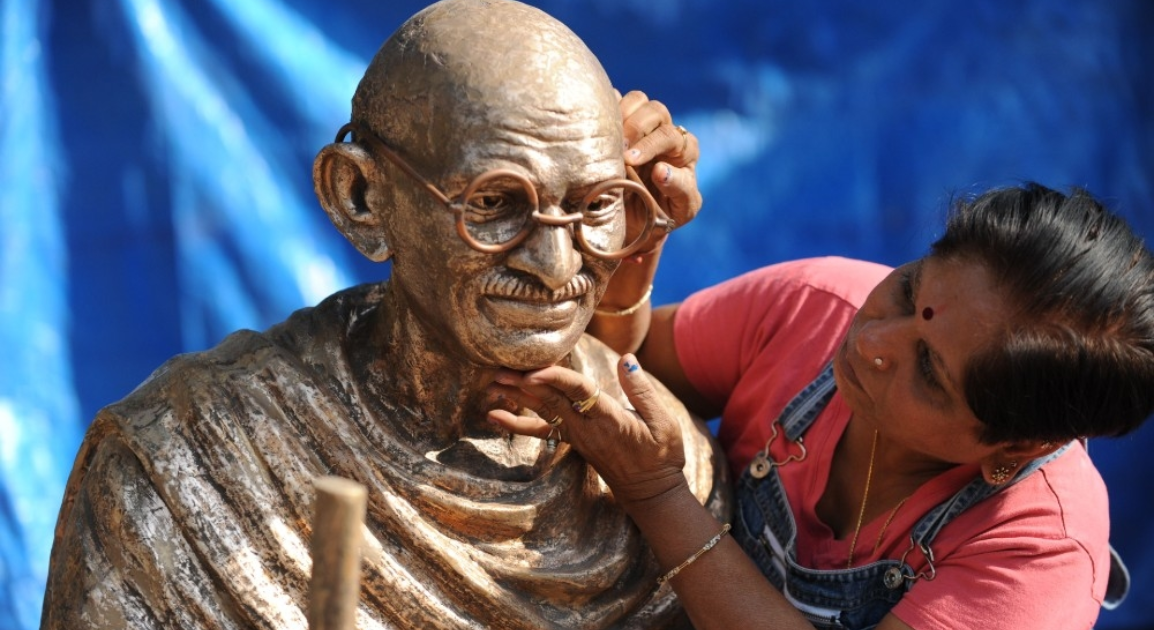
When Gandhi talked about Ram Rajya, he wasn’t talking about a made-up golden age or a society based on religious rules. Instead, Gandhi came up with a fundamentally moral view of politics. In this view, sovereignty is based not on the state’s power to force people to do things, but on the moral choices of its citizens. In contemporary India, where Ram Rajya is frequently employed as a civilizational or majoritarian slogan, Gandhi’s original vision is largely misconstrued, if not deliberately misinterpreted. To revive Ram Rajya in the Gandhian sense is thus a political intervention—one that calls into question our understanding of democracy, authority, justice, and the entire purpose of the state.
What Gandhi Meant by Ram Rajya
For Gandhi, Ram Rajya was about neither Lord Rama as a religious figure nor Hindu supremacy. He was quite clear on this point. Gandhi explained in several writings and speeches that Ram Rajya meant good governance, ethical rule, and social justice, not a Hindu state. He described it as a political order in which the weakest might live without fear, justice was available, and rulers were held accountable via moral constraint rather than raw force.
Gandhi declared in Young India (1929) that Ram Rajya was “the kingdom of God on earth”—a purposeful universal expression. The moral core of the notion was much more important than its cultural symbolism. Gandhi saw Rama as an ethical archetype: a ruler bound by duty (dharma), accountability, and sacrifice, rather than only an object of worship.
Significantly, Gandhi’s Ram Rajya was not theocratic. It was not intended to give preference to any particular religion. Instead, it called for equal regard for all faiths (sarva dharma sambhava). In reality, Gandhi frequently cautioned that when religion is weaponized by the state, both politics and faith suffer. Ram Rajya, as he saw it, was a secular ethical order—secular not in the Western sense of rigorous separation, but in the Indian meaning of principled plurality.
A State with Minimum Power and Maximum Responsibility
One of Gandhi’s most radical ideas was that he didn’t trust the government of the time. Gandhi did not think that giving power from colonial rulers to native elites was the same as independence. He believed that the centralized, bureaucratic, and coercive nature of the modern state made violence more likely.
In his book Hind Swaraj (1909), Gandhi famously said that real self-rule (swaraj) meant self-discipline, not political freedom. He argued that a society that relied on perpetual policing and punishment had failed morally. Ram Rajya so referred to a state that governed less because people governed themselves more.
This is where Gandhi diverges from both liberal constitutionalism and authoritarian nationalism. He thought that laws were important but not enough. It wasn’t enough for courts and bureaucrats to be the only ones who could bring justice. People needed to live it. Not only did elections give authority its legitimacy, but also moral behavior.
Gandhi’s Ram Rajya is like a moral republic today. In this kind of republic, authority is always held accountable by conscience, and the dignity of the poorest citizen is what determines how well the government is doing, not GDP growth or military power.
Ram Rajya and Social Justice
Gandhi’s vision was far from conservative or hierarchical but rather fundamentally egalitarian. Ram Rajya advocated for the abolition of untouchability, the empowerment of women, and the dignity of employment. Gandhi consistently stated that any government professing to be just must be assessed by the situation of its most marginalized citizens.
He was clear about caste. Untouchability, he contended, was a moral violation that contradicted Ram Rajya. While Gandhi’s methods and vocabulary on caste have been hotly debated—and rightfully criticised—his political ideal made no place for social exclusion.
Gandhi’s Ram Rajya was also against taking advantage of people for money. He was against state socialism, but he was also against violent revolution and capitalism that was too free. His philosophy of trusteeship said that people who have money should act as moral stewards instead of owners. This part of Ram Rajya is probably the most uncomfortable and important part during a time of incredible unfairness.
Nonviolence as a political method
What genuinely distinguishes Gandhi’s Ram Rajya from other ideal states is its ethical framework. For Gandhi, aims and means were inextricably linked. A just society cannot be established through unjust means. Violence, especially when used in the name of justice, tainted the moral underpinning of politics.
Ram Rajya was consequently inextricably linked to ahimsa. This was not passive idealism. Gandhi saw nonviolence as an active political force capable of mobilizing mass resistance, delegitimizing unjust power, and changing social relationships.
In this sense, Ram Rajya was not a static paradise imposed after independence but rather a continuous process of ethical striving. The freedom struggle was intended to be a dress rehearsal for moral rule. Gandhi warned that independence without ethical development would only result in the replacement of foreign rulers with local oppressors.
The Postcolonial Betrayal
Independent India did not—and may not be able to—adopt Gandhi’s Ram Rajya system. Nation-building, security, and economic planning necessitated the presence of a powerful central government. The Constitution upheld liberal democracy, fundamental rights, and secularism, but it also institutionalized the bureaucratic machinery Gandhi despised.
However, the larger betrayal occurred later—not through administrative centralization, but through intellectual takeover. Ram Rajya is gradually being remade in current political rhetoric as a Hindu civilizational state, stripped of its ethical meaning and repurposed as a symbol of majoritarian authority.
This transition is distinctly un-Gandhian. Gandhi’s Ram Rajya was open to everyone, but it was hard to do the right thing and made people in charge nervous. The modern exhortation frequently emphasizes cultural conformity over ethical accountability. Gandhi preached humility, but these days, people often talk about being in charge. Gandhi was afraid that the government would use violence against him, but that’s normal in politics today.
Mixing up Gandhi’s Ram Rajya with religious nationalism is a distortion, not a new way of looking at it.
Reclaiming Gandhi from the state
To recover Ram Rajya today does not imply romanticizing Gandhi or ignoring his intellectual limits. Its purpose is to protect his ideas from selective quotation and ideological exploitation. Gandhi did not provide a governing plan; rather, he presented a philosophy of responsibility.
In this sense, Ram Rajya is part of civil society rather than the state. It endures through acts of dissent, ethical refusal, and the insistence that power be justified morally rather than just electorally.
As Gandhi once stated, “If India copies England, it will be ruined.” The warning extends beyond imitation. A politics that uses Gandhi’s rhetoric while rejecting his principles risks more than ruin: moral emptiness disguised as tradition.
Conclusion: Ram Rajya as the Democratic Conscience
Gandhi’s Ram Rajya was not about temples or territory. It was about the ethical boundaries of power and the moral responsibilities of liberty. It envisioned a society in which rulers dreaded injustice more than protest, and citizens feared conscience more than power.
In an era when political discourse is becoming increasingly disconnected from ethical duty, reviewing Ram Rajya is not an antiquarian activity. It is a kind of democratic resistance.
To ask if India lives up to Ram Rajya is eventually to address a more difficult question: Do we still believe that politics must answer to morality at all?
That question—uncomfortable, unanswered, and urgent—is Gandhi’s ongoing challenge.