
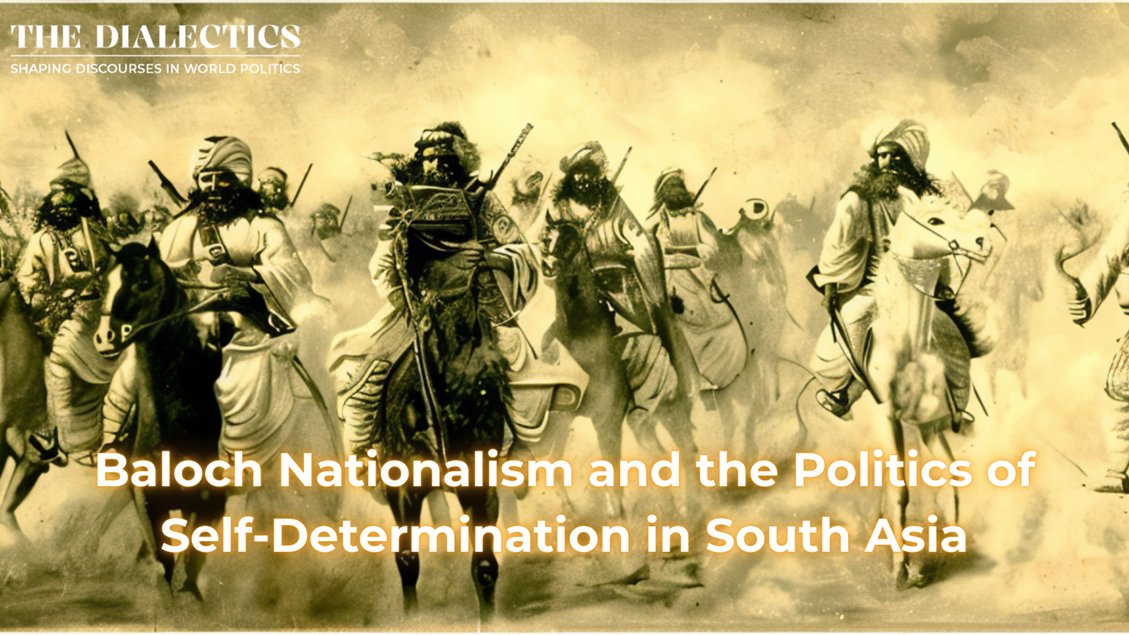
The origins of Baloch nationalism do not stem from a unified national consciousness but have been rather constructed over time through various cultural, social and political processes. The foundations of the Nationalist perception of Balochistan are linked to the literary and political activities of the British colonial administration, introducing modern concepts through literature and maps to create a unified body of knowledge about Balochistan. They helped formalize the Balochi language through dictionaries, stories and poems, laying the groundwork for the nationalist ideology. However, prior to this, in 1600, the area was under pressure from the expanding powers of Iran and the Mughal empire, which caused them to make Mir Ahmad Khan, the Khan of Kalat. He directly ruled over Khalat and indirectly ruled the surrounding areas of Kharan, Makaran and Las Bela, known as the Khanate of Khalat. Today, all these four areas comprise the Balochistan region.
Historical Foundations under Colonial Influence
Over time, various other phenomena have influenced the nationalistic perspective in Balochistan, such as the anti-colonial Indian National movement before India-Pakistan separation. During this period, the Khan of Khalat was promised an independent state of Khalat. Post 1947, the feeling of nationalism was greatly influenced by the ongoing conflicts between Pakistan, India and Afghanistan. At the same time, independence to Khalat was denied, and Pakistan asked the king of Khalat to merge with Pakistan. Upon denial, the government of Pakistan convinced the surrounding areas of Kharan, Makaran and Las Bela to join Pakistan as they were still greatly influenced by the tribal leaders.
Colonial Influence and the Khanate of Kalat
Completely isolating Kalat, eventually with the force of the Pakistani army, the King of Kalat was also made to merge. Further, this entire area was named Balochistan. Soon after this, guerrilla warfare tactics were used by the people against the Pakistani army to show their discontent. The ‘one unit’ policy of the for entire West Pakistan under one central authority further encroached upon the identity of the Balochi people, adding more fuel to the fire. In response, the Pakistani authorities imposed martial law, which further constrained the Balochi people. Giving rise to an individual named Nauroz Khan who waged a series of guerrilla warfare against the Pakistani army in retaliation. In order to curb this, the Pakistani authority falsely promised the removal of the ‘one unit policy’ and pardon to the activists. However, instead of arresting them and giving them a death sentence, they were further angered by the people of Baloch, giving rise to more factions of resistance groups, which started indiscriminately targeting the Pakistani authorities. Finally, in 1970, the one-unit policy was withdrawn, soon after which elections took place, and the Balochi got local parties into power, such as the National Awami Party and the Jamiat Ulema Islam.
Post-Independence Struggles and Merger with Pakistan
However, in 1972, as Bangladesh was liberated from Pakistan, there was a need for a new constitution in Pakistan. Initially, Zulfiqar Ali Bhutto managed to get the agreement of the National Awami Party in Balochistan, but soon after the constitution was drafted, the new Prime Minister Zulfiqar Ali Bhutto banned the National Awami Party, launching a full-scale military operation, killing thousands, further igniting the spark of guerrilla warfare activities in the region. During the Cold War, the Balochi nationalists were heavily influenced by the Soviet Union, adopting the concept of the “right of nations for self-determination” in order to garner support from the Eastern Bloc against the pro-US Pakistani government.
Guerrilla Resistance and the ‘One Unit’ Policy
Tribalism is another defining force in the construction of Baloch Nationalism. As Baloch Nationalism was initially a movement led by the traditional tribal elites, insurgencies before the 2000s were owned by tribal leaderships often driven by their own tribal interests. However, this was often exploited by the British through a divide and rule strategy by favouring the dominant tribal leaders, where later the Pakistani authorities have been effective in using this tactic. Although tribalism has played a foundational role, today this has transformed significantly from tribal elites dominating the struggle to one in which the common masses have increasingly led. This can be seen today through the leadership of Allah Nazar, who, despite coming from a lower middle-class background, is heading the movement, further encouraging the young and educated members of the Baloch society to join the cause. The epicentre of the movement has also seen a shift from the North-East Balochistan home to the Marris and Bugtis tribes, who have been known for their enduring separatist sentiment, to the South, which is home to the educated and professional class, rich in remittance and comparatively more urbanized.
Tribalism to Mass-Led Nationalist Movement
Being the biggest South Western province of Pakistan, it houses around 8% of the Pakistani population. Around the year 2000 the people of Baloch formed their most organized militant group called the Baloch Liberation Army, which started carrying out professional attacks. At the same time, today we see heavy Chinese engagement in the region. As can be seen with the Gwadar port, which is being strategically developed by China, where the employment comes from China and other major cities of Pakistan, completely ignoring the rights of the Balochi people, today we see the BLA strategically targeting the Chinese assets in the region as well. Balochistan is rich in natural resources like copper, oil, uranium, etc. The exploitation of these benefits is not of the people of Balochistan.
Modern Militancy and Push for Self-Determination
These and many more instances are where the Balochi people have been denied their basic rights. It has today fuelled the spirit of nationalism even more than before in the hearts of the Balochi people, as can be seen in the month of May of 2025, when Mir Yar Baloch, a Baloch Nationalist leader, declared independence from Pakistan, urging the international community, especially India, to recognize this action and the creation of their new state legitimately. Although India currently faces constraints in order to do so, the Nationalistic sentiment of the Baloch people is today building up Kinetic traction towards the path of Self-Determination.
