The Dialectics

Magazine Geopolitics In Depth (Sep 25) Society & Culture Stories

How Olive Groves Matter Deeply in the Israel–Palestine Conflict?

Olive groves politics in palestine and israel

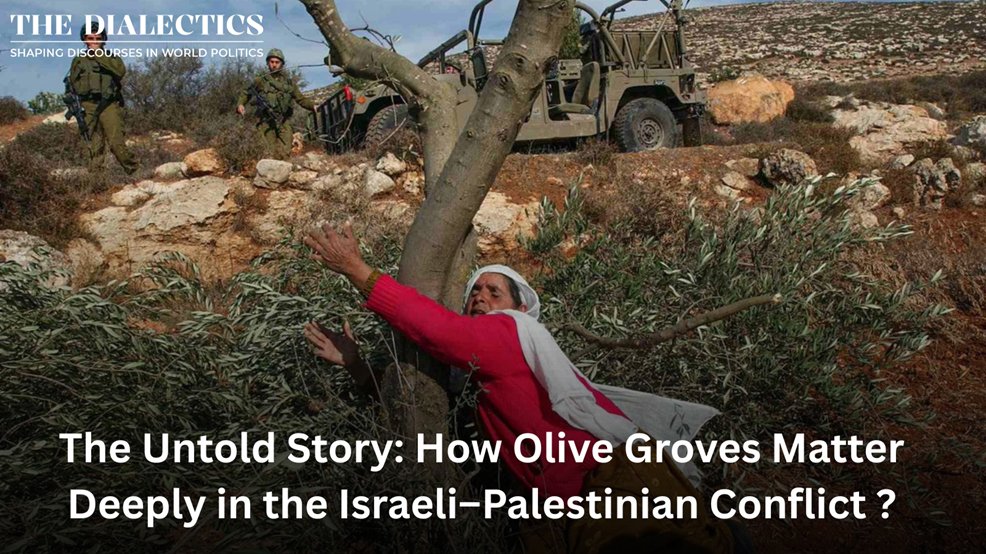
A Tree Older Than the Conflict…. The olive tree has endured millennia on the hills of the Levant, its roots gripping the earth through drought, war, and shifting empires. A plant older than the contemporary conflict between Palestinians and Israelis, and yet it has become synonymous with it. Not merely a shrub, the olive is a cultural icon, an economic lifeline, a religious symbol, and, unfortunately, a victim of political strife. Over the past few years, especially through the charged atmosphere of 2023–2025, the olive tree has again become a battle line. Both its preservation and its loss carry profound symbolic, material, and political significance. The olive tree’s iconic status in this war cannot be dismissed as a coincidence. Both Israelis and Palestinians hold it dear as a symbol of belonging, continuity, and identity. The tragedy is in the way that this common reverence has been manipulated into a battle for ownership and existence. To grasp the significance of the olive tree is to realize that it is not merely collateral damage, but a principal actor in the extended war for land, sovereignty, and survival…. Shared Heritage, Divided Realities There are few symbols of Israeli and Palestinian shared heritage as striking as the olive tree. In Jewish scripture, the dove brings back to Noah’s ark an olive branch — the time-honored symbol of peace. In Palestinian folklore, families tell of how their forebears planted groves to celebrate births or the passing of generations. In both communities, the olive harvest has long been a time of ritual and celebration, when families converge in groves, meals are eaten, and stories retold beneath the shade of silver-green leaves. s. But the same symbol of oneness has become a sign of disunity. For Palestinians, the olive tree is continuity on land that would otherwise be disputed, divided, or off-limits. Groves are family histories as much as working farms, attesting to generations of management. When these groves are uprooted, fenced out, or abandoned as a result of movement restrictions, the damage is economic as well as existential. To numerous Israelis, especially in the Galilee and Negev, olive production is also a badge of honor, part of the contemporary agricultural narrative of “making the desert bloom.” Government-afforestation projects and private efforts employed tree-planting as a means of taking hold in disputed lands, sometimes heightening arguments over belonging to the land. The paradox is stark: the olive tree is holy to both peoples, yet its holiness becomes a matter of competing claims. What ought to be a common symbol of survival has become instead a platform where both sides declare sovereignty.  Y. The Economics of Survival The olive tree conflict is not just symbolic; it’s also deeply economic. Olives are the mainstay of rural livelihoods for Palestinian farmers. Olive oil is both subsistence and income, with sales paying for school fees, health care, and minimum subsistence. The annual harvest is an important time in which family members work together for weeks, producing not only income but also social solidarity. When access to the groves is denied or trees are destroyed, the immediate loss echoes through whole households. International organizations estimate that olive-related production supports tens of thousands of Palestinian families, so interruptions to the harvest are a kind of economic warfare. To Israeli farmers as well, olives are not just a commodity. They are part of a diversified agricultural industry providing produce to domestic markets and making it onto export shelves globally. Israeli olive oil brands have worked hard to establish reputations for quality, combining traditional methods with the latest agro-technology. For many communities, especially in the north, the harvest of olives is a livelihood and a question of cultural identity. But olive groves tend to be situated in politically sensitive areas — close to settlements, security barriers, or military areas — and hence are exposed. Palestinians commonly complain of vandalism of groves, harvest theft, or hindrances put in the path of harvesting. Israeli farmers along border areas, on the other hand, encounter arson and destruction of orchards. The olive tree is therefore caught up in security calculations, its branches spanning the fault lines of everyday life.  The Olive Tree as a Political Tool Targeting olive trees intentionally prompts an underlying question: why target something so obviously humble? The reason is found in the layered significance the olive holds. A mature tree is priceless economically. It takes several years to achieve maximum productivity, and its fruit produces oil for many generations. Killing one is not an act of wanton vandalism but the erasure of a sustained livelihood. Culturally, groves embody memory. They are planted to commemorate births and endure as living markers of ancestry. To sever them is to disrupt the lineage of belonging. Politically, images of felled or burned trees are powerful currency. They circulate in international media as evidence of injustice, while replanting campaigns are mobilized as acts of resilience and hope. This symbolic strength is why diaspora communities, church groups, and international NGOs mobilize around olive trees. Solidarity harvests mobilize volunteers to Palestinian orchards; Jewish diaspora communities fund tree-planting in Israel as gestures of affiliation. Both sides see the tree as something greater than wood and fruit — it is a symbol of staying put in a disputed land. Heritage or Weapon? What is particularly tragic about the olive tree in this war is that it is both heritage and weapon. For Palestinians, tree destruction has become a symbol of dispossession, a story of uprooting that resonates with displacement from villages and homes. For Israelis, tree planting has been presented as taking back a desolate land, a form of writing belonging into the earth. Both uses instrumentalise the olive, converting a peace tree into an instrument of contention. This leads to a significant philosophical question: can a symbol endure when employed as a weapon? If the olive groves become evidence of dispossession or tools of settlement expansion, they no longer have the ability to bring people together. And yet the fact that both...

Free Membership Required

You must be a Free member to access this content.

Join Now

Already a member? Log in here