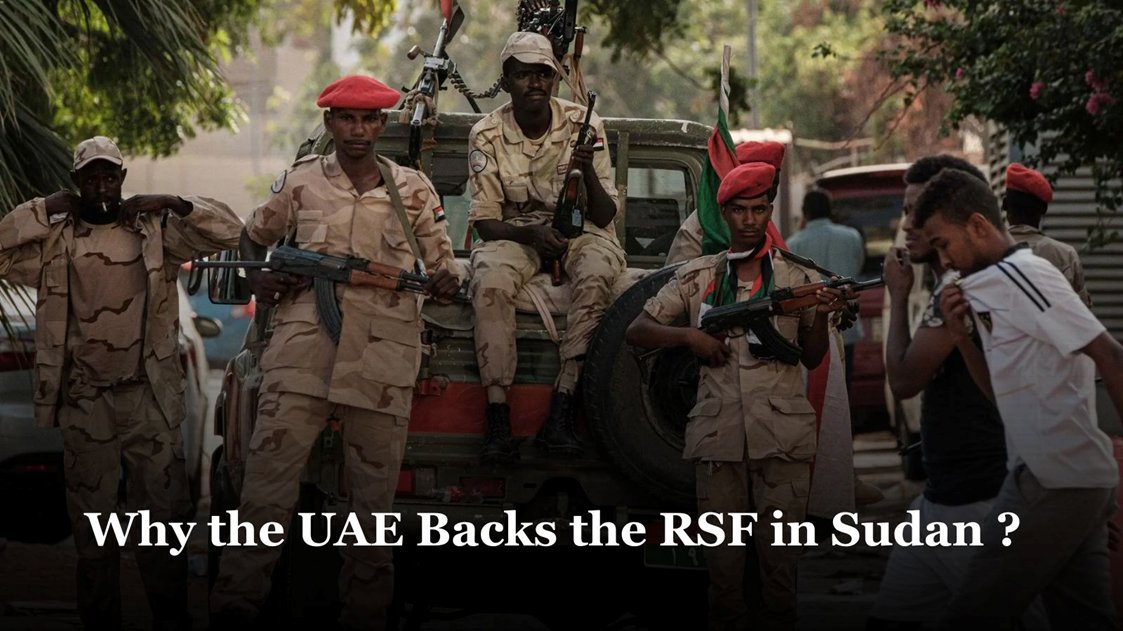
Conflicts around the World have increased in recent years due to a rapidly changing geopolitical environment. From news to social media, we hear daily updates on the developments about these conflicts. However, conflicts, such as the Sudanese Civil War, have not received much attention due to the war in Ukraine, the Israel-Hamas war and the Israel-Iran war, despite the destruction and human suffering being no less than those of the mentioned ones.
Sudan’s Civil War: Nature and Dynamics
In International political and war studies, there are several types of war depending on their characteristics, intent, and intensity. The war in Sudan is a civil war as it involves two political and military factions, the Rapid Support Forces (RSF), led by Mohammad Hamdan Dagalo and the Sudanese army, led by General Abdel Fattah al-Burhan, who are fighting each other for political control over the nation.
Involvement of regional and global powers in civil war is one of the characteristics of civil war, and the Sudanese civil war is not an exception. However, any nation’s involvement in any civil war is not an aimless manoeuvre, rather it contains strategic calculations of loss and gain.
The article identifies explicitly the reasons, strategic calculations, and miscalculations of the involvement of the United Arab Emirates (UAE) in the Sudanese civil war. According to several media reports, the UAE is financing and arming the RSF. This included funnelling weapons to the Darfur-based group under the guise of humanitarian aid operations for displaced Sudanese in Chad.
Why the UAE Backs the RSF
But what exactly are the interests of the UAE in Sudan? Several reports underline the involvement of the Gulf nations, including the UAE, in the Sudanese economy even during the era of international sanctions under former president Omar al-Bashir. Their easily accessible capital and geographical proximity allowed the UAE to make notable investments in banking, trade, agriculture, and many other areas despite the political risks. The UAE has contributed immensely to Sudan’s economic development in the last ten years and is prepared to continue doing so despite continued hostilities.
Gold: The Core of UAE’s Interest
Sudan’s gold has become central to both its civil war and the economy of the UAE. In 2024, Sudan officially produced 64 tonnes of gold, up from 41.8 tonnes in 2022, earning $1.57 billion in legal exports. However, nearly half of Sudan’s gold is smuggled through borders into Chad, South Sudan, and Egypt before reaching the UAE. According to Sudan Mineral Resources Company director Mohammed Taher, about 90% of Sudan’s legal gold exports go directly to the UAE, making it the main hub of this trade. The UAE not only benefits economically but also indirectly fuels both the Sudanese army and the paramilitary Rapid Support Forces (RSF), which control different mines, such as Jebel Amer in Darfur and operations in South Kordofan. Russian-Emirati firm Emiral Resources, through its subsidiary Alliance for Mining, also produces three tonnes annually in Sudan. Thus, Sudan’s gold industry is vital for the UAE’s role as a global gold trade centre. This economic interest in the form of gold is one of the vital reasons for the involvement of the UAE in the bloody war in Sudan.
Sudan as the Arab World’s Foodbasket
The second reason is food, a basic necessity of humans, societies, and nations strive to secure it for their population. Sudan has long been seen as the “Foodbasket” of the Arab world, especially for the UAE. It imports 90% of its food due to scarce land and water. According to the African Development Bank, agriculture makes up 60% of Sudan’s exports and one-third of its GDP in 2022. The UAE has invested heavily in Sudan as part of its global agricultural network, which spans about 1 million hectares worldwide. Before the 2023 war, Emirati companies like International Holding Company (IHC) and Jenaan were cultivating over 50,000 hectares in Sudan, while IHC had also signed a deal to develop an additional 162,000 hectares with the DAL Group. Most of these projects focused on animal feed, crops, and livestock to secure the UAE’s food supply. However, Sudan’s government rejected some deals, arguing they mainly benefited the UAE. As conflict deepened, the UAE increasingly relied on the RSF to safeguard its agricultural interests.
Sudanese Ports in Red Sea Ports are the UAE’s Gateway
The third reason is Sudan’s strategic location as it has a 700 km coastline along the Red Sea. The location of its strategic ports make it a prime target for the UAE’s efforts to have some leverage over the Sudanese political establishment. Sudanese key ports on the Red Sea are vital for the UAE’s commercial interests.
In 2020, Sudanese officials told Al Jazeera that the government was in talks with Dubai Ports World (DP World) to manage the South Port Container Terminal in Port Sudan. However, the plan was blocked after opposition from the Sudanese Ports Authority and trade unions, who rejected privatizing such a critical national asset. That same year, Al-Monitor reported that DP World paid USD 5 million to Ari Ben-Menashe, a former Israeli intelligence officer, and his lobbying firm Dickens & Madson to push for a 20-year concession in Sudan. In December 2022, Sudan finally signed a $6 billion deal with an Emirati consortium led by Abu Dhabi Ports Group and Invictus Investment to develop the Abu Amama port, 200 km north of Port Sudan. The project includes a free-trade zone and a 500 km road linking the port to major agricultural sites, strengthening the UAE’s trade and Red Sea presence.
Sudan in Regional Rivalries
Sudan is also part of the battleground of the regional geopolitical rivalry, where Gulf and Arab nations want to gain leverage over the war-torn nation for their own benefit. For example, Saudi Arabia has also involved itself in the war on the side of the Sudanese army to take economic leverage. Though the Kingdom and the Emirates have been allies due to shared regional interests, including opposition toward Iran and a mutual opposition to Islamist movements. However, economic competition has made a competitive environment for these nations in Sudan, and these nations are competing for more economic and geostrategic leverage in Sudan.
Power and Resources Over People
In a nutshell, it would be fair to say that the economic, geopolitical and strategic importance of Sudanese ports in the Red Sea draws the attention of regional powers to the ongoing bloody civil war in Sudan. Trade and investments, geared to gain access to the valuable resources of Sudan and strategic ports in the Red Sea, have attracted the UAE to put its military resources to help a faction (RSF) to win the war for future benefits.
In a civil war, resources, political powers and interests are more important than human lives. Millions of people in Sudan have died since the war started, yet the focus has not changed from the power politics, regional rivalry and resource extraction. The involvement of external powers in any civil war is less about humanitarian help and more about strategic gains, and Sudan is no exception.