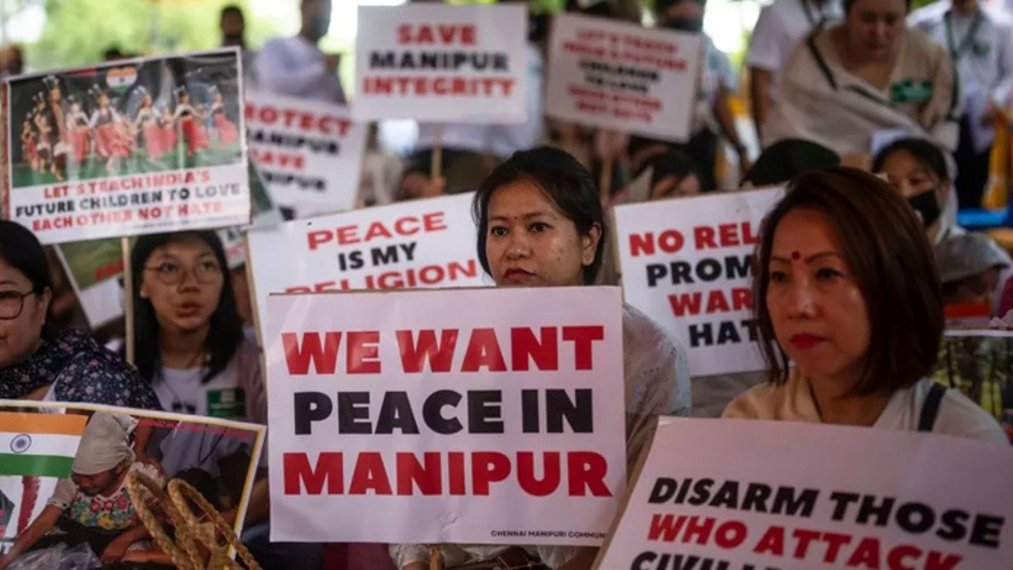
The conflicting political demands of Manipur’s three main ethnic groups— Meiteis, Kuki-Zo, and Nagas- have kept Manipur on edge for decades. The Nagas were the foremost to demand a separate state in the 1950s, followed by the Meiteis in the 1960s, and the Kuki-Zo formed a militant outfit only to defend themself from the Nagas in the 1990s. Over the years, the Kuki-Zo too placed their demand for autonomy and territorial concessions.
Manipur became a full-fledged state in 1972, after being a union territory since the kingdom of Manipur, ruled by a Meitei king, was forced to relinquish the throne in 1949. The state has been firmly under the control of the Meiteis since then. Due to historicity, the Meiteis consider it a duty to defend the state’s territorial integrity, including the tribal residing hills. It has been reluctant to accommodate the aspirations of the tribals in Manipur.
The Kuki-Zo group accuses the dominant Meiteis of having deliberately conspired to deny them inclusion in the sixth schedule of the Indian Constitution, which offers safeguards to many tribes in Northeast India by setting up autonomous institutions to protect their land rights, cultures, and traditions. Apparently, the sixth schedule includes tribes from Assam, Meghalaya, Tripura, and Mizoram only. In 2008, 25 Kuki-Zo groups signed a suspension of operations agreement with the Indian government, while continuing dialogue about creating an autonomous entity with separate administration. The demand for self-autonomy makes Meiteis anxious over losing their land, which they lay claim to.
The May 2023 violence in Manipur was a direct confrontation between the ethnic Meiteis and Kuki-Zo, over an order passed by the High Court of Manipur recommending Scheduled Tribe (ST) status to Meiteis on 27 March 2023. The Meiteis make up more than 53 percent of the state’s population and occupy mainly the central valleys and urban centers, whereas the Kukis and Nagas constitute under 40 percent and are largely occupants of the surrounding hill districts. By virtue of their demographic clout, Meiteis dominate political and economic power structures, whereas Kukis largely derive state benefits as an exclusive ST group, which includes protection of land rights and quotas in job opportunities.
The bone of contention between the groups has been the share in land resources, where historically the hilly area was off limits to the majority Meiteis. The high court order of March 2023 would remove the exclusive land rights of the Kuki-Zo over the hilly areas, threatening the livelihood of the tribes, and introduce quotas for college admissions and jobs. Apart from the thorny issue of granting ST status to Meiteis, the Meiteis accuse the Kuki-Zo of sheltering illegal immigrants from Myanmar, particularly Chin people, an ethnic group close to the Kuki-Zo, who primarily live in the neighboring Chin state of northern Myanmar, and are engaged in drug trafficking and militant activities.
In February 2024, the High Court directed the deletion of the paragraph from its previous order regarding the expedition of granting ST status to the Meiteis. The Kuki-Zo community welcomed the move as ‘the right course of action.’ However, the Meiteis expressed their determination to continue their rightful demand for ST status.
Three-Phase Resettlement Plan
The government of Manipur, in consultation with the Ministry of Home Affairs, Government of India, has launched a structured three-phase resettlement plan to rehabilitate over 57,000 internally displaced persons (IDPs) and close down the state’s 350 relief camps by December 2025, which were set up in impala valley and surrounding hill districts to provide shelter and relief material to the people who were affected by the May 2023 violence. The violence resulted in the death of over 200 people, injured thousands, displaced more than 50000, large-scale vandalism of properties and businesses, and religious structures, in one of the worst ethnic conflicts since 1993.
The resettlement of the IDP would be done in three phases, starting in July, October, and December, based on the security conditions and requisite infrastructure development in the areas affected. The primary focus of the plan is to see IDPs returning safely to their homes whenever possible. Wherever it is not possible to return due to security concerns, or there is extensive damage to the property, financial aid to the tune of rupees 3.03 lakh and prefabricated housing would be provided as a temporary relief, and the government has identified 7000-8000 families who fall under such a category.
The second category consists of 7000 families who fled their homes; their houses were not destroyed, but are in a dilapidated condition due to neglect for the past two years. For such families, ‘some kind of monetary help will be provided to them’, according to the chief secretary, P K Singh. Although the government plans to remove camps by the end of December, it is apprehensive about all IDPs returning to their homes even after December. The government estimates 8000 to 10000 people of such category, mainly from Moreh, Kangpokpi, and Churanchandpur, will be housed in prefabricated houses as a temporary measure.
Way Forward
Meiteis and Kuki-Zo share existential insecurities due to the fear of losing their right over the land. Meiteis demand the ST status to keep that in check, along with the opportunity to preserve their historicity, whereas such a measure would lead to erosion of their land rights and loss of livelihood, along with it. The conflict has reinvigorated the Kuki-Zo’s demand for self-autonomy, effectively separating themself from the dominant Meiteis.
The centre has been reluctant to quell violence and effectively call for peace. No doubt, its inactions have directly led to the loss of life and livelihoods on both sides. One of the reasons for the centre not to act is that the Manipur government is run by the BJP. Any action taken or initiated acknowledges the failure of state machinery and directly leads to backlash at the centre. Which the BJP was never going to let happen. Now that CM Biren Singh has resigned, one of the immediate demands of the Kuki-Zo group after the violence gripped Manipur and the state failed to rein in, and President’s Rule has been imposed, the centre has the rare opportunity to work towards disarmament and engage in dialogue with both to form a consensus on the political contentions.
At this moment, the peace that exists is precarious and hangs by a thread. Tensions could flare up at any time between these deeply divided communities, both fiercely vying for the same rights. Given their history of struggles, the possibility of renewed conflict becomes ever more tangible. By engaging in open discussions and fostering collaboration, these groups can work towards resolving their differences and building a stronger foundation for mutual respect and shared rights.