The Dialectics

Diplomatic De-escalation or Tactical Pause? India’s Cautious Dance with China

Background

The border dispute between India and China took an ugly turn in June 2020 when Chinese and Indian soldiers clashed in the Galwan Valley along the Line of Actual Control (LAC) in Ladakh. The incident led to significant Chinese and Indian casualties. Sino-Indian relations reached a historic low and was accompanied by intense anti-Chinese sentiments amongst the general Indian populace. While China was always considered the primary threat to Indian external security, the Galwan fallout solidified the Indian stance.

India-China relations necessarily exist in a dichotomy. They are both economically indispensable to each other however fail to cooperate effectively on any bilateral issue. China is India’s largest trading partner with bilateral trade amounting to over $118 billion. Their bilateral trade grew by over 66% from 2016 to 2023 which is over 9.4% annual growth. Even though India has a significant trade deficit of around $85 billion, the economic ties cannot be disregarded. Both nations are conspicuous parts of diplomatic, regional and international groupings which are allied to their purported goals of a more democratized, multipolar global order. The BRICS can be cited as an example, with its explicit goals of “de-dollarisation”, which cannot be achieved if China and India do not cooperate. Both are Asian revisionist powers, who do oppose the western led hegemonic rhetoric in their own ways as and when the opportunity presents. The commonalities are there but somehow it all goes out the window once a high tension border clash takes place.

Shifting Paradigms

The impasse in Indo-China relations necessarily stems from completely opposing viewpoints that both hold on the border issue. While India regards the border as the most critical issue in the bilateral ties, China calls for a relative de-hyphenation of the border dispute from other pursuits in the bilateral relations. While India considers solving the border as the first step towards normalization of broader ties, China on the other hand, seeks to broaden diplomatic engagement on issues beyond just border disagreements, while also maintaining its criticality.

India’s stance and underscoring of the border is, however understandable. It is, by all means the aggrieved party, with the Chinese occupying Aksai Chin since the 1962 war, which for all intents and purposes is Indian sovereign territory. China seeks to underplay the importance and tries to move ahead regardless of the border problem, which is convenient to Chinese strategic interests. This fundamental difference creates friction and leaves their relations in a state of quandary. However, by late 2023 new developments signaled a shift in the relative deadlock that had existed.

This was on account of significant agreements being reached on Depsang and Demchok through extensive negotiations from September 2022 to December 2024. In order to examine the shift in the nature of engagement, the mechanisms in place for Indo-China border negotiations must be studied. India and China negotiate on border disputes through 3 primary channels— the highest being the Politico-Strategic level which includes the heads of state, defense and foreign ministers (PSL); the Working Mechanism for Consultation and Coordination on India-China Border Affairs (WMCC) which is the nodal agency for diplomatic negotiations and the Senior Highest Military Commander Level Talks (SHMC) which consists of military staff to sort out ground level differences.

Since the blood stained Galwan clash of 2020 the primary focus of both sides was the de-escalation of tensions on the ground. Thus, SHMC and WMCC meetings took precedence and it was a rocky road. Negotiations were riddled with disagreements over deployments, positions, troop patrols. Progress was achieved by way of prevention of further clashes, but palpable tensions remained. This was not helped by contradictory statements by senior leaders over the status of the border situation. The WMCC meeting on May 31, 2023 yielded positive results by way of a joint statement where both sides agreed to promote the de-escalation of the border situation and further defend peace and tranquility in the border areas. This began a series of positive developments throughout 2023 and some of the first meetings at the PSL level since the conflict. The meeting between EAM S. Jaishankar and Chinese Foreign minister Wang Yi on the sidelines of the East Asia Summit in Jakarta in July was a conducive development.

This positive push was necessarily an effort by both nations to stimulate the relations which had been stuck in a diplomatic logjam at the SHMC and WMCC level and maybe break the ice with more Politico-Strategic dialogue at the highest level. Major summits were coming up ie. G20 and the BRICS, where an open spat between India and China would be detrimental to both their global ambitions on these platforms. Concerted efforts at the SMHC level continued to create conditions favorable for a summit between Indian PM Narendra Modi and Chinese Premier Xi Jingping. between in the upcoming BRICS summit. Significant meetings in mid-August 2023 actually led to a joint statement which reported that the stakeholders had come very close to resolving the deadlock on Depsang and Demchok. The positive atmosphere led to a meeting between the two heads of state at the Johannesburg BRICS Summit on August 23 where they reiterated commitments towards expeditious disengagement and de-escalation. India’s position still remained very strongly based on the border question before any other issue could be worked upon bilaterally.

No significant disengagement took place which highlighted a trust deficit weighing heavy on the Indian side. This was followed by President Xi Jingping not attending the G20 summit in Delhi in September signaling that actual progress was still far. No further PSL meetings took place in the next 11 months, however the momentum was not lost with SHMC and WMCC meetings continuing to etch out outstanding chinks. It was in closed door intense negotiations and diplomacy where the confidence was built. Throughout the winter of 2023 positive commentary followed with constructive progress on the issue of complete disengagement in eastern Ladakh. Even though publicly, India remained wary of Chinese intentions but at the same time New Delhi also realized that being too rigid on the issue wouldn’t yield any way forward. While the Chinese were not too yielding as well, they were eager to move forward. This positive momentum was reinforced when PM Narendra Modi reiterated in a pre-election interview that the relationship with China was important and significant and that stable and peaceful ties were crucial not just for them both, but for the entire region and the world. The Chinese Ministry of Foreign Affairs responded with further positive commentaries on the strategic height and long term prospects of the ties. China has maintained its stance throughout the process about the broad nature of the relations and why it shouldn’t only be tied to the boundary dispute, while India was stringent on the issue throughout much of 2022 and 2023 while softening its stance considerably by 2024.

Global headwinds fueling strategic reconsiderations?

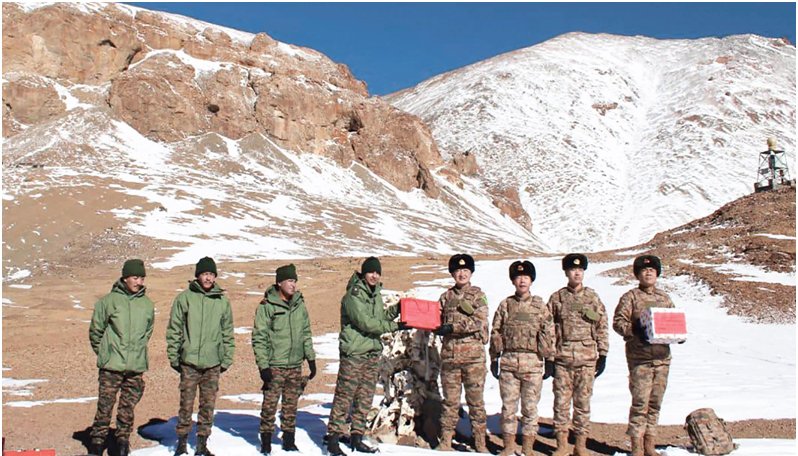
Late 2023 and 2024 showed definitive progress as both sides worked hard to build trust and confidence. Throughout 2024 several PSL meetings occurred and significant convergence was noticed between the two powers towards not only sorting out the issues that began in 2020 but doing so with urgency and haste. Consistent engagement at the highest levels along with dedicated diplomacy across all three mechanisms led to a breakthrough with complete disengagement in eastern Ladakh as envisaged and Indian patrols resumed in Depsang and Demchok. The same was announced by EAM Jaishankar in the Indian Parliament on December 3, 2024 marking a dramatic end to 4 years of tensions.

Global headwinds could explain this shift. 2024 being an election year was a time for change throughout the world. None mattered more so for India than the US. A Trump presidency was bound to throw some curveballs at Indian strategy. While traditionally Trump has been anti-China, he had other agendas as well—trade and tariffs and a general sense of disrupting the status quo. While Indian steadfastness towards China was buttressed by a strong US counterbalance, a Trump administration added a sense of virulent unpredictability. Nonetheless, Indian policy makers surely have come to realize that institutions like the BRICS are elemental to India’s strategic autonomy against an erratic US policy. In this scenario keeping options so constricted with China and prolonging a 5 year old spat didn’t seem conducive to realist strategic imperatives. An openly confrontative China is counterproductive to India’s relations with Russia and multilateral engagements like BRICS and RIC (Russia India China). India wants these institutions to work and provide a politico-economic bulwark to balance an increasingly unpredictable and isolationist US.

China also realized the need to pivot. It had to build trust with its southern neighbor in order to mend ties and make substantive progress. Further alienating India would essentially mean inviting the US deeper into Asia. It would also mean the failure of BRICS which is conspicuous to Chinese influence to an increasingly adversarial US. Antagonism with India doesn’t help Chinese interests in the long run. India’s economic significance to China is not lost on Chinese policy makers and so is the alignment in both the nations‘ broader global goals of a multipolar world order which is equitable and fair. The parallels have  always been there, but a constant security dilemma clouded the waters.

The India China Security dilemma

The Sino-Indian security dilemma is at its core a vicious cycle. India’s historical distrust has pushed it towards closer strategic ties to the US in order to deter Chinese adventurism. China tries to counter this by massive deployments on the LAC (Line of Actual Control) and security infrastructure buildup. This includes roads, bridges and entire settlements. This provides a legitimized impetus to India to build military infrastructure on its own side of the border. This militarization on both sides foments a sense of distrust and tension. China tries to deter India from infrastructure projects on the border since it views this as being done under US influence rather than valid pursuits of India’s own security. This belligerent attitude, hardens India’s stance, leading it to seek security arrangements in the maritime domain with the US eg. Quad, which again is countered by China through its Belt and Road Initiative  projects in the Indian Ocean Region and in India’s closest neighbors like Bangladesh and Nepal.

This is a self fulfilling cycle of hostilities and agitation with each other’s security objectives and strategic wrestling. While India and China both maintain that their border disputes are a strictly bilateral issue and welcome no external influence, the strain on the ties that it causes, percolates into face offs and tragedies like Galwan. India’s apprehensions cannot be dismissed as misplaced. Chinese disregard of the Mac Mahon line marking the far eastern border between the two nations and claiming the Indian state of Arunachal Pradesh as South-Tibet are actions which New Delhi doesn’t expect from a friendly neighbor. The Chinese track record to build enduring trust in the relationship has been sparse at best. Releasing maps which directly challenge India’s territorial sovereignty, militarizing the borders through massive infrastructure projects, building entire towns and villages near disputed areas eg. the Xiaokang Villages, which are as many as 624 villages built between 2018 to 2022 near the border with Arunachal Pradesh, are undoubted examples of Chinese bellicosity. New Delhi’s concerns are real and valid as to Chinese intentions. Even if current developments are positive, speculation remains about how lasting this momentum will be. India is wary, and is not so unfoundedly. Trust but verify seems to be India’s mantra when it comes to a thaw with China.

What Next?

For trust to grow between the two, both have to work towards de-escalation on a whole array of topics. Trimming down of the extensive militarization of the LAC is perhaps the first step. Scaling down the close to 100,000 troops would be central to ease the animosity that exists. Post that strategic cooperation on issues of common interests, such as climate change, security in the region, forming an equitable global multilateral order, can build lasting mechanisms of cooperation and engagement. Multilateral engagement through BRICS, G20 would ensure a sense of synergy in their global aspirations. Economic cooperation would also be cardinal in this respect. China and India share very deep trade ties which sounds counterintuitive given the nature of their bilateral ties, but that is the reality. India already seems open on this front after years of tight regulation of Chinese FDI. India’s Economic Survey mentions a China Plus One strategy for increasing Chinese FDI by striking the right balance between the trilemma of trade with China, investment by China and India’s territorial and non-territorial integrity and security. The Chinese have to respond in kind and reliably, they have to walk the talk. The ball is firmly in their court to considerably allay the apprehensions of Indian policy makers, for the ties to expand and galvanize towards strategic alignments. While calling the current developments a diplomatic de-escalation sounds optimistic and is true to an extent, the facts lie heavy on the side of a tactical pause in open animus, necessitated by global shifts and mutual interests.

Author