
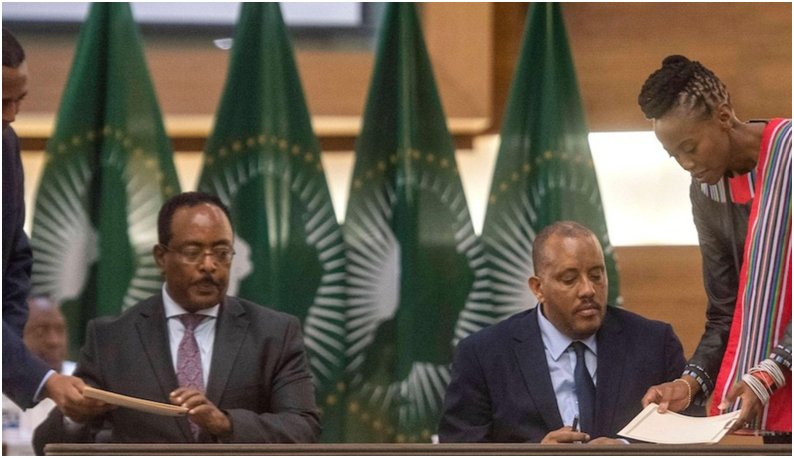
The contours of Ethiopia’s ethnic diversity is vivid; in particular, the historical trajectory of Tigrayans in Ethiopian politics is evident. In the immediate past, the trajectory of Tigray is marred with an episode of the most deadly civil war of this century where Ethiopian Federal forces colluded with the Amhara militias and the Eritrean Defense Forces confronted the Tigray People’s Liberation Front (TPLF) which lasted a couple of years. The catastrophic Civil war was concluded in November 2022 with the ratification of Cessation of Hostilities Agreement (CoHA), popularly recognised as the Pretoria Agreement.
Yet again, in the northernmost region of Federal Democratic Republic of Ethiopia, in the heartland of Tigray, another crisis is fomenting. However, a peculiarity that is prominent this time is the internal contention among the fragmented faction within the TPLF (i.e. the Tigray People’s Liberation Front (TPLF) and Tigray Interim Regional Administration (TIRA or TIA) who are vying for influence. Another distinction that is evident is TPFL’s affinity with the belligerent Eritrean forces which determines the probability of a spillover of volatility. This article traces the peace deal that followed the Tigray conflict and the current cleavages in the Tigray society that has the potential of escalating into proxy conflict, where Tigray remains as a suitable battleground for several contenders which has the potential of destabilizing the Horn of Africa.
BACKGROUND
In November of 2020 the Tigray civil war erupted when fissures among the Tigray People’s Liberation Front (TPLF) and the federal government of Prime Minister Abiy Ahmed deepened, with the TPLF’s refusal to integrate into the Prosperity Party (PP). Ahmed had dissolved the Ethiopian People’s Revolutionary Democratic Front (EPRDF) in December 2019 where the Tigray faction enjoyed a significant clout and sidelined their decades of influence in the politics of Ethiopia. The anxiety amplified when Ahmed asserted to postpone the 2020 election on the pretext of pandemic and the TPLF defied this directive by holding the regional election in September 2020 . In retaliation the federal government led by Abiy Ahmed launched a military offensive on 04 November against the TPLF, under the pretext of an alleged TPLF attack on a federal military base and it escalated into a disastrous civil war that altered the fabric of Tigray in mere a couple of years.
The efforts against the TPLF was a confluence of triad forces which comprised the Ethiopian National Defense Forces (ENDF), the Eritrean Defense Forces (EDF) and the armed Amhara militias (FANO). This collaborated attack stemmed from underlying bitter recollection of Tigray maneuvers since the inception of the Federal republic (Ethiopian Peoples’ revolutionary Democratic Front) in Ethiopia since 1991. For three long decades the TPLF ruled with prejudice and autocratic principles that subjugated the Oromo, Amhara and other minor ethnicities of Ethiopia. Besides, Eritrea’s animosity with the TPLF stemmed from the days of secession in 1993 when Eritrean People’s Liberation Front (EPLF) clashed with the federal forces of Ethiopia which was spearheaded by the TPLF. Moreover, Eritrea perceived the TPLF as a long-standing adversary because of border disputes and particularly their contention over the town of Badme.
PRETORIA PEACE DEAL
Counterattacks of the warring factions followed months of devastation and the hostility ceased only with the signing of ‘Agreement for Lasting Peace through a Permanent Cessation of Hostilities between the Government of the Federal Democratic Republic of Ethiopia and the Tigray People’s Liberation’ or the Cessation of Hostilities Agreement (CoHA), signed in Pretoria, South Africa on 02 November, 2022. Under the auspices of African Union (AU) High Representative for the Horn of Africa Olusegun Obasanjo (former President of Federal Republic of Nigeria) along with Uhuru Kenyatta, (former President of the Republic of Kenya) and Dr Phumzile Mlambo-Ngcuka (former Deputy President of the Republic of South Africa) the peace deal was ratified. This meditation was substantially backed by key regional and international partakers such as the Intergovernmental Authority on Development (IGAD), United Nations (UN) along with the United States (US) who facilitated and ensured productive negotiation. These observers significantly influenced the warring factions through diplomatic maneuvers and navigating them to the negotiating table.
The Cessation of Hostilities Agreement (CoHA) is an extensive document comprising 15 long Articles each enclosing several clauses. Of these, the key aspects on which the peace deal deliberated were an unhindered humanitarian aid access to Tigray with a permanent cessation of hostilities and hostile propaganda against the Federal government. A detailed Disarmament, Demobilisation and Reintegration (DDR) program was laid out which seeked disarmament of TPLF and restore the federal authority in the region. And the most significant of all was the Article 10 (1) of the agreement which proposed the establishment of an ‘inclusive Interim Regional Administration’ were to be appointed for a smooth transition. Thus, by March of 2023 the signatories jointly nominated Getachew Reda, the vice chairman of TPLF and this interim faction were to hold office until regular elections are held.
THE FALLOUTS
However, the sluggish implementation and exploitation of ambiguous clauses jeopardised the execution of key provisions of the agreement. Primarily, the exclusion of Eritrean and the ethnic militant representatives from the Pretoria agreement despite their significant engagement in subverting the Tigrayan forces evoked discord. This deliberate impunity has emerged as an evident failure of the federal government who failed to ensure a comprehensive retraction of foreign troops, thus impeding the progress of Pretoria agreement. Moreover, this peace agreement was reluctantly accepted by a certain faction within TPLF who perceived it as a lopsided deal. Subsequently the schism among the traditional hardline TPLF and the pragmatic-reformist interim faction became pronounced.
CURRENT COMPLICATIONS
The recent skirmish that has engulfed the Tigray region has stemmed from the divergence among the belligerent factions within the TPLF where one bloc is led by party chair of TPLF, Debretsion Gebremichael and the other reformist bloc is led by interim President Getachew Reda. The power struggle of Debretsion Gebremichael and Getachew Reda has simmered over the last year over several episodes like their contention over the control over Tigray Defense Forces (TDF) (aka Tigray Security Forces) where Debretsion refutes the claims of Getachew’s claims of TIA’s sole authority over TDF. The antagonism further escalated when the political reconciliation of TPLF was impeded by federal institutions like National Election Board of Ethiopia (NEBE) who had revoked the registration license of TPLF back in January 2020 on grounds of its violent actions against the federal forces of Ethiopia and only under special circumstance it re-registered the TPLF in August 2024. However, the TPLF has consistently defied the NEBE directives by neglecting the directive of convening a general assembly which would ensure credibility and accountability of TPLF. Its defiance peaked when it proceeded with 14th congress on 13 August 2024 in Mekelle and suspended Getachew Reda along with 16 members and eventually expelled them by December, 2024. However, the NEBE has contested the legitimacy of 14th Congress and Getachew Reda who was absent, responded by labelling the congress’s decision ‘null and void’.
Getachew Reda perceived such misdeeds of TPLF as a ‘coup’ against the interim government and seeked assistance from the federal counterpart. He also warned of possible conspiracy by Eritrea of morphing an alliance with the TPLF bloc led by Debretsion Gebremichael to advocate their concealed aspirations against the Tigray interim administration and the federal government. The confrontation only further intensified with security forces who vowed allegiance to TPLF led by Debretsion Gebremichael forcefully facilitated involuntary transition of several local administrations. This notorious campaign polarised the landscape of Tigray, where Central and Northwestern part of Tigray denounced the TIA leadership were dominated by the TPLF led by Debretsion Gebremichael whereas the Southern, Western, Eastern, and Southeastern parts remained the stronghold of Tigray interim Administration led by Getachew Reda. Moreover, several TIA mayors along with several key political actors were also abducted by the TPLF Security forces and an administrative deadlock persisted in Mekele, where either nominated separate mayors. Amid this chaos, on the grounds of incapability, Getachew Reda went on to suspend three senior military commanders, however, this move was contested by his deputy Lt. Gen. Tadesse Werede. Under such polarised circumstances, and to contain the exacerbated animosity, Abiy Ahmed declared the departure of Getachew Reda on 26 of March, 2025 and called for nominations for interim leader. This call of nominations drew further criticism from theTPLF who accused Abiy Ahmed of breaching the norms of Pretoria agreement which denounces unilateral nominations .
GEOPOLITICAL RAMIFICATION
This internal contention among the faction is likely to escalate far beyond the Tigray region as external meddling is already pronounced. It is noted that Eritrea’s pertinent presence in the town of Sheraro and Irob undermines the essential commitments of the Pretoria agreement which vowed absolute expulsion of foreign troops from the Tigray region. Despite the persistent animosity, the TPLF led by Debretsion Gebremichael is allegedly backed by the Eritrean People Front for Democracy and Justice (PFDJ). These belligerent cohorts are colluding to maneuver their individual pursuits in the conflict that has substantial potential to undermine stability in the region.
Moreover, since the conclusion of the Pretoria agreement, the bilateral relations between Eritrea and Ethiopia had remained fraught and deteriorated considerably in recent times. Over the past couple of months, a considerable troop mobilization has been noted on either side of the border. The simmering aspirations of Ethiopia, which remains the largest landlocked country in the Horn of Africa has made explicit claims over securing an access to the coast of the Red sea. Though Ethiopia has reaffirmed to abide by peaceful resolutions still over the years, Abiy Ahmed has been abrasive and has reflected a combative stance to secure the ‘natural right’ of Addis Ababa since it lost the post of Assab and Massawa in 1993 with the secession of Eritrea.
Into the bargain, the relative neighbors are susceptible to get embroiled in this escalating confrontation as their geopolitical aspiration to exploit the conflict to their means is probable. Egypts animosity with Ethiopia over the Grand Ethiopian Renaissance Dam (GERD) project which perceives it as a major existential threat to its fair share of blue Nile water is likely to polarise the conflict further. Tus, Egypt has already inclined towards Eritrea through intensifying their bilateral ties to avert the Ethiopian aspiration of being a leading player in the arena. This antipathy towards Ethiopia has further trickled into Sudan, another downstream nation like Egypt, which has remained broiled in civil war since April 2023. It is also anticipated that the paramilitary RSF is meddling beyond the borders to incite the ethnic militias (FANO) which seeks a destabilized Ethiopia.
Similarly, Somalia has remained antagonistic towards Ethiopia over its Memorandum of Understanding (MoU) with Somaliland, which it noted as an “act of aggression”. This MoU bartered the access to Port Berber in exchange for recognition of Somaliland (which undermines the territorial integrity of Somalia that considers Somaliland as an integral part of Somalia). The Ankara mediation in Dec 2024, anchored by Turkey has tried to soothe this animosity, yet another avenue of volatility arises from the presence of Al shabaab, an Al Qaeda affiliate which seeks to advance their tentacles into the greater Horn of Africa and consolidate power. And amid all this, Djibouti is likely to capitalize on such a precarious situation, which already exploits the dependency of Ethiopia by charging exorbitant $ 1.5 billion annually in exchange for leasing its port on the Red sea that manages almost 90 percent of Ethiopia’s trade.
Such polarisation of the conflict would escalate the adversity beyond the Horn of Africa as the environment remains conducive for the states in the immediate periphery of the region to leverage policies that best caters their selfish agenda. In recent times, the nations such as Saudi Arabia, Turkey, United Arab Emirates, Qatar and Iran along with global juggernauts (such United states, Russia, China) have strived to maneuver in the strategic location of Horn. Their engagement varies from political, economic and strategic domains particularly in the littoral states of Horn. Recent reports have indicated Saudi Arabia’s possible engagement in the Assab port of Eritrea is essential in averting an offensive in Ethiopia.
Similar engagement of UAE in port Mukalla, Aden, and Berbera and airbase in Assab and Turkey’s Mogadishu port in Somalia where it also maintains a military base, reflects their power play in the Horn. Riyadh as well as Ankara have enacted as credential mediator in the region(Sudan, Eritrea- Ethiopia and Ethiopia- Somalia respectively), however, they have also extended their rivalry into the region which often backs the belligerent cohorts thus impeding the course of resolution. It is evident that Saudi’s affinity with Egypt as well as Eritrea and UAE’s backing of Ethiopia Aggravates the division that only intensifies the discord. Moreover, there lies some low key players like Russia, China as well as Iran who influence such adversaries down south. Such an influx of meddling is prone to plummet the Horn of Africa as a Geopolitical battleground.
This confrontation, if not contained, would have severe ramification on the global shipping corridor as its proximity to the strategic conduit is significant. This crucial juncture of Bab el Mandeb has already been compromised since the inception of Houthi attacks that are intended at the Israeli vessels. Such menaces has already destabilized the Gulf of Aden and has significantly curtailed the international traffic through this strait. This volatility in the Horn of Africa would only catalyse the already fragile coastline of the Red Sea.
In the post Pretoria era, Tigray is prone to emerge as a suitable battleground for proxy warfare among the federal government of Ethiopia and the regional as well as global contenders. In case this strife in Tigray further deteriorates, factions are prone to be mere pawns of belligerent forces. It is imperative to ensure that these sheer intricacies are not exploited that would have ramifications over the greater Horn of Africa. If this crisis escalates, the tremors would reverberate across the horn and the epicenter would be Tigray. Thus, it is essential to reach an equilibrium to ensure that spillovers are tactfully contained before all states are contained in the spillover.
