
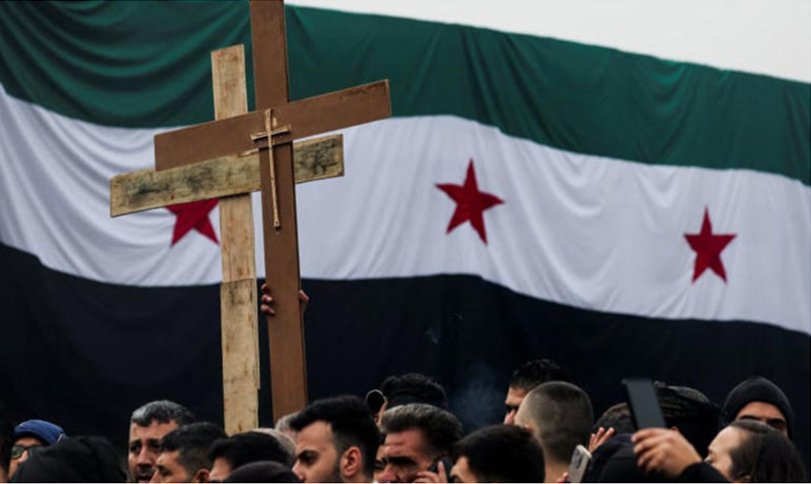
In Syrian discourse, great emphasis is placed on the Sunni majority, the Alawite ruling class, the Kurds, and Shia Iran-backed militias. Yet one community is ignored: Syria’s Christians. They are historically relevant and deeply entrenched in Syrian society, having suffered persecution, changing allegiances, and existential threats from different regimes. Now they are in the middle of the crossfire of regional conflicts, extremism, and geopolitical realignments that threaten their very survival.
A Legacy in Jeopardy: The Historical Presence and Contributions..
Syria boasts one of the earliest Christian communities worldwide, with roots that date back to Christianity’s early years. The ancient city of Antioch (currently Antakya, Turkey), which was part of historic Syria, was where Jesus’ followers were initially referred to as Christians.. Through history, Syria’s Christian community contributed significantly to education, commerce, and administration, flourishing under various empires such as the Byzantines and Umayyads.
Under the Ottoman Empire (1516–1918), Christians were dhimmis—protected but inferior under Islamic rule. They were taxed and socially discriminated against, but they made significant contributions to administration and commerce..The collapse of the Ottoman Empire and the establishment of modern Syria in 1920 under French mandate gave them relative security and a place in national politics. Their churches were beacons of strength, and their traditions spun an irreplaceable thread into the Syrian fabric.
The Ba’athist Period: An Unstable Existence.
When the Ba’ath Party seized power in 1963 and Hafez al-Assad became president in 1971, Syria formally adopted secularism..Although this did not eliminate the supremacy of the Alawite-dominated government, it gave Syrian Christians some protection. During the rule of the Assads—both Hafez and his son Bashar—Christians were permitted to practice their faith, construct churches, and serve in government, but under close state supervision.
In spite of this comparative protection, Christians were closely watched, their movements regulated by the intelligence machinery. Their opposition voices were muffled. But for decades, Syrian Christians thought that remaining loyal to the regime was their best hope for survival. But that tenuous sense of security collapsed as war engulfed the country.
The Syrian Civil War: A Nightmare Unfolds.
The outbreak of the Syrian Civil War in 2011 initiated an existential crisis among Christians. Initially, the uprising against the government turned into a multi-faceted, complicated war between local militias, jihadist movements, Kurdish parties, and outside powers.
The conflict let loose horror on Christian populations. Radical Islamist movements, including al-Nusra Front (al-Qaeda’s Syrian branch) and ISIS, regarded Christians as infidels. Christian villages were destroyed, churches were violated, and priests and nuns were abducted or killed. Centuries-long-resident families were forced out of their homes overnight.
In 2013, the village of Maaloula, a historic Christian community where Aramaic—the language of Christ—is still used, was taken by jihadist forces. Militants invaded churches, killed civilians, and compelled others to convert or be killed. ISIS militants in Sadad slaughtered men, women, and children wholesale. The world hardly took cognizance.
As cities fell apart and war lingered, Christians had no definite patron. The Assad regime presented itself as their guardian, but its own violent military campaigns disfigured entire Christian communities. Opposition forces, in turn, frequently perceived Christians as regime loyalists, and thus they became targets for retaliation. There was no shelter.
The Role of Foreign Powers: Empty Promises and Geopolitical Games.
Russia’s 2015 military intervention supported Assad’s grip on power. Russian leaders sat down with Christian leaders, positioning themselves as protectors of religious minorities. Their interests, however, were never to protect Christian lives; rather, they were interested in keeping Syria as an ally.
Even while publicly advocating democracy and human rights, Western powers largely left Syrian Christians alone. Although they accepted Muslim refugees, Christian asylum seekers were not welcomed. The U.S. and Western powers focused on Sunni opposition groups, even including some with an extremist component, while Christian villages were on their own.
Nowadays, Syria’s Christian community has significantly reduced. Christians comprised around 10% of Syria’s population prior to the civil war, with a total of about 1.5 million. By 2022, they had dropped to below 2%, with estimates as low as 300,000 still being in the country.
Life in the Ruins.
For those who remain, life is one of daily survival. In regime-held areas, they live under economic collapse and state surveillance. Many churches that once echoed with hymns now stand as hollowed-out ruins, their congregations scattered across the world.
In the north, where Kurdish militants hold ground, Christians have discovered some relative tranquillity, although that is precarious. Turkish-backed militants, most of whom have Islamist tendencies, advanced into Christian towns, causing further forced displacement.
Iranian growing reach in Syria is another threat. Militias aligned with Iran, Shia in composition, are moving into territories and properties, shifting the religious and demographic equilibrium. Christians, who were once part of the social mix of Arab, are having their way eliminated.
The Unending Exodus.
Every day, still more Syrian Christians depart, many aware they might never again set foot in their homeland. Their departure isn’t only about warfare—it’s the gradual loss of their position in society. Unless something changes, the Christian community in Syria will be all but a memory.
The world has witnessed Syria’s Christians vanish without doing anything meaningful. While foreign governments politic over strategy and alliances, Christian communities are being erased from the face of the earth. Unless global policymakers, human rights bodies, and religious leaders act, Syria will have no Christians to claim anymore.
A Cry for Recognition
Syrian Christians’ sufferings are an unfolding tragedy in silence. While other suffering groups have been getting international spotlight, theirs remains unseen and receives none. They find themselves in between warring factions, forgotten by the West, and played like pawns by world powers..But, in the midst of destruction, their strength prevails. The old priests who will not leave their churches. The families that hold on to their faith in the midst of horrors surrounding them. The people who recreate, even when the rest of the world has forgotten them. Their stories need to be told. Their past needs to be remembered. And their future cannot be abandoned..If the world remains silent, it will have to live with the guilt of having witnessed one of the world’s oldest Christian communities vanish forever.
